
Last updated: October 2026
Key Takeaway
- A math calculator can help you perform everyday calculations quickly and accurately.
- Different calculators are designed for different needs, including basic arithmetic, scientific calculations, graphing, and step-by-step problem solving.
- Understanding the calculation is still important. A calculator should support your reasoning rather than replace it.
- Always check the expression you enter, especially when working with percentages, fractions, negative numbers, and order of operations.
- Online calculators are useful for homework, budgeting, shopping, finance, measurements, and everyday math.
The 10 PM Homework Problem
It is 10 PM. You are sitting at the table with a homework question that looks much harder than it actually is. You know the basic math, but one wrong sign, decimal point, or calculation can change the final answer.
This is where a reliable math calculator can help. Instead of spending several minutes checking arithmetic manually, you can use a calculator to verify the numerical part of the problem and spend more time understanding the method.
The important point is that a calculator should not simply give you a number. You should still understand what you are calculating, which formula or operation you are using, and whether the result makes sense.
What Is a Math Calculator?
Math Calculator
Free online calculator for basic math
A math calculator is a digital tool designed to perform mathematical operations. Depending on the type, it can handle simple arithmetic such as addition and subtraction or more advanced calculations involving percentages, fractions, powers, logarithms, trigonometry, equations, and graphs.
A basic calculator is useful for everyday calculations, while a scientific or graphing calculator can be useful for higher-level mathematics, science, engineering, and technical subjects.
For many everyday problems, an online calculator is convenient because it works directly in a web browser without requiring a separate physical calculator.
The Four Main Types of Math Calculators
Not every math problem requires the same type of calculator. The four common categories below cover most everyday and educational needs.
1. Basic Calculator
A basic calculator is designed for everyday arithmetic.
- Addition
- Subtraction
- Multiplication
- Division
- Percentages
- Decimal calculations
You can use a basic calculator for shopping totals, household expenses, simple budgeting, school arithmetic, and many other routine calculations.
2. Scientific Calculator
A scientific calculator provides functions needed for more advanced mathematics and science.
- Powers and roots
- Fractions
- Logarithms
- Trigonometric functions
- Scientific notation
- Advanced arithmetic
Students studying algebra, geometry, trigonometry, physics, chemistry, and other technical subjects may need a scientific calculator.
3. Graphing Calculator
A graphing calculator goes beyond numerical calculations by allowing you to visualize mathematical relationships.
For example, graphing tools can help you see how an equation behaves, compare functions, identify intersections, and understand changes in a mathematical relationship.
Graphing calculators are particularly useful when learning functions, equations, algebra, and advanced mathematics.
4. Online Math Calculator (Step-by-Step Solver)
An online math calculator can combine the convenience of a web-based tool with features designed to make calculations easier to understand.
Depending on the calculator, you may be able to enter an expression and receive a result immediately. More advanced online tools may also show intermediate steps or explanations.
This can be especially useful when you are checking homework or trying to understand where a calculation went wrong.
How to Pick the Right Math Calculator
The best calculator depends on the problem you are trying to solve.
- Everyday arithmetic: Use a basic calculator.
- School mathematics: A scientific calculator may be more appropriate.
- Functions and equations: A graphing calculator can make relationships easier to visualize.
- Quick online calculations: An online math calculator can be convenient when you are using a phone or computer.
- Finance and budgeting: Use a calculator designed specifically for the financial calculation you need.
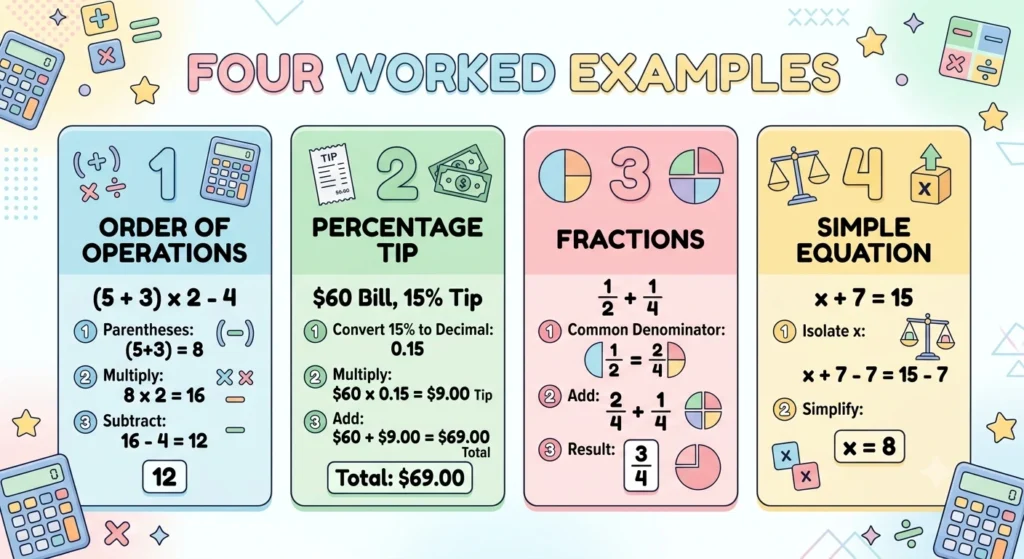
Four Worked Examples You Can Try
The easiest way to understand how a math calculator can help is to work through a few common examples.
Example 1: Order of Operations
Consider this expression:
8 + 4 × 3
The multiplication should be completed before the addition.
First:
4 × 3 = 12
Then:
8 + 12 = 20
Therefore, the answer is 20.
This is a good example of why you should understand order of operations instead of simply entering numbers without checking the expression.
For additional practice with order of operations, fractions, percentages, and equations, see Khan Academy's Math resources.
Example 2: Percentage Tip
Suppose your restaurant bill is ₹1,000 and you want to calculate a 10% tip.
Calculate:
₹1,000 × 10 ÷ 100 = ₹100
The tip is therefore ₹100, making the total:
₹1,000 + ₹100 = ₹1,100
For percentage calculations, it is important to know how the particular calculator interprets the percentage button or percentage expression.
Example 3: Adding Fractions
Consider:
1/2 + 1/4
The denominators are different, so you need a common denominator.
Convert 1/2 to 2/4.
Now:
2/4 + 1/4 = 3/4
Therefore, the answer is 3/4.
A fraction calculator can make these calculations faster, but understanding how common denominators work helps you verify the result.
Example 4: Solving a Simple Equation
Consider the equation:
x + 5 = 12
Subtract 5 from both sides:
x = 12 − 5
Therefore:
x = 7
An equation solver can help with more complicated equations, but it is still important to understand which mathematical operation is being performed.
How to Get Accurate Results Every Time
A calculator can produce a very precise answer, but only if the information entered is correct. A small input mistake can produce a completely different result.
- Check every number: Make sure you entered the correct values.
- Check the decimal point: A missing or extra decimal can dramatically change a result.
- Check the operation: Make sure you selected addition, subtraction, multiplication, or division correctly.
- Follow order of operations: Multiplication and division may need to be performed before addition and subtraction.
- Review percentages: Percentage calculations can be interpreted differently depending on the tool.
- Estimate the answer: A rough mental estimate can help you identify obviously incorrect results.
For financial calculations, the same principle applies. A calculator provides a mathematical estimate based on the numbers and assumptions you enter; it does not guarantee what will happen in the real world.
What to Look for in an Online Math Calculator
If you regularly use online calculators, look for tools that are easy to understand and behave predictably.
- Simple interface: The buttons and input fields should be easy to understand.
- Clear results: The answer should be displayed in an easy-to-read format.
- Mobile-friendly design: The calculator should work properly on phones and tablets.
- Useful functions: Choose a calculator that supports the operations you actually need.
- Transparent explanations: For educational calculations, explanations or worked examples can be useful.
- Reliable calculations: The underlying mathematical logic should be consistent and tested.
When to Put the Calculator Down
Using a calculator does not mean you should stop learning mathematics.
If you are learning a new concept, first try to understand the problem yourself. Then use the calculator to check your arithmetic or verify your answer.
This approach is particularly useful for students because it helps prevent a calculator from becoming a substitute for mathematical reasoning.
Common Mistake
Entering the entire problem without understanding the order of operations.
A calculator may follow a specific order of operations, but you still need to know whether the expression you entered represents the problem you intended to solve.
Pro Tip
Estimate first, calculate second, and check the result afterward.
For example, if you expect an answer close to 100 but your calculator shows 10,000, stop and check your inputs before accepting the result.
Frequently Asked Questions
What is a math calculator?
A math calculator is a digital tool used to perform mathematical operations such as addition, subtraction, multiplication, division, percentages, fractions, powers, and other calculations depending on the calculator type.
What is the difference between a basic and scientific calculator?
A basic calculator is designed mainly for everyday arithmetic. A scientific calculator includes additional functions such as powers, roots, logarithms, trigonometry, and other advanced mathematical operations.
Can I use an online math calculator on my phone?
Yes. A properly designed online calculator can work in a mobile web browser without requiring a separate calculator application.
Are online math calculators accurate?
A calculator can provide an accurate mathematical result when its underlying calculation logic is correct and the user enters the correct values. Always review the expression and assumptions before relying on the result.
Can a calculator replace learning mathematics?
No. A calculator is a useful tool for performing or checking calculations, but understanding mathematical concepts, formulas, and reasoning remains important.
What calculator should I use for homework?
It depends on the subject. Basic arithmetic may only require a basic calculator, while algebra, trigonometry, physics, and advanced mathematics may require a scientific or graphing calculator.
Ready to Pick Your Calculator?
The right math calculator can save time, reduce arithmetic mistakes, and make complicated calculations easier to check.
For simple calculations, a basic online calculator is often enough. For advanced mathematics, a scientific or graphing calculator may be more appropriate. And when you need to understand how a calculation works, a step-by-step solver can be especially useful.
The most important habit is simple: understand the problem, enter the numbers carefully, calculate, and then check whether the answer makes sense.
Use the calculator as a tool to support your thinking—not as a replacement for it.
Disclaimer
This article and the math calculator on EasyInvestCalc.com are provided for general educational and informational purposes only. Calculator results are mathematical estimates based on the values and assumptions entered by the user. While reasonable care is taken to provide useful and accurate calculations, no guarantee is made that every result will be error-free or suitable for a particular purpose.
For financial, tax, investment, loan, education, or other important decisions, verify the relevant figures and consult an appropriately qualified professional when necessary.
Explore More Calculators
Once you are comfortable with basic calculations, you can explore specialized calculators for investing, saving, retirement planning, loans, and taxes on EasyInvestCalc.com.
- SIP Calculator – Estimate potential mutual fund SIP growth and maturity value.
- Lumpsum Calculator – Estimate potential growth from a one-time investment.
- FD Calculator – Calculate fixed deposit maturity value and interest.
- PPF Calculator – Estimate PPF investment growth and maturity value.
- Loan EMI Calculator – Calculate monthly loan EMI and interest.
- NPS Calculator – Estimate retirement corpus and potential pension.
- SWP Calculator – Estimate withdrawals and remaining investment balance.
- Income Tax Calculator – Compare tax calculations under the available tax regimes.

Founder of EasyInvestCalc.com with 8+ years of experience in personal finance. Sunita simplifies complex financial mathematics—from SIP compounding to tax planning—empowering Indian investors to make smart, debt-free decisions based on real market mechanics.