
A 20 year mortgage calculator helps you find out exactly what your monthly payments, total interest, and payoff timeline look like — before you ever talk to a lender.
Here’s a quick snapshot of what to expect on a 20-year fixed-rate mortgage:
| Loan Amount | Est. Interest Rate | Monthly P&I | Total Interest Paid |
|---|---|---|---|
| $200,000 | 6.26% | ~$1,491 | ~$157,800 |
| $320,000 | 6.26% | ~$2,386 | ~$252,500 |
| $400,000 | 6.26% | ~$2,982 | ~$315,700 |
Estimates based on current average 20-year fixed rates as of May 2026. Actual payments vary by lender, credit score, and location.
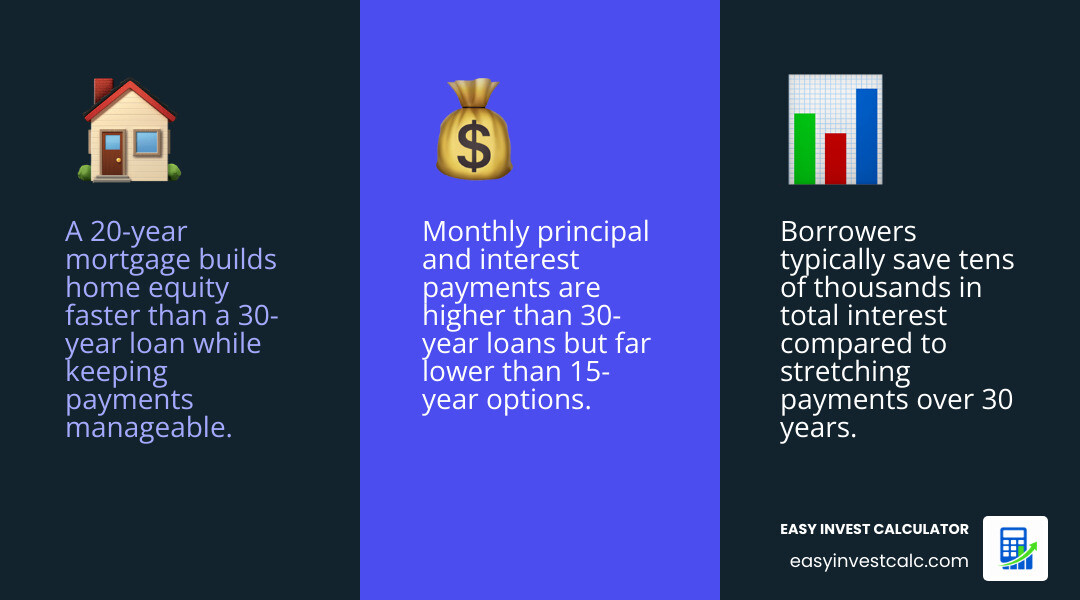
Most home buyers go straight to the 30-year loan — in fact, nearly 90% of mortgaged buyers choose it. But that “affordable” lower payment comes at a steep cost: tens of thousands of dollars more in interest over the life of the loan.
The 20-year mortgage sits right in the middle. It’s not as aggressive as a 15-year loan, but it’s far cheaper than stretching payments out over three decades.
It’s a practical middle ground for busy professionals who want to:
- Build home equity faster
- Pay less total interest than a 30-year loan
- Keep monthly payments more manageable than a 15-year term
The key is knowing your numbers before you commit. That’s exactly what a 20-year mortgage calculator is built for.
Handy 20 year mortgage calculator terms:
How to Use a 20 Year Mortgage Calculator for Financial Planning
Using a 20 year mortgage calculator is about more than just seeing a single number. It’s about understanding the architecture of your debt. When we look at a mortgage, we are looking at four main pillars: Principal, Interest, Taxes, and Insurance (often called PITI).

To get started, you’ll need to input the purchase price of the home and your down payment. The calculator then takes the remaining loan term (in this case, 240 months) and applies an interest rate to determine your monthly obligation. By playing with these variables, you can see how a slightly larger down payment or a better credit score (which leads to a lower rate) can drastically change your monthly outlook.
For a deeper dive into how these calculations impact your long-term wealth, check out our guide on Mastering Your Mortgage with the EasyInvestCalc Amortization Calculator.
Comparing total interest with a 20 year mortgage calculator
One of the most eye-opening experiences in financial planning is comparing the total interest paid across different terms. While the APR (Annual Percentage Rate) for a 20-year loan is often slightly lower than a 30-year loan, the real savings come from the shortened timeframe.
For example, on a $200,000 loan, paying 3.5% over 20 years results in approximately $79,830 in total interest. If you took that same loan at 3.7% over 30 years, you would pay over $115,246 in interest. That is a savings of over $35,000 just by shaving ten years off the term! You can explore these differences further in our 15‑Year vs 20‑Year Mortgage Comparison Guide.
Factoring in PMI and taxes in a 20 year mortgage calculator
A basic calculator might only show you principal and interest, but a “real-world” 20 year mortgage calculator must include the “hidden” costs.
- Down Payment & PMI: If you put down less than 20%, lenders usually require Private Mortgage Insurance (PMI). This protects the lender, not you, and can cost between 0.3% and 1.9% of the loan amount annually.
- Property Taxes: These are determined by your local government and vary wildly by location.
- Homeowners Insurance: Lenders require this to protect the asset against fire or disasters.
Accurately estimating these ensures you aren’t “house poor” once you move in. Learn how to Calculate Your Rental Yield and Mortgage Repayments Like a Pro to see how these costs affect your bottom line.
Comparing 20-Year Terms to 30-Year and 15-Year Options
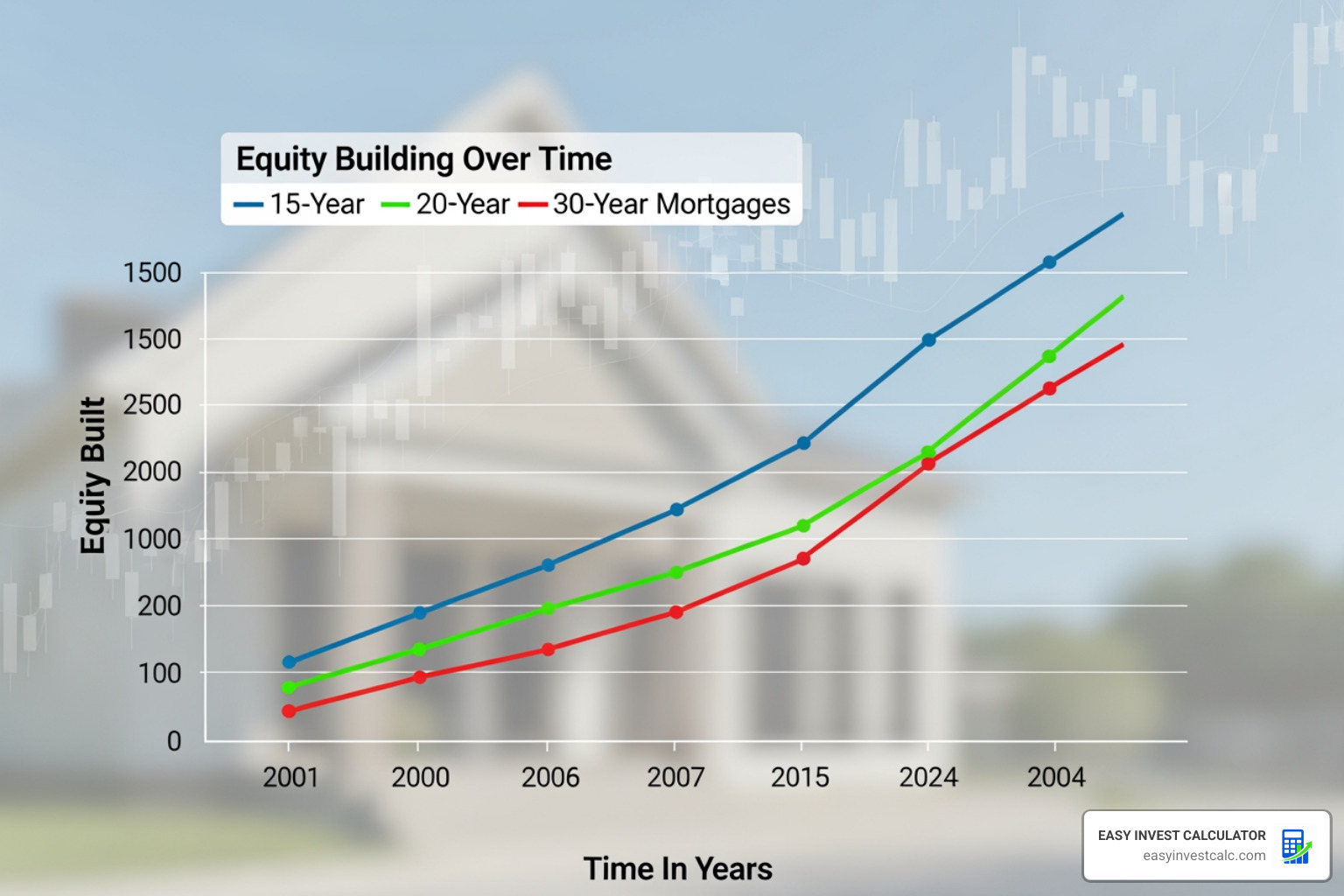
Choosing a mortgage term is a balancing act between monthly payments and equity growth. The 20-year term is often called the “goldilocks” of mortgages—it’s just right for those who find the 15-year too expensive and the 30-year too slow.
| Feature | 15-Year Fixed | 20-Year Fixed | 30-Year Fixed |
|---|---|---|---|
| Monthly Payment | Highest | Moderate | Lowest |
| Interest Rate | Lowest | Lower | Higher |
| Equity Building | Fastest | Fast | Slow |
| Total Interest | Lowest | Low | Highest |
As the table shows, the 20-year option provides life certainty. It ensures you own your home a full decade sooner than the standard 30-year route, which is a major win for retirement planning. To see the month-by-month breakdown, use our Amortization Schedule Calculator Principal vs Interest.
Advantages of the 20-year fixed-rate mortgage
The primary advantage is the lower interest rate. Lenders view shorter terms as lower risk, often offering a rate 0.25% to 0.5% lower than 30-year products. This, combined with faster equity buildup, means you are actually “buying” your home rather than just renting it from the bank.
We also recommend following the 28/36 rule: your total housing costs shouldn’t exceed 28% of your gross monthly income, and your total debt shouldn’t exceed 36%. A 20-year mortgage often fits perfectly within these boundaries for middle-to-high-income earners.
Disadvantages and eligibility requirements
The main drawback is cash flow. Because you are compressing the repayment into 240 months, your monthly payment will be higher than a 30-year loan. This might limit how much house you can buy if your debt-to-income (DTI) ratio is tight.
Additionally, 20-year mortgages are sometimes considered “niche” products. While most lenders offer them, they aren’t as aggressively marketed as the 15 or 30-year options. You will still need a solid credit score and must stay within regional loan limits (conforming limits for 2026 are roughly $832,750 for single-unit homes) to qualify for the best rates.
Key Factors Influencing Your Monthly Payment Estimates
When you use a 20 year mortgage calculator, you need to be aware of external factors that can shift your results.
- HOA Fees: If you are buying a condo or a home in a planned community, Homeowners Association fees can add hundreds to your monthly cost.
- Closing Costs: Typically 2% to 5% of the loan amount. While these aren’t part of the monthly payment, they affect how much cash you have left for a down payment.
- Interest Rate Fluctuations: Even a 0.5% change in rates can swing your payment by a significant margin.
To keep your stress levels low, Don’t Let the Math Scare You Away from Your Dream Home — just make sure you’ve accounted for every line item.
Adjusting inputs for accuracy
To get the most out of your 20 year mortgage calculator, try “stress-testing” your budget:
- Extra Payments: See how adding just $100 a month to your principal can shave years off the loan.
- Biweekly Schedule: Making a half-payment every two weeks results in 13 full payments a year, accelerating your payoff date.
- Annual Increases: Factor in a 2-3% annual increase in property taxes and insurance to see your future costs.
Check out why Extra Payments are the Secret Sauce for Debt Freedom to see these strategies in action.
Understanding the 20-Year Amortization Schedule
The amortization schedule is a table that shows every single payment over the 20-year term. It’s a roadmap of your journey to debt freedom.
In the beginning, your payments are interest-heavy. Because the balance is high, the interest calculation takes a larger bite out of your monthly check. However, as the years pass, the principal paydown accelerates. By the middle of the term, you’ll see a “tipping point” where more of your money goes toward the house than toward the bank’s profit.
How amortization works over time
- The Start: High interest, low principal. You’re mostly paying the cost of borrowing.
- The Middle: The balance shifts. You’ll notice your remaining balance dropping much faster than it would on a 30-year schedule.
- The Finish: The final years are principal-heavy. Your interest cost is negligible, and you are rapidly approaching your payoff date.
For a complete breakdown of this process, read The Ultimate Guide to Fixed Rate Amortization.
Frequently Asked Questions about 20-Year Mortgages
What are the eligibility requirements for a 20-year fixed-rate mortgage?
Lenders typically look for a credit score of 620 or higher for conventional 20-year loans. You’ll also need to provide proof of stable income and have a debt-to-income ratio that usually falls below 43%, though some lenders allow higher with a large down payment.
How does a 20-year mortgage impact my debt-to-income (DTI) ratio?
Because the monthly payment is higher than a 30-year loan, it will increase your DTI. If you are already carrying significant student loans or car payments, this might reduce the total loan amount you qualify for. It’s always best to use a 20 year mortgage calculator to see if the payment fits within the 28% housing cost guideline.
Is it better to get a 30-year loan and pay it off in 20 years?
This is a popular strategy because it offers “flexibility.” You have the lower required payment of a 30-year loan but can make extra payments to finish in 20 years. However, the downside is that 30-year loans carry higher interest rates. If you know you can afford the 20-year payment, signing for the 20-year term will save you more money due to the lower rate.
Conclusion
At EasyInvestCalc, we believe that financial clarity leads to financial freedom. Choosing the “middle ground” of a 20-year mortgage can be one of the smartest moves for your long-term wealth. It offers a disciplined path to homeownership, massive interest savings, and the peace of mind that comes with owning your home a decade sooner.
Don’t guess your future—calculate it. Calculate your monthly payments now and take the first step toward a more secure financial horizon.

Founder of EasyInvestCalc.com with 8+ years of experience in personal finance. Sunita simplifies complex financial mathematics—from SIP compounding to tax planning—empowering Indian investors to make smart, debt-free decisions based on real market mechanics.