

Why an Annual Amortization Calculator Is the Budgeting Tool You’ve Been Missing
An annual amortization calculator gives you a clear, year-by-year breakdown of exactly how your loan payments are split between principal and interest — so you can plan your finances with confidence instead of guesswork.
Quick answer: How does an annual amortization calculator work?
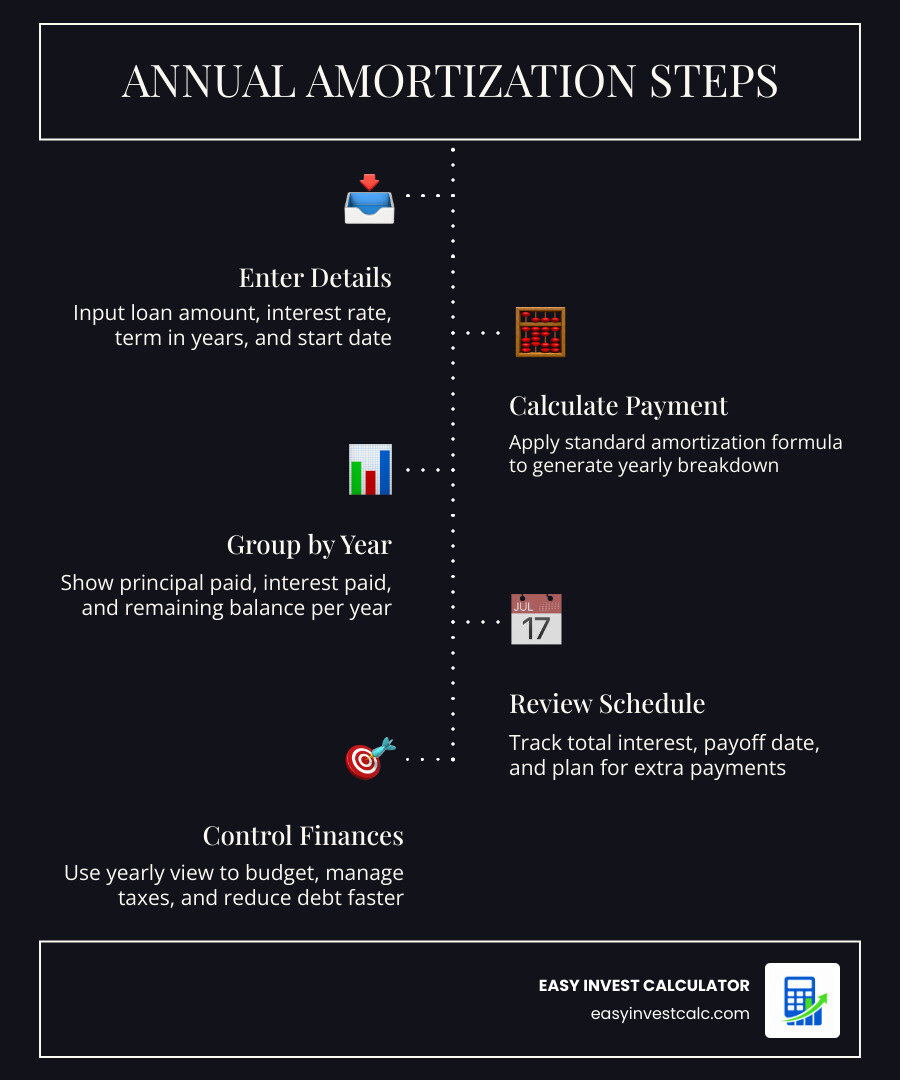
- Enter your loan details — loan amount, interest rate, loan term (in years), and start date
- The calculator computes your payment using the standard amortization formula
- Results are grouped by year — showing interest paid, principal paid, and remaining balance for each year
- Review your full schedule — see exactly when your loan is paid off and how much total interest you’ll pay
Most people only look at their monthly payment. That number feels manageable, so they stop there.
But the real story is in the yearly picture.
Take a $350,000 loan at a typical 30-year rate. By the time it’s paid off, you’ll have paid over $515,961 in interest alone — nearly 1.5 times the original loan amount. A monthly view buries that reality. An annual view makes it impossible to ignore.
That’s the power of looking at your loan through a yearly lens. It turns abstract numbers into a clear financial roadmap — one that actually fits how most people budget, plan taxes, and set yearly goals.
Whether you’re managing a home mortgage, a farm loan, or a land purchase, understanding your loan year by year puts you in control.
Key annual amortization calculator vocabulary:
- amortization schedule calculator
- amortization schedule with extra payments
- amortization schedule with fixed monthly payment
Why You Need an Annual Amortization Calculator for Long-Term Planning
When we sit down to plan our lives in May 2026, we don’t usually think in 30-day increments. We think about the year ahead: the vacations we want to take, the taxes we need to file, and the savings goals we want to hit by December. This is exactly why an annual amortization calculator is superior for long-term financial forecasting compared to a standard monthly tool.
Standard calculators focus on the “Equated Monthly Installment” (EMI). While that helps you know if you can afford your mortgage this month, it obscures the speed of your principal reduction. By looking at a yearly summary, you can see the “tipping point”—that magical year where your payments finally start covering more principal than interest.
Understanding the mechanics of your loan is vital. As explained in The Ultimate Guide to Fixed Rate Amortization, most consumer loans are structured so that interest is front-loaded. In the early years of a $350,000 loan, your “wealth building” (principal reduction) is agonizingly slow. Without an annual view, you might not realize that after five years of payments, you’ve barely chipped away at the original balance, despite paying tens of thousands of dollars.
To get technical for a moment, the math behind these tools relies on Understanding Amortization Formulas. The formula calculates a fixed payment that results in a zero balance at the end of the term. Because interest is calculated on the remaining balance each period, the interest portion of your payment drops as the principal drops. An annual calculator aggregates these twelve monthly shifts into one clear data point, allowing you to track total interest and total principal paid per calendar year.
Key Inputs for an Annual Amortization Calculator
To get the most out of our tool, you need to have a few numbers ready. Accuracy at the start prevents surprises at the end!
- Loan Amount (Principal): The total amount you are borrowing.
- Interest Rate: The annual percentage rate (APR). This is different from the APY (Annual Percentage Yield), which accounts for compounding.
- Loan Term: Usually expressed in years (e.g., 15, 20, or 30 years).
- Start Date: This is crucial for yearly budgeting. If you start a loan in October, your “Year 1” summary will only reflect three months of interest and principal.
- Compounding Frequency: Most mortgages compound monthly, but some specialized loans might compound semi-annually or annually.
Calculating Yearly Principal and Interest with an Annual Amortization Calculator
Let’s look at a real-world example. Imagine you have a $200,000 mortgage at a 6.75% interest rate for 30 years. Using the standard EMI formula, your monthly payment is approximately $1,297.20.
If you look at this through a monthly lens, you see $1,297 leaving your bank account. If you use our annual amortization calculator, you see a much more detailed story for the first year:
- Total Annual Payments: $15,566.40
- Interest Paid in Year 1: ~$13,445
- Principal Paid in Year 1: ~$2,121
Ouch! In the first year, only about 13% of your money actually went toward “owning” your home. The rest went to the bank. By using an Amortization Schedule Calculator Principal vs Interest, you can track how this ratio improves every single year. By year 20, the numbers flip, and the majority of your annual payment finally goes toward your principal.
How Yearly Amortization Schedules Benefit Specialized Loans
While homeowners love these tools, they are absolute game-changers for those in the agricultural sector. Farm loans, land loans, and ranch financing often operate on different schedules than a suburban mortgage.
For a farmer, income is often seasonal. You might make one large payment a year after the harvest or quarterly payments based on livestock sales. An annual amortization calculator allows you to see the entire lifecycle of the asset—whether it’s a new tractor, a parcel of grazing land, or a poultry house—in a way that aligns with the farm’s annual profit and loss statement.
Consider a $400,000 agricultural land loan. Over 30 years at standard rates, you’ll pay roughly $508,284 in total interest. If you are trying to determine the “break-even” point for that land—the moment when the income generated by the soil exceeds the cost of the financing—you need a yearly schedule. A monthly view is too granular; you need to see the annual “cost of capital” to make informed planting and expansion decisions.
| View Type | Best For | Key Metric |
|---|---|---|
| Monthly View | Cash flow management | Can I pay my bills this month? |
| Annual View | Wealth building & Tax planning | How much equity did I gain this year? |
| Life-of-Loan View | Long-term strategy | What is the total cost of this debt? |
The Financial Impact of Extra Payments on Your Yearly Schedule
If the numbers above (like paying $515,961 in interest on a $350,000 loan) make you a little nauseous, don’t worry. You have a secret weapon: extra payments.
Using an annual amortization calculator to model extra payments is the single best way to motivate yourself to save. Seeing a monthly $100 extra payment might not feel like much, but seeing the yearly and total impact is staggering.
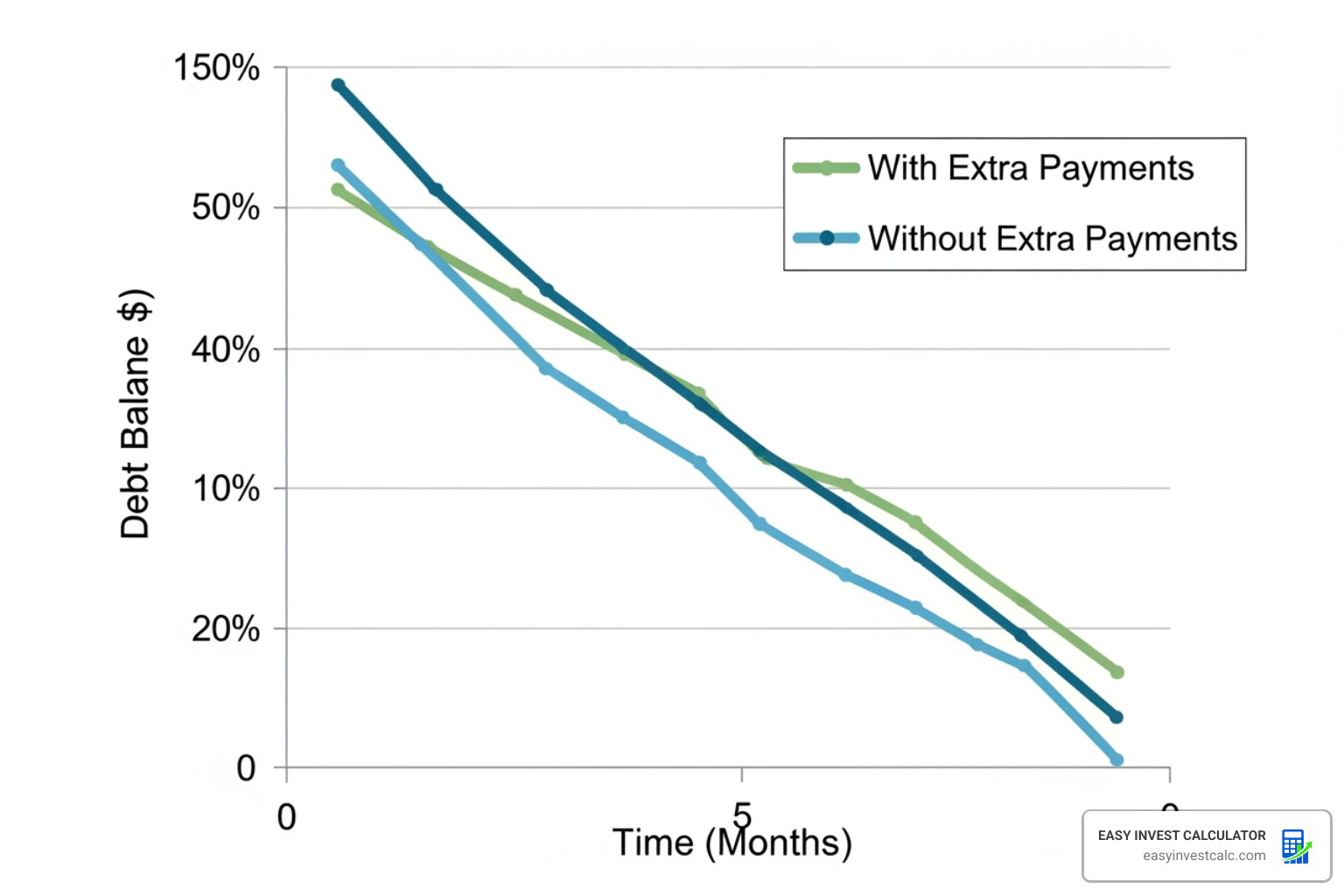
Let’s look at the data:
- The Scenario: A $300,000 loan at 7% interest for 30 years.
- The “Small” Change: You add just $100 to your payment each month.
- The Yearly Result: You pay an extra $1,200 in principal per year.
- The Total Impact: You save $44,786 in interest and shorten your loan term by 2.5 years.
If you’re feeling more aggressive and add $500 per month, the results are life-changing. You would save $141,843 in interest and knock 8 years off your mortgage.
We often call this the “Secret Sauce” for a reason. As we discuss in Extra Payments: The Secret Sauce for Debt Freedom, every dollar you pay over the required amount goes directly to the principal. This reduces the balance that interest is calculated on for every single month for the rest of the loan’s life.
By using our Amortization Calculator with Extra Payments, you can test different scenarios. Maybe you want to make a one-time lump sum payment when you get your tax refund in May 2026. Or perhaps you want to commit to an extra $50 a month. Our tools show you exactly how much “future time” you are buying back with those extra dollars.
Strategic Tax Planning and Financial Forecasting
For business owners and savvy investors, an annual amortization calculator isn’t just a debt tracker—it’s a tax planning tool.

Intangible Assets and IRS Section 197
Amortization isn’t just for loans; it’s also a method for spreading the cost of intangible assets over their useful life. According to IRS Section 197 Intangibles, costs like franchise fees, patents, and trademarks must be amortized over exactly 15 years (180 months).
If you purchase a franchise in May 2026 for $45,000, you can’t deduct that whole amount at once. You must use a straight-line annual amortization.
- Annual Deduction: $45,000 / 15 years = $3,000 per year.
- Proration: If you started in May, your 2026 deduction would be prorated for 8 months.
Business and Vehicle Loans
If you use a vehicle for business, tracking the interest portion of your loan is essential for tax deductions. While the principal part of a car payment isn’t typically deductible (that’s handled through depreciation), the interest on a business vehicle loan often is.
Using The Ultimate Amortization Calculator Car Loan helps you separate these two figures. When tax season rolls around, you won’t have to dig through 12 months of bank statements to find your interest totals; your annual schedule will have the number ready for you.
Frequently Asked Questions about Annual Amortization
What is the difference between an annual and monthly amortization calculator?
A monthly calculator shows you the breakdown for every single payment (360 rows for a 30-year loan). An annual amortization calculator aggregates those payments into 30 rows—one for each year. This makes it much easier to see the big picture and align your loan data with your yearly tax filings and household budget.
How do extra payments affect my yearly interest total?
Extra payments reduce your principal balance immediately. Since interest is calculated as a percentage of your remaining balance, a lower principal means less interest is charged the following month. Over a year, these savings compound, significantly lowering the total interest you pay for that calendar year and every year thereafter.
Can I use an annual amortization schedule for tax planning?
Absolutely. It is one of the primary uses for the tool. For homeowners, it helps estimate the mortgage interest deduction (if you itemize). For business owners, it provides the exact figures needed for Section 197 intangible amortization or business loan interest deductions on Schedule C.
Conclusion
At EasyInvestCalc, we believe that financial clarity shouldn’t be a luxury reserved for people with accounting degrees. Whether you are planning your May 2026 budget or looking ahead to a debt-free 2046, our annual amortization calculator is designed to give you the fast, accurate, and user-friendly insights you need.
By moving beyond the “monthly payment” mindset, you can start making strategic decisions about your wealth. You can see the real cost of your debt, the power of extra payments, and the tax benefits waiting for you at the end of the year.
Ready to take the first step toward mastering your debt? Master your debt with our EMI Calculator and start building your personalized yearly roadmap today. Financial freedom isn’t about how much you make; it’s about how well you manage what you have. Let us help you make every dollar count.