

Priya sat at her dining table last weekend, looking at two investment statements. Her father wanted her to buy more jewellery as an investment. Her colleague believed in investing in the stock market through systematic plans. Both views seemed valid but were at odds.
Do you find yourself in a similar situation? The price of gold has soared past $5,000 per ounce in early 2026. Meanwhile, the stock market keeps rising. From December 2015 to December 2025, gold’s price went from $1,062 to $4,341 per ounce.
But here’s something interesting: a $10,000 investment in 1985 would be worth $323,000 in the S&P 500 versus $132,747 in gold. Both have given good returns, but they work in different ways in your portfolio.
This isn’t about picking a winner. It’s about knowing how each asset class works, what returns you can get, and how they can work together to grow your wealth. Whether you’re starting your first portfolio or adjusting your current one, understanding this is key.
Key Takeaways
- The precious metal has reached unprecedented highs above $5,000 per ounce in 2026, but historical data shows stock market indices have outperformed over longer periods
- Your investment choice shouldn’t be either-or; both asset classes serve distinct purposes in a balanced portfolio for Indian investors
- Understanding performance patterns, risk profiles, and tax implications helps you make informed allocation decisions aligned with your financial goals
- Recent market conditions have intensified the equity mutual funds vs gold debate, making proper analysis more crucial than ever
- Long-term wealth creation strategies often benefit from combining both options rather than favouring one exclusively
- Your personal financial situation, time horizon, and risk tolerance should drive your allocation between these two popular investment avenues
Understanding Your Investment Choices in 2026
In 2026, the choice between equity funds and gold is more important than ever for Indian investors. The financial world is changing fast, with new chances and challenges. It’s not just about picking winners; it’s about building a strong financial base that fits your goals.
Your investment choices today will shape your financial future. Whether you’re saving for retirement or your children’s education, knowing how these investments work is key. Let’s look at why this comparison is crucial and what the current investment climate means for your money.
Why This Comparison Matters for Your Wealth
Your financial success depends on making smart decisions about where to put your money. Equity mutual funds let you invest in the growth of Indian and global companies. They offer the chance for big returns over time as businesses grow and make profits.
On the other hand, gold acts as your financial safety net. It keeps its value when other investments falter and provides stability during economic ups and downs. Gold is seen as a safe investment that holds or increases in value during tough times.
This comparison is important because we’re in a unique time. The economy is growing in some areas but facing inflation worries. Geopolitical tensions are rising, and central banks are making big policy changes that affect everything from interest rates to currency values.
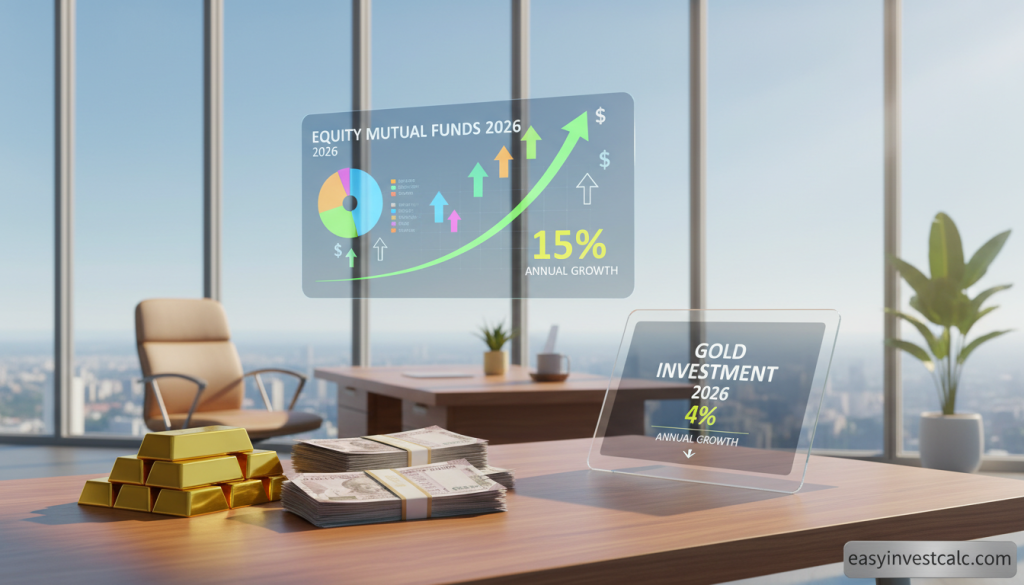
Experts suggest putting 5% to 15% of your portfolio in gold for protection from market swings. This way, you can still invest in other securities to grow your wealth over time. Remember, these investments work together to help you build wealth.
The Current Investment Climate in India
India’s economy in 2026 offers great opportunities and challenges that affect your investment choices. The domestic economy is growing, with Indian companies expanding and the stock market offering good chances for equity investors. Corporate earnings are strong, and many sectors are changing thanks to technology and new consumer tastes.
But, global issues like trade tensions, currency changes, and inflation are also important. These factors have made gold more appealing as a way to protect your wealth. Big economic events, policy changes, inflation, and global tensions have driven gold prices up over the last decade.
Geopolitical issues and ongoing inflation have boosted gold’s appeal. Gold has outperformed other investments over 25 years, showing its value in uncertain times. This has caught the eye of investors looking for stability.
Gold is still popular in India, but new investment options have made it easier to include in your portfolio. Gold ETFs and Sovereign Gold Bonds offer convenient, cost-effective ways to invest in gold without the need for physical storage. These options have made gold more accessible to everyday investors.
2026 is interesting because both equity and gold have shown strong performance. Equity markets have given solid returns, while gold has hit new records. This situation highlights the need to carefully choose which investment fits your goals, time frame, and risk tolerance. This dual strength shows the importance of a balanced approach to investing.
| Investment Aspect | Equity Mutual Funds | Gold | Key Consideration |
|---|---|---|---|
| Primary Purpose | Long-term wealth creation through capital appreciation | Wealth preservation and inflation hedge | Aligns with different financial objectives |
| Market Drivers | Corporate earnings, economic growth, sectoral performance | Economic uncertainty, currency fluctuations, geopolitical tensions | Often move inversely to each other |
| Recommended Portfolio Allocation | Varies based on age and risk profile (typically 60-80%) | 5% to 15% for portfolio stability | Balance provides diversification benefits |
| 2026 Market Environment | Strong growth potential with moderate volatility | Record highs driven by global uncertainties | Both showing strength simultaneously |
Understanding these dynamics helps you make informed decisions, not just based on emotions or market noise. The current climate rewards those who take a diversified approach. Your investment strategy should reflect your personal situation, financial goals, and risk comfort, not just what’s doing well now.
What Are Equity Mutual Funds
Equity mutual funds are a great way to grow your wealth over time. They pool your money with others to invest in many companies. This way, you get to benefit from the growth of different businesses.
When you invest in an equity mutual fund, you buy units. Each unit represents your share of the fund’s stocks.
This approach offers many benefits. You get to diversify your investments easily. You also benefit from expert research and stock picking by fund managers.

How Equity Funds Generate Returns
Equity mutual funds can grow your money in two main ways. This makes them a popular choice when comparing equity mutual funds vs gold.
Capital appreciation is the first way. It happens when the companies in your fund’s portfolio grow. As businesses expand and become more profitable, their stock prices go up.
Your fund captures these price increases. This means the value of your units grows too.
The second way is dividend income. Companies that make a profit often share some of it with their shareholders as dividends. Your mutual fund collects these dividends. The fund manager can then choose to reinvest them or give them to you as income.
Most growth funds reinvest dividends. This helps your money grow faster over time.
“Unlike income-producing assets like stocks or bonds, gold doesn’t generate dividends or interest.”
Equity funds have a big advantage over gold. They benefit from the compounding effect of reinvested dividends and business growth. Gold’s value mainly comes from price changes due to supply and demand.
History shows equity funds outperform gold. If you invested ₹10,000 in an S&P 500 index fund in 1985, it would be worth around ₹3,23,000 by 2025. The same amount in gold would be worth about ₹1,32,747.
Popular Equity Fund Categories in India
India offers a wide range of equity fund categories. Each is designed for different investment goals and risk levels. Knowing these categories helps you make better choices when comparing equity mutual funds vs gold.
Large-cap funds focus on the biggest companies. These are stable and less volatile. They’re good for steady growth.
Mid-cap and small-cap funds invest in smaller companies. These have higher growth potential but are riskier. They’re best for longer investment horizons.
Multi-cap and flexi-cap funds can invest in all sizes of companies. This flexibility helps managers adapt to market changes. It can improve your returns across different market conditions.
Sectoral and thematic funds concentrate on specific industries or themes. You can choose funds based on your interests. However, they carry more risk due to concentration.
Index funds and ETFs track specific market indices. They offer broad market exposure at lower costs. They don’t require active management by fund managers.
| Fund Category | Primary Focus | Risk Level | Ideal Investment Horizon |
|---|---|---|---|
| Large-Cap Funds | Top 100 companies by market cap | Moderate | 5+ years |
| Mid-Cap Funds | Companies ranked 101-250 | High | 7+ years |
| Small-Cap Funds | Companies beyond rank 250 | Very High | 10+ years |
| Flexi-Cap Funds | All market capitalisations | Moderate to High | 5-7 years |
| Index Funds/ETFs | Market index replication | Moderate | 5+ years |
When choosing between equity mutual funds vs gold, consider your goals. You might pick large-cap funds for stability and mid-cap for growth.
Long-Term Wealth Creation Potential
Equity mutual funds are powerful for long-term wealth. They’re especially good for retirement and big life goals. Their ability to build wealth comes from several factors.
Compounding returns are key. When your fund earns returns, those returns are reinvested. This creates a snowball effect that grows your wealth faster than linearly.
Over time, this effect makes a big difference in your wealth.
Your equity mutual funds let you participate in economic growth. As India’s economy grows, companies expand. This drives up their stock prices, benefiting your fund.
Professional management and diversification also help. They reduce risks by spreading investments across different companies. This protects your wealth while still allowing for growth.
For Indian investors, equity mutual funds offer great accessibility advantages. You can start investing with just ₹500 through SIPs. This makes it easy to build a large portfolio over time, regardless of your income.
SIPs also help with rupee-cost averaging. This means you buy more units when prices are low and fewer when prices are high. It can improve your average purchase price over time.
History shows equity funds outperform most other investments. Despite short-term ups and downs, they deliver better returns over the long term. This makes them ideal for long-term goals.
When planning your investments, consider the long-term potential of equity mutual funds. This is crucial for aligning with your financial goals and timeline.
Gold Investment Fundamentals
Gold is different from stocks or mutual funds. It’s a physical item with real value worldwide. When looking at gold investment vs equity funds, gold works in a unique way. It’s a limited resource, making it special in the financial world.
Gold isn’t like most financial assets. It doesn’t rely on someone else’s promise. This makes it valuable when the economy is uncertain.
In India, gold is important for both culture and finance. Knowing how gold works as an investment in 2026 can help your portfolio.
Ways to Add Gold to Your Portfolio
You can add gold to your portfolio in several ways. You can buy physical gold like coins or bars. Or, you can choose Sovereign Gold Bonds (SGBs) or Gold Exchange Traded Funds (ETFs).
Buying physical gold lets you hold the metal. But, it comes with storage worries, insurance costs, and making charges that can lower your returns.
Sovereign Gold Bonds (SGBs) are a modern choice. They offer gold price growth and a 2.5% annual interest rate.
SGBs don’t need storage. They come with a government guarantee. And, the capital gains on redemption are tax-free if you hold until maturity.
Gold Exchange Traded Funds (ETFs) are another easy option. Each unit represents one gramme of gold. You can buy and sell them like shares.
Gold mutual funds invest in gold ETFs or mining companies. They offer professional management and diversification in the gold sector.

Physical Gold vs Sovereign Gold Bonds vs Gold ETFs
Choosing gold investments depends on their unique features. Each option meets different investor needs. They have their own benefits and drawbacks.
| Feature | Physical Gold | Sovereign Gold Bonds | Gold ETFs |
|---|---|---|---|
| Liquidity | Moderate (selling requires finding buyers) | Low (lock-in until 5th year) | High (instant trading on exchanges) |
| Additional Returns | None (only price appreciation) | 2.5% annual interest | None (tracks gold price) |
| Storage Requirement | Yes (bank locker or home safe) | No (held in demat form) | No (electronic holding) |
| Making/Transaction Costs | High (3-25% for jewellery) | None | Very low (brokerage only) |
| Purity Concerns | Yes (verification needed) | None (sovereign guarantee) | None (99.5% purity assured) |
Gold ETFs are convenient and cost-effective compared to physical gold. They allow quick entry and exit, with low annual expense ratios.
Sovereign Gold Bonds are best for long-term investors. They offer regular income and are attractive for long-term commitment.
Physical gold is for those who value tangible ownership. It may have higher costs, but many prefer holding the metal, especially in crises.
Gold’s Traditional Safe Haven Status
Gold has shown resilience in economic crises. Its safe haven status makes it key for diversifying portfolios.
Gold keeps its value over long periods. Unlike currencies, gold prices often rise with living costs.
In the 2008 crisis, gold prices soared while stocks fell. This shows gold’s protective role in downturns.
For Indian investors in 2026, gold’s protective role is clear. Global uncertainty and inflation risks make it attractive.
Gold is not at risk of default like bonds or currencies. It’s backed by no government or company, so it can’t fail.
Recent global events have boosted gold’s appeal. Economic disruptions, currency concerns, and central bank policies have increased demand.
But, it’s important to know gold’s limits. Unlike stocks, it doesn’t generate income or dividends (except SGBs). Its value depends on market sentiment and price growth.
Gold prices can be volatile in the short term. When the economy looks optimistic, gold may not perform as well as equities.
Equity Mutual Funds vs Gold Returns Performance
Looking at mutual funds versus gold returns shows patterns important for Indian investors. Real data helps avoid making guesses about investments. The story of these two assets changes with the time period you look at.
Your investment timeline is crucial. Short-term results often differ from long-term trends. Knowing both helps you plan investments that fit your goals and time frame.
Historical Performance Across Different Time Horizons
Gold has recently outperformed, surprising many investors. Over five years, gold’s returns were about 18%. This was due to global uncertainty, pandemic disruptions, and inflation.
Last year, gold’s returns were around 65%. This is nearly four times what equity markets returned. Gold’s returns over two and three years were about 45% and 33%, respectively.
However, longer periods show a different picture. From 1985 to 2025, a ₹10,000 investment in gold grew to about ₹1,32,747. The same investment in broad equity indices would have grown to ₹3,23,000 in the S&P 500 or ₹7,15,000 in the Nasdaq.
For Indian investors, domestic equity mutual funds have generally outperformed. The power of compounding through systematic investment plans amplifies these advantages significantly when you maintain discipline across market cycles.
| Time Period | Gold Returns | Equity Returns | Performance Leader |
|---|---|---|---|
| 1 Year | ~65% annualised | ~16% annualised | Gold dominates |
| 5 Years | ~18% annualised | ~14% annualised | Gold edges ahead |
| 40 Years (1985-2025) | 13x growth | 32x to 71x growth | Equities outperform significantly |
How Each Asset Behaves Through Market Cycles
Gold and equity mutual funds perform differently in bull and bear markets. In bull markets, equity mutual funds shine as stock prices rise. Your equity investments capture this growth momentum as companies expand and profits increase.
In bear markets, gold tends to hold its value better or even appreciate. This inverse relationship becomes your portfolio’s shock absorber during turbulent times. Whilst equity funds may experience substantial temporary declines, gold often moves in the opposite direction.
Recent history shows this pattern clearly. During economic uncertainty, inflation spikes, and geopolitical tensions over the past 25 years, gold has consistently performed well. Meanwhile, equity markets have delivered superior returns during extended periods of stability and growth. Neither asset wins in all conditions—that’s precisely why understanding their complementary nature matters for your portfolio construction.
Indian equity mutual funds have shown resilience through various domestic and global market cycles. They’ve benefited from India’s economic transformation and growing corporate sector. Gold, meanwhile, has protected Indian investors during currency fluctuations and global market turmoil.
What Your Money Actually Earns After Price Increases
Real returns after accounting for inflation represent what truly matters for your wealth building journey. Nominal returns can look impressive on paper, but inflation steadily erodes your purchasing power. What you can actually buy with your investment gains determines whether you’re genuinely building wealth or simply treading water.
Gold has historically served as an effective inflation hedge, with prices generally rising alongside or ahead of inflation rates. This characteristic helps preserve your purchasing power even when currency values decline. During periods of high inflation, gold prices often accelerate upward, protecting you from the erosive effects of rising prices on your savings.
Equity mutual funds, over long periods, have typically delivered returns that substantially exceed inflation rates. Rather than merely preserving value like gold, equities generate genuine wealth growth through corporate profit expansion and economic development. Indian equity funds investing in growing businesses capture real economic value creation that pushes returns well beyond inflation.
Consider a practical example: if inflation runs at 6% annually and gold returns 8%, your real return is approximately 2%. An equity mutual fund returning 14% during the same period delivers a real return of about 8%—four times the wealth creation after accounting for rising prices. These differences compound dramatically over decades, explaining why long-term wealth builders typically favour equity exposure.
The taxation treatment also affects your real returns significantly. Understanding how different holding periods and investment structures impact your after-tax, inflation-adjusted returns helps you make smarter allocation decisions. Your net returns—after taxes and inflation—ultimately determine your financial success, not the headline figures you see in performance reports.
Risk Profiles and Volatility Assessment
Understanding the risks of equity mutual funds versus gold makes investing smarter. It’s about knowing how much risk you can handle. Every investment has its own level of volatility, which is important for building a portfolio that meets your goals without too much worry.
Success in investing isn’t just about choosing between equity funds and gold. It’s about knowing how each performs during market ups and downs. This knowledge helps you make decisions based on facts, not emotions.
Equity Market Fluctuations and Your Portfolio
Investing in equity mutual funds means facing big ups and downs. Market changes are caused by many things like company earnings and interest rates. These changes can be huge.
Indian markets have seen drops of 10-20% before. In bad times, they can fall by 30-40% or more.
The 2008 crisis and the 2020 pandemic showed how markets can drop sharply. These drops can worry new investors, especially.
But, it’s key to remember that these changes are short-term. If you stay patient, quality equity funds can bounce back and grow. This is how you build wealth over time.
Managing your emotions during market downturns is tough. The urge to sell during bad times can lead to losses. But, if you wait, the market usually recovers.
Gold Price Volatility Patterns
Gold is seen as a safe investment, but its price can surprise. It’s usually stable during economic downturns but can be volatile in the short term.
In 2026, gold’s price jumped to $5,595 per ounce before falling to $4,894. This big swing caught many off guard.
Gold recently fell 9% on news before stabilising. This shows even safe investments can have sharp price changes. No investment is completely safe from volatility.
Gold bull markets have seen big corrections. The 1976-1980 and 2001-2011 bull markets had significant downturns. The current bull market, starting in 2022, has also seen big swings.
- The 1976-1980 bull market produced roughly 500% returns but experienced five corrections of 10% or more along the way
- The 2001-2011 bull market generated approximately 600% returns, also punctuated by multiple significant pullbacks
- The current cycle beginning in 2022 has generated approximately 200% so far and has experienced volatility including a recent pullback from record highs
Gold’s price changes come from different things than equity markets. Currency, interest rates, and global events all affect gold prices in unique ways.
Matching Investments to Your Risk Tolerance
Finding the right investments for you means knowing yourself well. You need to think about many things before choosing between equity funds and gold.
Your investment time horizon is very important. If you’re young, you can take more risk because you have time to recover from market ups and downs.
If you’re close to retirement or have short-term goals, you might want more gold and stable assets. You don’t have time to wait for the market to recover if it drops a lot.
When checking your risk tolerance, consider these things:
- Income stability: Having a steady job means you can take more risk than if your income is uncertain
- Existing assets and liabilities: What you owe and what you own affects how much risk you can handle
- Financial goals: Different goals like retirement or education need different levels of risk
- Emotional capacity: How well you can handle market changes without making rash decisions is key
Testing your comfort level is a good way to find out your risk tolerance. Ask yourself if you’d stay invested, add more, or sell if your portfolio dropped 25% tomorrow. Your answer shows your true risk tolerance.
Remember, your risk tolerance can change as your life does. Regularly reviewing your portfolio ensures it still fits your current situation, not just your past one.
Taxation Rules and Liquidity Considerations
Tax efficiency and how quickly you can get your money back are key. When you look at mutual funds gold investment analysis, these factors are crucial. They affect how much you keep and how fast you can get your money in emergencies.
The tax on your investments impacts your final wealth. Liquidity lets you be flexible with your money when you need it or see opportunities.
Current Tax Treatment for Equity Mutual Funds
Understanding taxes on equity mutual funds is important for 2026. In India, taxes depend on how long you hold your investment. This creates different tax rules for different holding times.
Long-term capital gains (LTCG) apply to investments held over a year. These gains are taxed at a specific rate on amounts over ₹1 lakh per year. This rule gives you a tax-free cushion for moderate gains each year.
Short-term capital gains (STCG) apply to investments held for less than a year. These gains are taxed at a higher rate than long-term gains. This encourages you to hold your investments longer.
Dividend income from equity mutual funds is added to your total income. You pay tax on these dividends based on your income tax slab. This means higher earners pay more tax on dividend income.
One big advantage of equity mutual funds is tax-deferred growth. You don’t pay tax until you redeem your units. This lets your investments grow without tax drag each year. It gives you control over when to pay tax, helping with tax planning.
Taxation on Physical and Digital Gold
Gold investments have different tax rules based on their form. Knowing these differences helps you choose the most tax-efficient gold investment for you.
Physical gold, like jewellery, coins, and bars, is taxed as a capital asset. When you sell physical gold, your gains are taxed based on how long you held it.
If you hold physical gold for more than 36 months, it’s long-term capital gains. This means you get indexation, which adjusts your purchase price for inflation. This can greatly reduce your taxable gains.
Short-term gains on physical gold held for less than three years are added to your total income. You pay tax at your income tax slab rate, which could be up to 30% plus cess for the highest bracket.
Gold ETFs and gold mutual funds have similar tax rules to physical gold. The three-year holding period determines if your gains are long-term or short-term, with the same indexation benefits for long-term gains.
Sovereign Gold Bonds (SGBs) have the best tax treatment among gold investments. You get 2.5% annual interest, taxed as income. But, capital gains on redemption are completely tax-free if you hold the bonds until maturity. This makes SGBs very tax-efficient for long-term investors, avoiding capital gains tax while still benefiting from gold price appreciation.
How Quickly Can You Access Your Money
Liquidity, or how fast you can turn investments into cash, varies a lot. This is important for emergencies or when you spot good investment opportunities.
Equity mutual funds offer great liquidity. Most open-ended equity funds let you redeem units on any business day. The money usually reaches your bank in 1-3 business days, making it very convenient.
Some funds charge an exit load if you redeem early, usually within a year. This fee is about 1% of the redemption value. After that, you can get your money quickly without much hassle.
Gold ETFs are as liquid as equity mutual funds. You can sell them during market hours, with funds credited within the standard settlement cycle. This makes gold ETFs much more liquid than physical gold.
Physical gold is harder to sell and can take longer. You need to find a buyer, like a jeweller or gold dealer, who might offer lower prices. You also have to check the gold’s purity, which adds time and cost.
Dealing with physical gold buyers often means getting lower prices. If your gold is in jewellery, you might lose the making charges you paid. These factors make physical gold less liquid than financial gold instruments, especially when you need cash fast.
Understanding Entry and Exit Costs
The real returns from your investments depend on market performance and the costs of entering and exiting. A thorough mutual funds gold investment analysis must consider these often-hidden expenses. They can eat into your wealth over time.
Equity mutual funds usually have low entry costs, especially with direct plans that avoid distributor commissions. These direct plans offer the same management but with lower costs, helping you keep more of your returns.
Expense ratios, the annual fund management fees, range from 0.5% to 2.5%. They depend on the fund category and whether you choose regular or direct plans. These ongoing costs affect your returns, even though they’re not seen as explicit charges.
Exit loads may apply if you redeem units early, usually within a year. Most equity funds charge about 1% for early redemption, though many waive this fee after the first year. This encourages longer holding periods, which aligns with equity investing’s long-term nature.
Physical gold investments have high costs that impact your net returns. Making charges for jewellery can be 10% to 25% of the gold’s value. Storage and insurance costs add ongoing expenses, while selling involves bid-ask spreads that can reduce your realisation value by 2-5% or more below market rates.
Gold ETFs are a cost-efficient choice with expense ratios between 0.5% and 1% annually. Transaction costs are minimal, limited to brokerage fees that might be ₹10 to ₹20 per trade or a small percentage of the transaction value. This makes gold ETFs much cheaper than physical gold for those seeking gold exposure.
Sovereign Gold Bonds have no ongoing costs, making them very cost-efficient. You buy them at issue price (usually aligned with market rates) and incur no storage, insurance, or management fees. The only consideration is that early exit before maturity requires selling on the secondary market, where liquidity might be limited compared to ETFs.
| Investment Type | Entry Costs | Ongoing Costs | Exit Costs | Liquidity Speed |
|---|---|---|---|---|
| Equity Mutual Funds (Direct) | None | 0.5% – 1.5% annual expense ratio | 1% exit load if redeemed within 1 year | 1-3 business days |
| Physical Gold (Jewellery) | 10% – 25% making charges | Storage and insurance costs | 2% – 5% discount to market rate | Several days to weeks |
| Gold ETFs | Brokerage fees (₹10-₹20 or 0.1%-0.5%) | 0.5% – 1% annual expense ratio | Brokerage fees only | 2-3 business days |
| Sovereign Gold Bonds | None (issued at market rate) | None | None if held to maturity; brokerage if sold early | Immediate on maturity; variable if sold early |
This detailed comparison shows that choosing between equity mutual funds and gold investments has big implications. Tax treatment, liquidity, and costs all affect your wealth growth. It’s crucial to consider these practical aspects alongside performance when building your investment strategy.
Building Your Optimal Investment Strategy
The smartest investors don’t just pick between equity funds and gold. They figure out the right mix for their goals and risk comfort. A strategic blend is key to a well-rounded portfolio.
Equity funds and gold are not rivals but complementary assets. Each has its own role in your investment strategy, depending on the economic situation.
It’s about knowing when to focus on one over the other and how to mix them effectively.
Choosing Equity Mutual Funds for Growth
Equity mutual funds are best for those in their 30s or 40s with a long time until retirement. They’re the backbone of your portfolio.
Compounding works wonders over time. A ₹10 lakh investment growing at 12% annually becomes ₹31 lakh in 10 years and ₹96 lakh in 20 years.
This growth is hard to achieve with conservative investments alone.
Invest in equities when you’re in the wealth accumulation phase of life. If you have stable income and years before needing your money, you can handle market ups and downs.
Short-term market swings are less worrying with a long-term view.
Equity funds are also good for beating inflation. If you’re saving for your child’s education 15 years from now, you need returns that grow your money significantly.
With education costs rising 8-10% annually, equity investments are the only realistic way to stay ahead.
Consider prioritising equities if you have enough emergency savings and insurance. When you’ve saved 6-12 months’ expenses in liquid funds and insured your family, you can take risks with longer-term investments.
The choice between equity funds and gold depends on your emotional readiness for market volatility. If you can handle a 20% drop in your portfolio without stress, you’re ready for equity investing.
When Gold Deserves Higher Priority
Gold is crucial during times of significant economic uncertainty. This includes banking crises, currency instability, or geopolitical tensions. Gold’s ability to preserve capital is invaluable in such times.
Gold is essential when protecting your wealth becomes more important than growing it. This is especially true as you approach retirement or are already retired.
Increasing gold to 15-20% of your portfolio can add stability. This is important when you’re drawing down assets for living expenses.
Rapidly rising inflation makes gold attractive. When consumer prices surge at 6-8% or higher, gold acts as a hedge.
Its value helps maintain purchasing power even as currency values decline.
Gold is better as a portfolio stabiliser when you already have a lot of equity exposure. If 80-85% of your investments are in stocks and equity mutual funds, adding 10-15% in gold provides a low-correlation asset.
When stock markets decline, gold often appreciates. This smooths your overall returns.
For investors without real estate, gold provides tangible asset exposure. If you’re a renter with most wealth in financial instruments, a larger gold allocation—perhaps 12-15%—adds physical asset diversification that property ownership might otherwise provide.
Harnessing Diversification’s Protective Power
The key principle is diversification across asset classes. Different investments react differently to the same economic conditions. When equities struggle, gold may thrive, and vice versa.
This negative or low correlation smooths your portfolio journey and reduces the severity of drawdowns.
Consider this practical illustration of diversification’s power. During a significant market correction where equities fall 30%, imagine you hold 85% in equity funds and 15% in gold.
If gold appreciates 20% during this period, your overall portfolio decline reduces to approximately 21% rather than 30%. That 9 percentage point cushion can prevent panic selling and help you stay invested for recovery.
Financial experts consistently recommend allocating 5-15% of your total portfolio to gold. The specific percentage depends on your age, risk tolerance, other assets you own, and financial objectives.
Younger investors might allocate 5-8%, whilst those nearing retirement might prefer 12-15%.
The table below illustrates balanced portfolio allocations for different investor profiles:
| Investor Profile | Equity Mutual Funds | Gold Allocation | Debt/Cash | Primary Objective |
|---|---|---|---|---|
| Young Professional (25-35 years) | 75-80% | 5-10% | 10-15% | Aggressive wealth accumulation |
| Mid-Career (35-50 years) | 65-75% | 10-15% | 15-20% | Balanced growth with stability |
| Pre-Retirement (50-60 years) | 50-60% | 15-20% | 25-30% | Wealth preservation with moderate growth |
| Conservative Investor (Any Age) | 40-50% | 15-20% | 35-40% | Capital protection priority |
A balanced approach might involve 70-75% in equity mutual funds for long-term growth, 10-15% in gold for stability and inflation protection, and the remainder in debt instruments or cash equivalents for liquidity and capital preservation.
Customise this framework based on your specific circumstances. If you own a mortgage-free home representing substantial wealth, you might need minimal gold allocation since real estate provides tangible asset exposure.
Conversely, if you’re a renter with a sizeable retirement account but no hard assets, increasing gold to 12-15% makes sense.
The debate over equity funds compared to gold investment resolves itself when you recognise that both deserve space in most portfolios. Your specific allocation should reflect your investment timeline, income stability, existing assets, and comfort with volatility.
Maintain discipline by rebalancing periodically—perhaps annually or when allocations drift 5% from targets. This systematic approach naturally forces you to sell assets that have outperformed and buy those that have underperformed.
You’re essentially selling high and buying low without trying to time the market.
Remember that smaller gold allocations work better if volatility causes you anxiety. If watching gold prices fluctuate would trigger constant portfolio checking and stress, keep your allocation toward the lower end of the 5-15% range.
Your investment strategy should help you sleep soundly, not create worry.
Conclusion
When comparing equity mutual funds and gold, aim for a balanced portfolio. Both have their own roles in your financial journey.
Equity mutual funds offer strong growth over the long term. They let you share in India’s economic growth and corporate achievements. Quality equity funds have often beaten inflation over time.
Gold shows great strength in uncertain economic times and global tensions. Its investment outlook is strong, making it key to a diverse portfolio.
Your ideal mix depends on personal factors. Think about your age, retirement plans, and income stability. Also, consider your comfort with market ups and downs.
Start by putting 70-80% of your growth portfolio in equity mutual funds and 10-15% in gold. This mix balances growth with stability in uncertain times.
Before investing, weigh the good and bad of each option. Check your financial goals often. Adjust your portfolio if it strays from your targets.
Good investing isn’t about timing. It’s about discipline, diversification, and sticking to your long-term goals, even when markets change.
FAQ
Should I invest in equity mutual funds or gold in 2026?
It’s not just a choice between equity mutual funds and gold. You should mix both based on your goals and situation. Equity funds should be the main part of your portfolio (70-85%) if you’re investing for 10+ years. They offer great growth potential.
Gold should be a smaller part (10-15%) for stability and protection. Your exact mix depends on your age, risk level, and goals. Younger investors might choose more equity, while those nearing retirement might prefer more gold.
What returns can I expect from equity mutual funds compared to gold?
Gold has recently given about 18% annual return over five years and 65% in the last year. This beats equity funds. But, over 20-40 years, equity investments outperform gold.
An initial ₹10,000 in broad equity indices would grow to ₹3,23,000 (S&P 500) or ₹7,15,000 (Nasdaq). Gold would grow to ₹1,32,747. Equity mutual funds, especially those focused on Indian companies, have given better returns over time.
Gold can do well during uncertain times. But, equity mutual funds usually create more wealth over the long term.
How risky are equity mutual funds versus gold investment?
Equity funds are riskier in the short term, with Indian markets seeing 10-20% corrections. They can drop by 30-40% in severe crises. But, they recover well, rewarding patient investors.
Gold is seen as safer but not completely stable. It swung from ₹4,59,500 to ₹4,04,700 per ounce in 2026. A single day’s drop of 9% shows gold’s volatility. Equity risks come from company performance and economic conditions. Gold risks come from currency movements and geopolitical events.
Your risk tolerance, investment time, and goals should guide your mix of equity funds and gold.
What are the tax implications of investing in equity funds compared to gold?
Equity funds have favourable tax rules. Long-term gains (over one year) are taxed at a specific rate on gains over ₹1 lakh. Short-term gains face higher taxes. You only pay tax when you redeem.
Gold held over 36 months gets long-term capital gains with indexation, reducing tax. Holdings under three years are taxed at your income rate. Gold ETFs and mutual funds follow similar tax rules. Sovereign Gold Bonds offer tax benefits, with interest taxable but no capital gains tax at maturity.
How liquid are equity mutual funds versus gold investments?
Equity funds are very liquid, allowing quick redemption with proceeds credited in 1-3 days. Exit loads may apply for early redemptions. Gold ETFs offer similar liquidity with standard settlement times.
Physical gold is less liquid, requiring a buyer and dealing with purity and price negotiations. Sovereign Gold Bonds have an 8-year maturity with exit options from the 5th year. For quick access, equity funds and Gold ETFs are better than physical gold.
What percentage of my portfolio should I allocate to gold versus equity mutual funds?
Experts suggest 5-15% gold and 70-80% equity funds for growth. The rest goes to debt or cash for liquidity. Your mix depends on your age, risk tolerance, and goals.
Younger investors might prefer less gold (5-10%) and more equity (80-85%) for growth. Those nearing retirement or risk-averse might choose more gold (10-15%) and less equity (65-75%) for safety.
Regular rebalancing helps maintain your target mix, buying low and selling high without emotional decisions.
Which form of gold investment is best for Indian investors in 2026?
The best gold investment depends on your priorities. Sovereign Gold Bonds offer long-term benefits, including tax-free gains at maturity. Gold ETFs provide easy buying and selling with low costs.
Physical gold is good for those who value tangible assets but involves storage and security costs. Gold mutual funds offer professional management. Sovereign Gold Bonds are best for long-term investors, while Gold ETFs suit those seeking liquidity.
How do equity mutual funds and gold perform during inflation?
Both assets play important roles during inflation. Gold acts as an inflation hedge, preserving purchasing power. When inflation rises, investors often add gold to their portfolios.
Equity funds can also protect against inflation, but through different means. Companies can pass on increased costs to consumers, supporting stock valuations. Quality businesses with pricing power tend to see earnings grow faster than inflation.
For comprehensive protection, holding both assets is best.
Can I invest in both equity mutual funds and gold simultaneously?
Yes, and it’s the best strategy for a resilient portfolio. This mix allows you to benefit from equity’s growth potential while gold provides stability during market turbulence.
The combination works because equity and gold often move independently. When equity markets correct, gold usually appreciates, cushioning your portfolio. Start with equity mutual fund SIPs and add gold through Sovereign Gold Bonds or Gold ETFs. Regular rebalancing helps maintain your target mix.
What is the historical correlation between equity markets and gold prices?
Equity markets and gold prices have historically shown low to negative correlation. This means they often move independently or in opposite directions. Gold’s diversification value in your portfolio is based on this inverse relationship.
During equity bull markets, gold often underperforms as investors favour growth assets. But, during bear markets, gold typically holds value better or appreciates, providing a cushion against equity losses. Recent examples show this pattern, with gold remaining stable or appreciating during crises.
However, this correlation isn’t always consistent. There are times when both assets move in the same direction. The key insight is that gold’s low correlation with equities provides valuable diversification benefits, reducing overall portfolio volatility while maintaining return potential.