
Is a 50-Year Mortgage Right for You? What the Numbers Actually Show
A 50 year mortgage calculator is the fastest way to see whether stretching your home loan over half a century makes financial sense — or quietly costs you a fortune.
Quick answer for most borrowers:
| What you want to know | The short version |
|---|---|
| Monthly savings vs. 30-year | ~$108/month on a $400,000 loan |
| Extra interest you’ll pay | $541,000+ over the life of the loan |
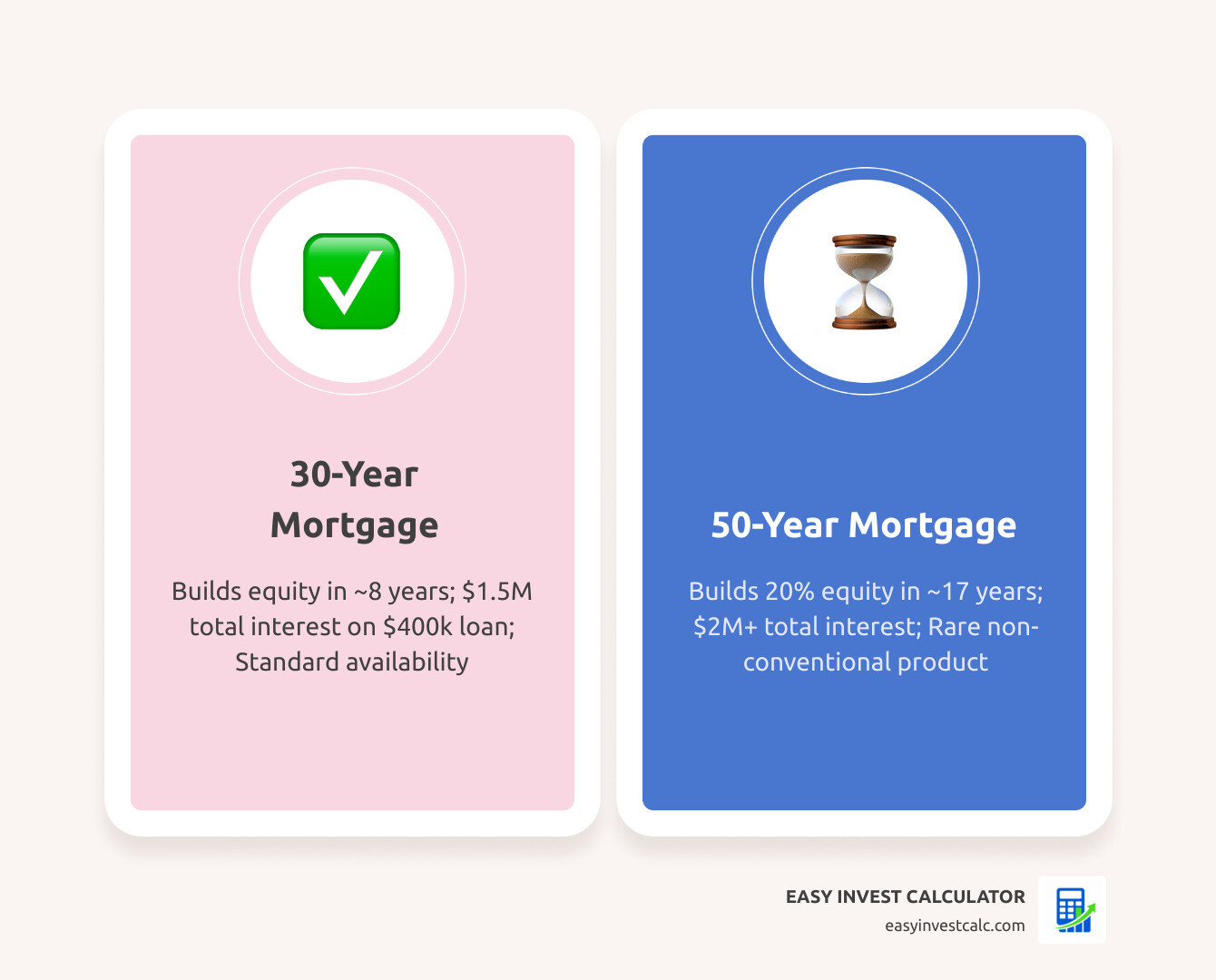
| Time to build 20% equity | ~17 years (vs. ~8 years on a 30-year) |
| Is it widely available? | No — rare, non-conventional product |
| Who it fits best | High-cost market buyers, cash-flow investors |
So yes, your monthly payment goes down. But the total cost goes way up.
Here’s the reality of the 2026 housing market: home prices remain stubbornly high, and a lot of buyers in their 30s and 40s are searching for any lever they can pull to make the monthly numbers work. A 50-year mortgage looks tempting on paper — lower payment, same house. But what looks like relief today can turn into a very expensive commitment that outlasts your career, your kids leaving home, and possibly your retirement.
The research is blunt. On a $400,000 loan, extending from 30 to 50 years saves you roughly $108 per month — but adds over $541,000 in total interest. That’s not a rounding error. That’s a second house.
This guide will walk you through exactly how to use a 50-year mortgage calculator, what the results mean, and whether this loan structure is a smart tool or a financial trap for your situation.
Relevant articles related to 50 year mortgage calculator:
- amortization schedule calculator
- amortization schedule with extra payments
- bank loan repayment calculator
What is a 50-Year Mortgage and How Does It Work?
A 50-year mortgage is exactly what it sounds like: a home loan where you agree to pay back the principal and interest over a span of 50 years, or 600 monthly payments. While the standard 30-year mortgage has been the “gold standard” of American homeownership for decades, the 50-year term is an ultra-long-term product designed to maximize monthly affordability by stretching the repayment period to the absolute limit.
The mechanics of the loan are dictated by amortization. In the early years of any mortgage, the bulk of your payment goes toward interest rather than the principal balance. With a 50-year term, this effect is amplified. Because the timeline is so long, the amount of principal you “chip away” at each month is miniscule. You can see this breakdown clearly by using our Amortization Schedule Calculator: Principal vs Interest.
It is important to note that 50-year mortgages are considered “Non-Qualified Mortgages” (Non-QM). They don’t meet the strict standards set by Fannie Mae or Freddie Mac, which means they aren’t sold on the secondary market like traditional loans. Instead, they are typically held by “portfolio lenders”—banks or credit unions that keep the loans on their own books—or specialized non-conventional lenders.
Comparing 50-Year Terms to Standard 30-Year Loans
When you move from a 30-year to a 50-year loan, you aren’t just changing the timeline; you’re often changing the price of the money itself. Lenders view 50-year loans as riskier. After all, a lot can happen to a borrower (and the economy) in half a century. Consequently, these loans usually come with an interest rate premium, often 0.3% to 0.5% higher than a standard 30-year fixed rate.
| Feature | 15-Year Fixed | 30-Year Fixed | 50-Year Fixed |
|---|---|---|---|
| Monthly Payment | Highest | Moderate | Lowest |
| Total Interest | Lowest | Moderate | Highest |
| Equity Growth | Rapid | Steady | Very Slow |
| Typical Rate | Lowest | Standard | High (Premium) |
| Availability | Universal | Universal | Very Rare |
The biggest trade-off is equity buildup. On a 30-year loan, you might reach 20% equity in about 8 years. On a 50-year loan, it could take nearly 17 years to reach that same milestone. If property values flatten, you risk being “underwater” (owing more than the home is worth) for a very long time.
Using a 50 Year Mortgage Calculator to Estimate Costs

Before you sign on the dotted line for a five-decade commitment, you need to run the numbers. A 50 year mortgage calculator allows you to input your specific data to see the “all-in” cost of the loan. To get an accurate picture, you can use the 50-Year Mortgage Calculator to see how your specific variables interact.
Standard inputs include:
- Home Purchase Price: The total cost of the property.
- Down Payment Percentage: Usually, 20% is recommended to avoid extra fees, but many 50-year products allow less.
- Interest Rate: Remember to add that 0.3% to 0.5% premium to current 30-year rates.
- Property Taxes & Insurance: These are recurring costs that don’t disappear just because your loan term is longer.
- HOA Fees: If you’re buying a condo or in a planned community, these can significantly impact your monthly budget.
How to Interpret Your 50 Year Mortgage Calculator Results
When the calculator spits out your results, don’t just look at the monthly payment. Look at the Total Interest Paid. This is the number that usually shocks people. For a $400,000 home, you might find that you end up paying back over $1 million by the time the 600th payment is made.
You should also look at the Loan Payoff Date. If you are 35 years old today, a 50-year mortgage won’t be paid off until you are 85. We recommend using our tool to Master Your Yearly Budget with an Annual Amortization Calculator to see how this debt fits into your long-term retirement planning.
Adjusting Inputs for Real-World Accuracy
A basic calculation often misses the “hidden” costs of homeownership. To get a truly accurate estimate of How a 50-Year Mortgage Could Change What You Pay, you must include:
- Closing Costs: Typically 2% to 5% of the loan amount, paid upfront.
- Private Mortgage Insurance (PMI): If your down payment is under 20%, you’ll likely pay an annual fee (often 0.3% to 1.9% of the loan) until your equity reaches 20%.
- Maintenance Budget: Experts suggest setting aside 1% of your home’s value annually for repairs. On a 50-year timeline, you will definitely be replacing the roof, the HVAC, and the appliances—likely several times.
The Financial Trade-offs: Lower Payments vs. Massive Interest
The primary reason anyone considers a 50-year term is cash flow. In high-cost markets like San Francisco, New York, or Los Angeles, the difference of a few hundred dollars a month can be the difference between qualifying for a home and continuing to rent.
However, the “savings” are often surprisingly small. On a $400,000 loan at 2026 rates, extending the term from 30 to 50 years might only save you about $108 per month. Is $108 worth an extra $541,000 in interest? For most, the answer is a resounding no. This is a classic case of diminishing returns. Extending from 15 to 30 years provides a massive payment drop; extending from 40 to 50 years provides a tiny drop (about $41/month) for a massive increase in total cost ($270,000).
Impact on Equity and Long-Term Wealth
Equity is your “savings account” within your home. With a 50-year mortgage, that account grows at a snail’s pace. Because you are paying so little toward the principal each month, you are essentially “renting” the home from the bank for the first two decades.
If you find yourself in a 50-year loan but your income increases later, you can mitigate this damage. Making Extra Payments: The Secret Sauce for Debt Freedom can shave decades off your loan and save you hundreds of thousands in interest. Even one extra payment a year can drastically alter your amortization schedule.
Risks and Historical Context of Ultra-Long Mortgages

Ultra-long mortgages aren’t a new invention; they often appear when housing markets become overheated. History shows they are frequently a sign of systemic instability.
- Japan’s 100-Year Mortgages: During the Japanese asset price bubble of the late 1980s, 100-year mortgages became a thing. They were less about affordability and more about estate planning—multi-generational debt passed from parents to children.
- Sweden and Denmark: In Sweden, the average mortgage term once hit 140 years before regulators stepped in to cap them at 105 years.
- 2006 US Bubble: Right before the 2008 crash, 40 and 50-year mortgages popped up in Southern California as a way to keep the “buying frenzy” alive even as prices outpaced wages.
The risk is that these loans encourage people to overextend. If you need a 50-year term to afford a house, you are one repair bill or one missed paycheck away from a crisis.
Is a 50 Year Mortgage Calculator Showing You a Sustainable Path?
Some financial advisors argue that if you are disciplined, a 50-year mortgage could be a tool. The logic is that you take the monthly savings (say, $200) and invest it in an S&P 500 index fund. Over 50 years, that $200/month could theoretically grow to over $500,000, potentially offsetting the extra interest paid.
However, this requires perfect discipline and a high tolerance for market risk. For most people, the “savings” just get spent on groceries or gas. If you’re considering this path, use our Amortization Calculator with Extra Payments to see how much you’d actually save by simply paying down the debt instead.
Frequently Asked Questions about 50-Year Mortgages
Are 50-year mortgages widely available in 2026?
No. They remain a niche product. Because they don’t conform to Fannie Mae or Freddie Mac standards, you won’t find them at most big-box banks. You’ll need to look at specialized portfolio lenders, credit unions, or “Non-QM” lenders. You’ll also likely need a solid credit score (620+) and a stable debt-to-income (DTI) ratio, as lenders are extra cautious with 50-year terms.
Can I pay off a 50-year mortgage early?
Generally, yes. Most modern mortgages do not have prepayment penalties, but you should always check the fine print. By making extra principal payments or switching to a bi-weekly schedule, you can effectively turn a 50-year loan into a 30-year or 20-year loan. Many borrowers use the 50-year term as a “safety net” for low required payments, then pay extra whenever they have a good month.
How much higher are interest rates on 50-year loans?
Expect to pay a “risk premium.” Because the lender is tying up their capital for half a century, they want a higher return. Typically, the interest rate on a 50-year loan is 0.3% to 0.5% higher than the prevailing 30-year fixed rate. Always compare the APR (Annual Percentage Rate), which includes fees, rather than just the base interest rate.
Conclusion
At EasyInvestCalc, we believe in the power of data to drive better financial decisions. A 50-year mortgage is a powerful tool, but it’s one that cuts both ways. While it can offer a path to homeownership in an expensive 2026 market, the long-term costs are staggering.
Before committing to a lifetime of debt, explore your options. Could you buy a slightly smaller home? Could you make a larger down payment? If you do choose an ultra-long term, have a plan to pay it down early. You can visualize that plan using our Amortization Schedule with Extra Payments.
Financial literacy is about looking past the “monthly payment” and seeing the big picture. Whether you are looking for a standard loan or an exotic term, we invite you to Master your monthly budget with our EMI Calculator to ensure your home remains a blessing, not a burden.