

Amortization Calculator with Extra Payments
See how much time and money you can save.
How Extra Payments Can Slash Your Loan Interest (And How to Calculate the Savings)
Use this amortization calculator with extra payments to estimate your regular monthly principal-and-interest payment, compare an additional monthly payment, and see how your estimated total interest and payoff time could change. Enter your loan details below to compare scenarios.
Using an amortization calculator with extra payments is one of the easiest ways to see how paying more than your scheduled monthly payment can affect your loan balance, total interest, and payoff date.
If you are wondering, “How much interest can I save by paying extra on my mortgage?”, an amortization calculator can turn that question into a specific dollar amount and payoff date. You can compare a regular payment schedule with scenarios such as $50, $100, $200, or $300 in additional principal each month.
Here are examples using standard fixed-rate monthly amortization assumptions:
| Extra Monthly Payment | Loan Example | Approx. Interest Saved | Approx. Time Saved |
|---|---|---|---|
| $50/month | $250,000 at 5%, 30 years | $21,299 | 28 months |
| $100/month | $400,000 at 6%, 25 years remaining | $35,329 | 24 months |
| $200/month | $405,000 at 6.625%, 30 years | $115,824 | 67 months |
| $300/month | $300,000 at 5%, 30 years | $91,741 | 104 months |
These examples assume a fixed interest rate, monthly payments, no fees or penalties, and that each extra payment is applied directly to principal. Actual savings can differ depending on your loan terms, payment timing, and servicer rules. The estimates use the original scheduled principal-and-interest payment plus the extra monthly amount, with the final payment adjusted to clear the remaining balance.
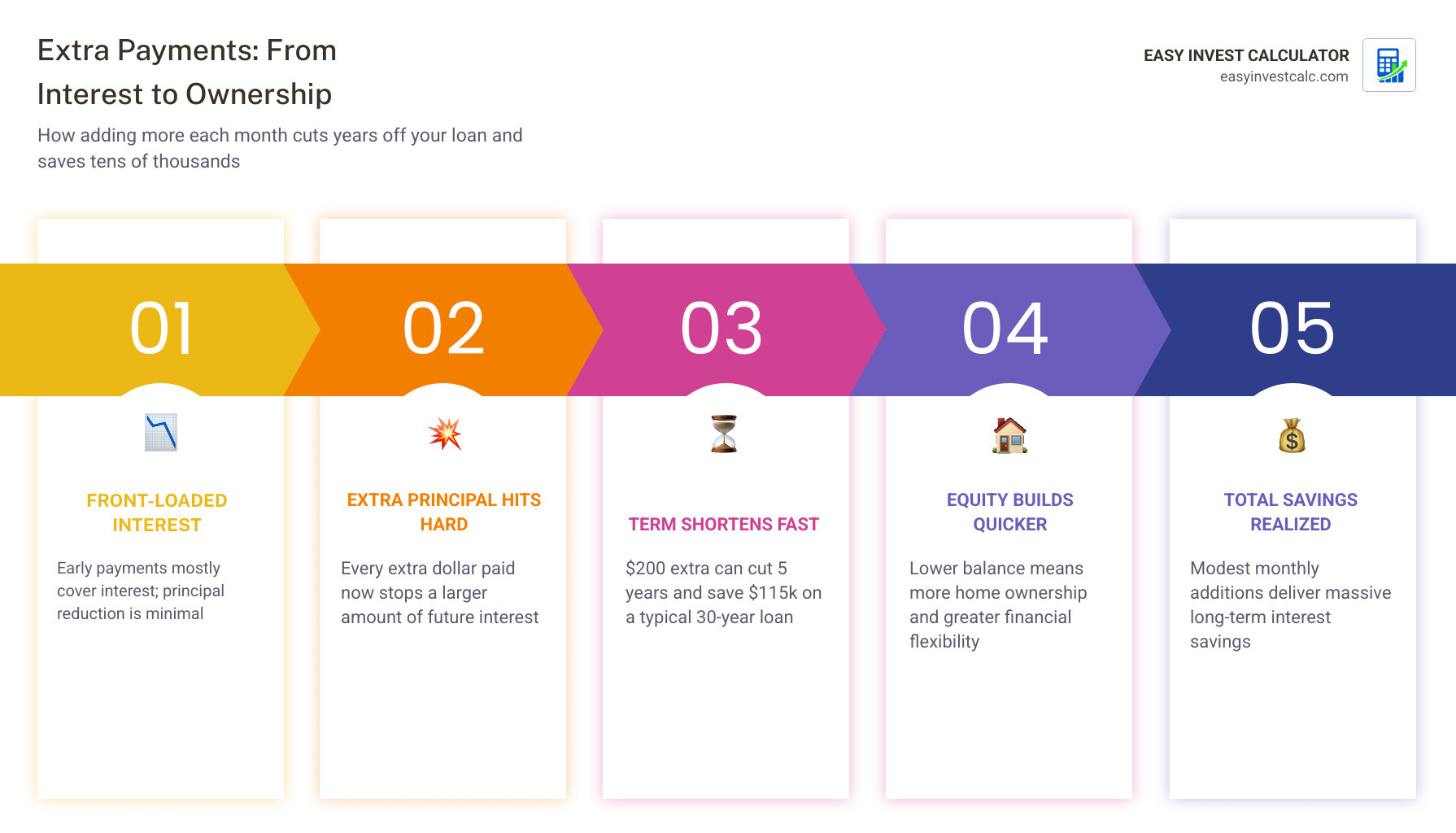
The numbers show why even a modest additional payment can make a meaningful difference. When extra money reduces your principal balance, future interest is calculated on a smaller balance, which can reduce total interest and shorten the repayment period.
Mortgage interest is often higher in the early years because the outstanding loan balance is highest. As the principal balance falls, the interest portion of each scheduled payment generally falls as well, while more of the payment goes toward principal.
This guide explains how an amortization calculator with extra payments works, how to calculate interest savings, which extra-payment strategies you can compare, and what to check before sending additional money to your lender.
Essential amortization calculator with extra payments topics:
- Amortization schedule with extra payments
- Amortization schedule calculator
- Amortization schedule with fixed monthly payment
Understanding the Amortization Calculator with Extra Payments
At EasyInvestCalc, we believe that understanding your debt is the first step toward making informed repayment decisions. An amortization calculator with extra payments is more than a basic math tool: it lets you compare how different payment amounts can change your loan balance, total interest, and payoff date.
In simple terms, amortization is the process of paying off a loan through a series of scheduled payments. For a typical fixed-rate mortgage, each principal-and-interest payment contains an interest portion and a principal portion. Early in the loan, the balance is larger, so the interest portion is generally larger. As the principal falls, the interest charged each period generally decreases.
When you use an amortization calculator, several key factors determine the result:
- Loan Principal: The amount originally borrowed or the current balance being amortized.
- Interest Rate: The annual rate used to calculate periodic interest. Even a small rate difference can materially change total interest over a long loan term.
- Repayment Term: The number of years or months scheduled for repayment, such as 15 or 30 years for many mortgages.
- Regular Payment: The scheduled principal-and-interest payment based on the loan amount, rate, and term.
- Extra Payments: Additional amounts that are applied to the loan, ideally reducing principal when permitted by the loan terms.
By using an Amortization Schedule Calculator: Principal vs Interest, you can see how each payment changes the balance and how the principal and interest portions evolve over time.
How Amortization Schedules Change with Extra Principal
The key reason extra principal payments can save interest is straightforward: future interest is calculated using the outstanding balance and the applicable interest rate. When you reduce the principal earlier, future interest charges can be lower.
This is especially important early in a long loan because the outstanding balance is larger. A regular payment reduces the balance according to the amortization schedule, while an additional principal payment can reduce the balance faster than originally scheduled.
For example, if your regular mortgage payment is $1,850 and you voluntarily pay $2,000 while the additional $150 is applied to principal, the extra $150 can reduce the balance beyond the original schedule. The exact interest savings depend on your rate, remaining term, current balance, payment timing, and lender rules.
According to our guide on fixed-rate amortization, the basic principle is simple: a lower principal balance can mean lower future interest charges. An amortization calculator helps you quantify that difference instead of relying on estimates.
Strategies to Accelerate Your Loan Payoff
There is no single best way to make extra loan payments. The right strategy depends on your cash flow, loan terms, financial priorities, and whether your lender allows additional principal payments without a penalty.
- Monthly Recurring Payments: Add a fixed amount, such as $50, $100, or $200, to each scheduled payment and make sure the extra amount is applied as intended.
- One-Time Windfalls: A tax refund, work bonus, inheritance, or other lump sum can be used for an additional principal payment if doing so fits your overall financial plan.
- Biweekly Payment Strategy: Paying half of a monthly principal-and-interest payment every two weeks can result in 26 half-payments over a year, equivalent to 13 monthly payments. Check your servicer's rules and fees before enrolling in a biweekly program.
As we explain in Extra Payments: The Secret Sauce for Debt Freedom, the most useful strategy is often the one you can maintain consistently without weakening your emergency savings or other financial priorities.
Comparing Interest Savings Across Frequencies
To illustrate the difference, consider a $300,000 mortgage at 5% interest with a 30-year term. The following examples use standard amortization assumptions and show approximate results.
| Payment Strategy | Additional Amount | Approx. Total Interest Saved | Approx. Time Saved |
|---|---|---|---|
| Round up with $150 extra/month | $1,800/year | $55,604 | 62 months |
| Biweekly payments | About 1 extra monthly payment/year | $51,492 | 123 payment periods, depending on payment method |
| $300 monthly extra | $3,600/year | $91,741 | 104 months |
| $5,000 one-time payment after Year 1 | $5,000 once | $15,730 | 12 months |
Important: These are illustrations, not quotes for a specific mortgage. Biweekly calculations can vary depending on how a servicer handles payments, and a one-time payment produces different results depending on when it is made. Verify the biweekly and lump-sum figures against the exact payment timing and assumptions before relying on them.
Maximizing Savings with an Amortization Calculator with Extra Payments
To get the most from an amortization calculator with extra payments, compare several what-if scenarios rather than testing only one extra-payment amount.
- What happens if you pay an extra $50 each month?
- How much more could you save with $100 or $200 extra?
- What if you make a $5,000 lump-sum payment after one year?
- How much does starting extra payments five years earlier change the result?
- What happens if you increase your extra payment as your income rises?
The primary benefit of using an Amortization Schedule with Extra Payments is that you can compare the estimated payoff date and interest cost under different assumptions. For many borrowers, the goal is not only to reduce interest but also to eliminate the monthly debt obligation sooner.
For example, paying an additional amount toward principal every month may shorten a 30-year repayment schedule by several years. The exact result depends on the loan balance, interest rate, remaining term, and size and timing of the extra payments.
Critical Factors Before Making Extra Payments
Before putting every available dollar toward your mortgage, consider your loan terms and your broader financial situation. Paying extra principal can reduce future interest, but it is not automatically the best use of every dollar.
First, check for prepayment penalties. Some mortgages can include a fee for paying all or part of the loan early. The rules depend on the specific mortgage and loan documents, so check your agreement or ask your servicer before making a large additional payment.
Second, consider your opportunity cost. Paying down a mortgage provides an interest-saving benefit based on the loan rate, but investing or keeping money in savings may serve other financial goals. The right choice depends on factors such as your mortgage rate, taxes, investment risk, liquidity needs, and other debts.
Third, protect your emergency fund. Home equity is not as liquid as cash in a savings account. Before making aggressive extra payments, consider whether you have enough accessible savings for unexpected expenses.
Finally, consider higher-interest debt. If you have credit-card or other high-interest debt, compare those interest costs with the potential benefit of paying down a lower-rate mortgage.
If you are a DIY enthusiast, you might also want to try Excel at Debt: Building Your Own Amortization Schedule to track your progress alongside your lender's statements.

Ensuring Payments Apply to Principal in Your Amortization Calculator with Extra Payments
This is an important practical step: confirm how your lender or mortgage servicer applies an extra payment.
An additional payment can have different effects depending on the servicer's procedures and your loan terms. If the extra amount is applied to principal, it reduces the outstanding balance and can reduce future interest. If a payment is instead treated as a paid-ahead amount, the effect may differ.
Before making a recurring extra payment, consider these steps:
- Check Your Loan Terms: Confirm whether additional principal payments are permitted and whether any prepayment restrictions apply.
- Specify the Intended Application: If your servicer provides an option to designate an additional amount toward principal, use the appropriate payment instruction.
- Check Your Statement: After the payment posts, verify that the principal balance decreased as expected.
- Ask Your Servicer: If you are unsure how an extra payment was applied, contact the lender or servicer before making additional payments.
When your extra payment is actually reducing principal, the results from an amortization calculator with extra payments can provide a useful estimate of how your payoff date and total interest may change.
Frequently Asked Questions about Extra Loan Payments
How much interest can I save by paying an extra $100 per month?
The amount depends on your loan balance, interest rate, remaining term, and when you begin making the extra payments. For example, under standard monthly amortization assumptions, an extra $100 per month on a $400,000 loan at 6% with 25 years remaining could save approximately $35,329 in interest and shorten the schedule by about 24 months, assuming the extra amount is applied to principal each month.
Will extra payments automatically reduce my monthly bill?
No. Making extra principal payments generally reduces the loan balance and can shorten the payoff period, but it does not automatically change the scheduled principal-and-interest payment. A mortgage recast may reduce the required payment if the lender offers that option and the loan qualifies. Refinancing is another possible way to change payment terms, but it involves a new loan and potentially additional costs.
Is it better to invest extra cash or pay down a mortgage?
There is no universal answer. Compare your mortgage interest rate with your expected after-tax investment return, risk tolerance, emergency savings, liquidity needs, and other debts. Paying down mortgage principal can provide a predictable interest-saving benefit, while investments involve market risk and can produce gains or losses.
If you have higher-interest debt, such as credit-card debt, compare that debt first because its interest cost may be substantially higher than the mortgage rate.
How Do I Calculate Mortgage Interest Savings From Extra Payments?
The simplest approach is to create two amortization schedules using the same loan assumptions.
- Calculate the regular payment schedule without extra payments.
- Calculate a second schedule with the additional principal payment.
- Compare the total interest in both schedules.
- Subtract the interest under the extra-payment scenario from the original interest.
- Compare the number of payments required to see how much earlier the loan may be paid off.
Interest saved = Original scheduled interest − Interest with extra payments
For example, if a loan would generate $279,767 of scheduled interest and the extra-payment scenario generates $188,027, the estimated interest saving is about $91,741.
Conclusion
Extra mortgage payments can be a powerful way to reduce the total interest you pay and potentially become debt-free sooner. The key is understanding exactly how an additional payment changes your loan balance and repayment schedule.
By using an Amortization Schedule with Extra Payments, you can move from guessing to comparing specific scenarios. You can estimate how much interest you could save, how many payments you could eliminate, and how different extra-payment amounts affect your payoff date.
Before making extra payments, check your loan terms, confirm how your servicer applies additional money, maintain an appropriate emergency fund, and consider your other financial priorities.
At EasyInvestCalc, our goal is to provide practical calculators and explanations that help you understand your numbers before making financial decisions. Use an EMI Calculator or an amortization calculator to compare your own loan scenarios and see how additional payments could affect your repayment plan.

Founder of EasyInvestCalc.com with 8+ years of experience in personal finance. Sunita simplifies complex financial mathematics—from SIP compounding to tax planning—empowering Indian investors to make smart, debt-free decisions based on real market mechanics.