

What the Bankrate Amortization Calculator Shows You (And Why It Matters)
The Bankrate amortization calculator is a useful online tool for seeing how a mortgage payment is divided between principal and interest. Instead of looking only at one monthly payment, an amortization schedule lets you see how your loan balance changes month after month and how much interest you pay over the full loan term.
Here’s how to use it in 5 steps:
- Enter your loan amount (e.g., $400,000).
- Enter your loan term (e.g., 30 years).
- Enter your interest rate (e.g., 6.10%).
- Enter your loan start date.
- Optionally, add extra monthly, yearly, or one-time payments to see how additional principal payments may change the payoff timeline.
The calculator can then show a mortgage amortization schedule, including your payment amount, principal paid, interest paid, remaining balance, total interest and projected payoff information. Bankrate also provides chart and schedule views so you can see how the balance and payment allocation change over time. View the Bankrate amortization calculator.
One of the biggest advantages of an amortization schedule is that it makes the long-term cost of a mortgage easier to understand. A fixed monthly payment does not mean the same amount goes toward principal and interest every month. Early payments generally contain a larger interest portion because the outstanding balance is highest at the beginning of the loan.
For example, on a $400,000 30-year fixed mortgage at 6.10%, the monthly principal-and-interest payment is about $2,424. After five years, the borrower would have made payments totaling roughly $145,439, but only about $27,326 would have reduced the original loan balance. The remainder largely reflects interest paid during those five years.
That is why an amortization schedule can be more useful than looking at the monthly payment alone. It turns a large long-term mortgage commitment into a month-by-month payoff plan that you can analyze and compare.
For homeowners planning around retirement, refinancing, home improvements or early mortgage payoff, understanding this payment breakdown can make it easier to evaluate different loan strategies.
Handy Bankrate amortization calculator terms and related tools:
- amortization schedule calculator
- amortization schedule with extra payments
- amortization schedule with fixed monthly payment
Understanding the Easy Invest Amortization Calculator and How It Works
At Easy Invest Calc, we believe financial calculations should be easy to understand. Mortgage amortization is the process of repaying a loan through scheduled payments over a defined period. With a typical fixed-rate mortgage, the required principal-and-interest payment stays consistent while the amount allocated to interest and principal changes throughout the loan.
The Bankrate amortization calculator uses standard amortization mathematics based on your loan amount, term and interest rate. Each month’s interest is calculated from the outstanding principal balance. As the balance falls, the interest portion generally decreases and the principal portion increases.
This is the key idea behind an amortization schedule: you are not simply paying the same amount of interest every month. The payment allocation changes because the remaining loan balance changes.
Understanding this mechanic is useful when comparing a 15-year mortgage with a 30-year mortgage, considering extra principal payments, or evaluating whether refinancing could make financial sense. If you want to explore the underlying calculation in more detail, check out The Ultimate Guide to Fixed Rate Amortization.
Key Inputs Required for the Amortization Calculator
To get useful results from a Bankrate amortization calculator or another mortgage amortization tool, you need a few basic loan details. Using the figures from your loan estimate or closing documents is better than relying on guesses.
- Loan Amount: This is the amount you actually borrow, not the home’s full purchase price. If you make a down payment, the mortgage principal is generally the purchase price minus the down payment, subject to the structure of your loan.
- Loan Term: This is the length of time scheduled to repay the loan. Common mortgage terms include 15 and 30 years, although other terms are available.
- Interest Rate: Enter the mortgage’s quoted interest or note rate. Do not automatically substitute APR. APR is a broader measure that can include the interest rate plus certain loan costs and fees.
- Start Date: The loan start date helps determine the timing of the amortization schedule and projected payoff date.
For the most precise calculation, keep your loan estimate, closing disclosure or current mortgage statement nearby and verify the loan amount, rate, term and payment details before comparing scenarios.
Step-by-Step Guide: Estimating Your Monthly Mortgage Payments
Using the Bankrate amortization calculator is straightforward, but the real value comes from testing different scenarios rather than looking at one payment estimate. Start with your expected loan terms and then compare alternatives such as a shorter term or additional principal payments.
First, determine the amount you expect to borrow after accounting for your down payment. Then enter the mortgage interest rate and loan term. If you already have a mortgage or preapproval, use the actual rate whenever possible. If you are shopping for a new mortgage, remember that advertised rates can change and your actual rate may depend on credit, loan type, lender and other factors.
As you review the results, the traditional 28/36 affordability guideline can be useful as a starting point. It generally suggests keeping housing expenses around 28% or less of gross monthly income and total debt obligations around 36% or less. However, these are guidelines rather than universal rules. Your taxes, insurance, other debts, emergency savings and overall financial situation also matter.

Why an Easy Invest Amortization Calculator Can Be a Useful Alternative
Bankrate’s amortization calculator is useful for analyzing the principal-and-interest side of a mortgage. However, borrowers sometimes need additional calculations depending on the question they are trying to answer.
For example, your real monthly housing budget can include costs beyond principal and interest:
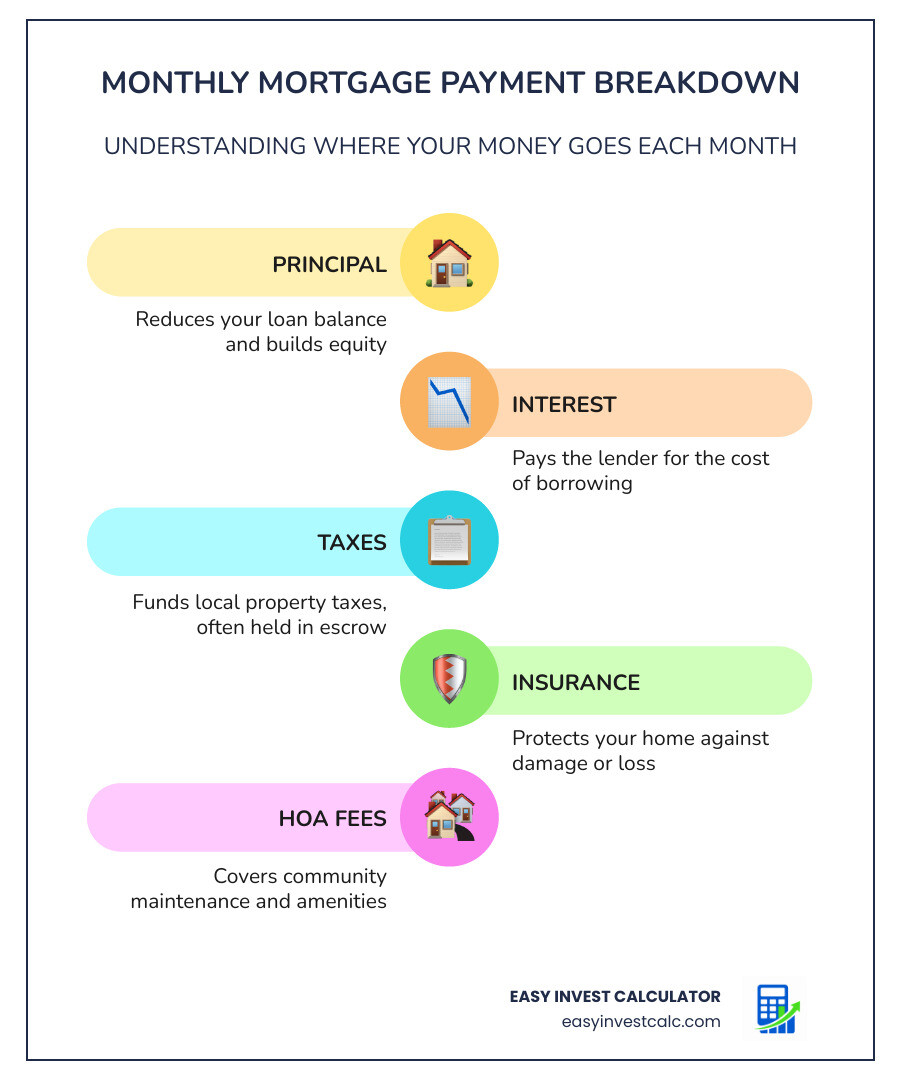
- Property Taxes: Local property taxes can add a significant amount to your monthly housing cost.
- Homeowners Insurance: Insurance premiums are commonly included in the total monthly housing expense for many mortgaged properties.
- HOA Fees: Homeowners association dues can be a recurring cost depending on the property.
- PMI (Private Mortgage Insurance): Borrowers with a conventional mortgage and a smaller down payment may have PMI depending on their loan terms. The amount varies based on factors such as loan-to-value ratio, credit profile, loan type and insurer.
It is important to distinguish these costs from the amortization itself. Bankrate states that its amortization calculator focuses on the principal and interest portion and does not estimate property-tax or homeowners-insurance escrow.
If you want to examine the relationship between principal and interest in more detail, explore our Amortization Schedule Calculator Principal vs Interest.
Visualizing the Tipping Point: Principal vs. Interest Over Time
One of the most useful things an amortization schedule calculator can show is the point at which the principal portion of a regular payment becomes larger than the interest portion.
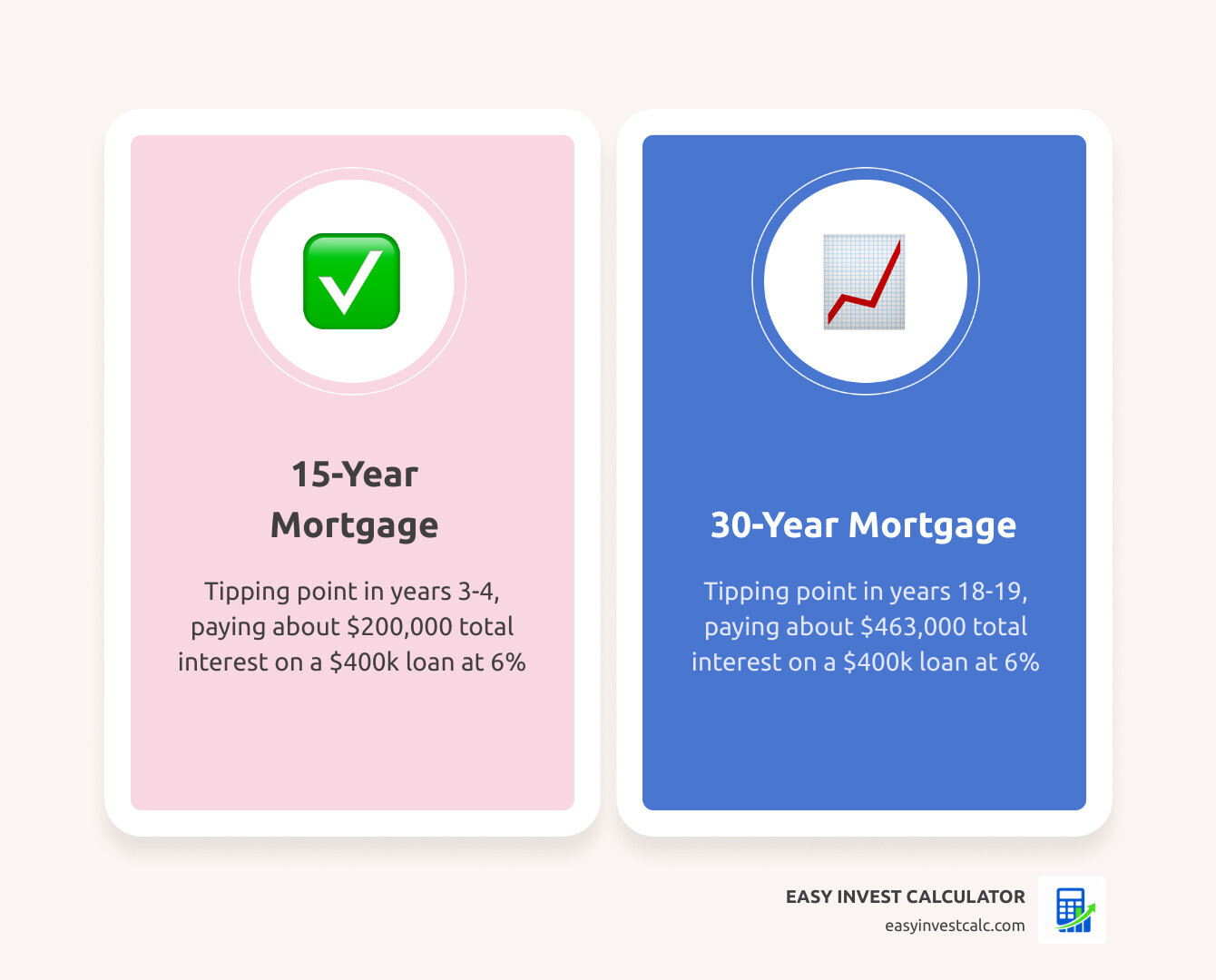
For a conventional 30-year fixed mortgage, this crossover can occur around the middle of the loan, depending on the interest rate and other loan terms. In the $400,000 example at 6.10%, Bankrate’s published schedule shows the principal portion overtaking interest around year 19. A shorter 15-year mortgage reaches this point much earlier because the loan is being repaid faster.
| Loan Term | Approximate Principal-Interest Crossover | Total Interest on $400k @ 6% |
|---|---|---|
| 15-Year Fixed | Around Year 3–4 | ~$207,000 |
| 30-Year Fixed | Around Year 18–19 | ~$463,000 |
The exact crossover point changes with the interest rate, loan amount and term, so the table should be treated as an illustration rather than a universal rule. The bigger lesson is that a longer mortgage term can produce a much larger total interest bill even when its monthly payment is easier to manage.
For a $400,000 mortgage at 6%, the total interest over a 30-year term is roughly $463,000. In other words, the interest paid over the life of the loan can exceed the amount originally borrowed. This is why understanding your amortization schedule is so important.
For borrowers dealing with more complex loan structures, you can also review our Amortization Schedule with Balloon Payment to understand how a large final payment can change the repayment structure.
How an Amortization Calculator Helps You Understand Equity Growth
Equity is the portion of your home’s value that is not covered by your outstanding mortgage balance. Your equity can increase as you make principal payments, although changes in the home’s market value can also affect the amount of equity you have.
During the early years of a mortgage, principal generally falls more slowly because a larger portion of each scheduled payment goes toward interest. Over time, the balance falls and more of the payment goes toward principal.
The Bankrate amortization calculator provides a remaining-balance view that can help you estimate how much of the original loan remains after five, ten, twenty or more years. This can be useful when thinking about refinancing, selling the property, potential PMI cancellation or other long-term financial decisions.
Strategic Financial Planning: Extra Payments and Refinancing
If you want to reduce mortgage interest or become debt-free sooner, testing extra principal payments can be one of the most useful features of an amortization calculator.
Even a relatively small additional payment can reduce the principal balance faster. Because future interest is calculated using the remaining balance, paying down principal earlier can reduce future interest charges. The actual savings depend on your loan amount, interest rate, remaining term, timing and lender rules.
The Bankrate amortization calculator allows you to explore additional-payment scenarios, while our related tools can help you focus specifically on extra-payment strategies. You can test a fixed monthly amount, an annual lump sum or a one-time payment and compare the projected payoff timeline.
To dive deeper into these strategies, check out our guide on the Amortization Schedule with Extra Payments.
Factoring Extra Payments into the Amortization Calculator
When testing an accelerated mortgage payoff strategy, there are three common types of extra payments to compare:
- Monthly Extra: Add a fixed amount to every scheduled payment.
- Yearly Extra: Apply a larger lump sum once a year, such as part of a bonus or tax refund.
- One-Time Payment: Apply a larger amount from a windfall or other available funds.
Additional payments can reduce the principal balance sooner, which can reduce the interest charged in subsequent periods. However, always check your mortgage terms and make sure extra payments are applied to principal as intended. Some loans may also have specific rules regarding additional payments or prepayment penalties.
You can experiment with these scenarios using our Amortization Calculator with Extra Payments.
Frequently Asked Questions about Amortization
What are the limitations of the amortization calculator?
Amortization calculators are planning tools, not guarantees of your future mortgage payments. A standard fixed-rate amortization calculation assumes the loan terms remain consistent. An Adjustable-Rate Mortgage (ARM) can behave differently because the interest rate and payment may change after the initial fixed-rate period.
Another important limitation is that a principal-and-interest amortization calculator does not necessarily represent your complete monthly housing expense. Property taxes, homeowners insurance, HOA dues and other costs may be separate. Bankrate specifically notes that its amortization calculator focuses on principal and interest and does not estimate property-tax and homeowners-insurance escrow.
Can I use this tool for auto or personal loans?
Yes. The basic amortization concept can also be used for many fixed-rate installment loans, including auto loans and personal loans. However, the exact calculation can vary depending on the loan’s interest method, fees, payment frequency and terms.
For example, comparing a shorter and longer auto or personal loan term can show the trade-off between monthly affordability and total interest. A longer term may reduce the required payment but can increase the total interest paid. We also provide specialized tools for different financial calculations, including our EMI Calculator.
How does the calculator help with refinancing decisions?
An amortization calculator can help you compare your current mortgage with a potential refinance by showing the payment, remaining balance and projected interest under different loan terms. This can help you estimate whether the interest savings could justify the costs of refinancing.
Rather than relying on a universal “1% rule,” compare the complete picture: the new interest rate, closing costs, remaining term, new loan term, monthly payment, total interest and your expected break-even period. A lower rate does not automatically mean refinancing will save money if the new loan resets the repayment period or adds substantial costs.
For example, someone who is already 15 years into a 30-year mortgage should be careful about replacing it with another 30-year loan. The new payment may be lower, but extending the repayment period can increase total interest. An amortization comparison can make this trade-off easier to see.
Conclusion
The Bankrate amortization calculator is useful for understanding how a mortgage payment changes over time, how much goes toward principal and interest, how your loan balance declines and how extra payments may affect your payoff timeline.
The most important takeaway is that a mortgage should not be judged only by its monthly payment. Look at the total interest, remaining balance, loan term, payoff date and additional costs before deciding whether a mortgage or repayment strategy fits your financial goals.
If you are comparing different scenarios, Easy Invest Calc provides additional resources for examining principal versus interest, extra payments and different amortization structures. Start with our EMI Calculator and explore the related amortization tools throughout this guide.
Important: Calculator results are estimates for educational and planning purposes. Your actual mortgage payment, interest charges, taxes, insurance, fees and payoff date depend on your lender, loan documents and individual circumstances.

Founder of EasyInvestCalc.com with 8+ years of experience in personal finance. Sunita simplifies complex financial mathematics—from SIP compounding to tax planning—empowering Indian investors to make smart, debt-free decisions based on real market mechanics.