
Using a 15 year fixed mortgage calculator is the fastest way to see exactly how much you’ll pay each month — and how much interest you’ll save compared to a 30-year loan.
Here’s a quick answer if you’re in a hurry:
| Loan | Rate | Monthly Payment | Total Interest |
|---|---|---|---|
| $300,000 / 15-year | 6.00% | ~$2,532 | ~$155,683 |
| $300,000 / 30-year | 6.50% | ~$1,896 | ~$382,633 |
| Your savings | ~$636 more/month | ~$226,950 saved |
The trade-off is simple: pay more each month, pay far less overall.
A 15-year fixed mortgage locks in the same interest rate and payment for the full loan term. Rates on 15-year loans are typically 0.25% to 0.75% lower than 30-year rates — because lenders take on less risk with a shorter repayment window.
Despite this, only about 6% of home buyers choose a 15-year term. Most go with the 30-year option because the lower monthly payment feels safer. But for anyone serious about building wealth and retiring debt-free, the 15-year path is worth a hard look.
This guide walks you through exactly how to use a 15-year mortgage calculator, what the numbers mean, and how to decide if this loan term fits your life.
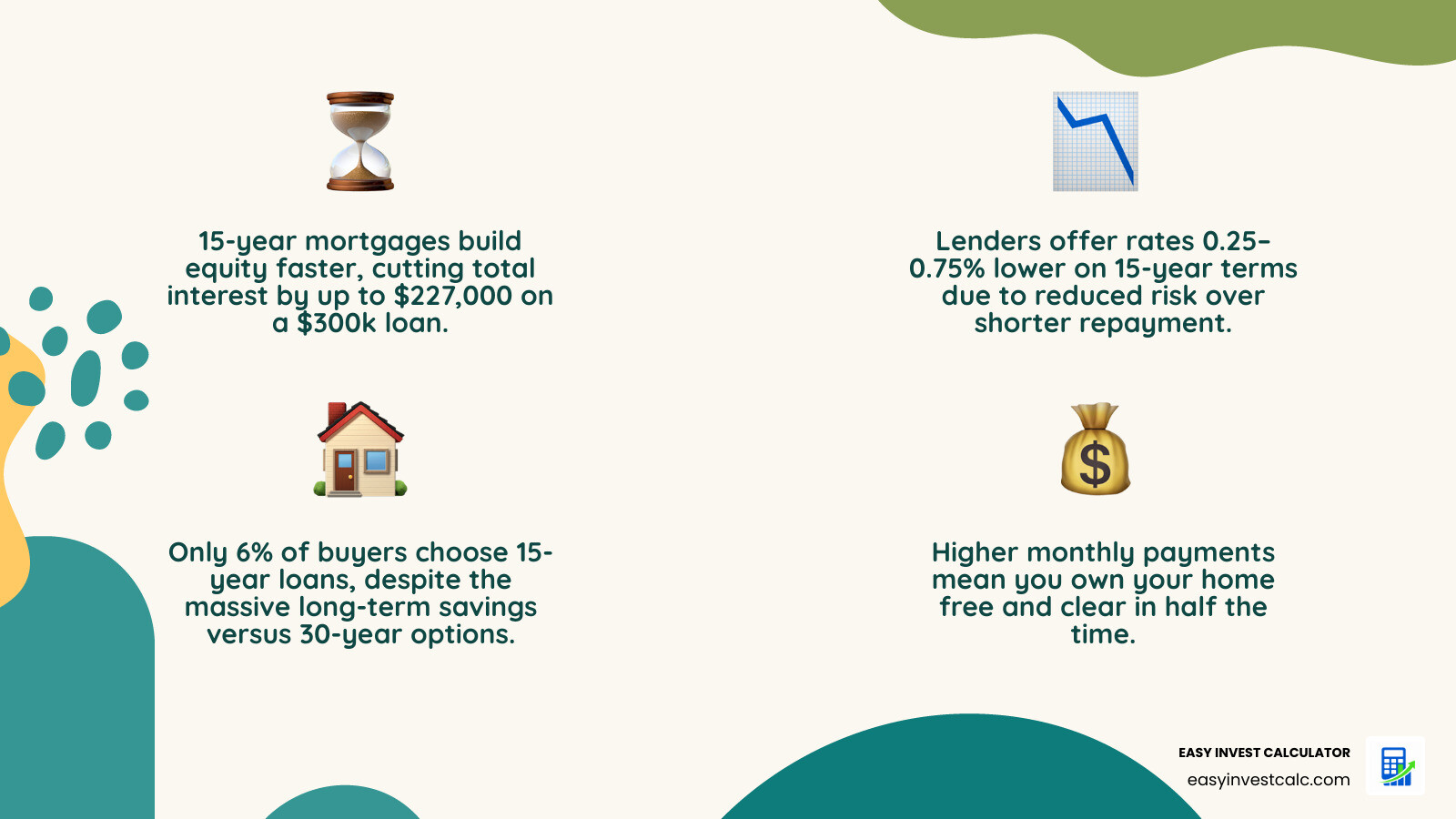
15 year fixed mortgage calculator terms at a glance:
How to Use a 15 Year Fixed Mortgage Calculator
When we sit down to plan a home purchase, the numbers can feel like a swirling cloud of “what-ifs.” A 15 year fixed mortgage calculator is designed to cut through that fog. To get an accurate picture of your future financial life, you need to input several key data points.

First, you’ll enter the Home Price. This is the total purchase price of the property. Next is the Down Payment. While many believe 20% is the gold standard, our tools allow you to test different amounts to see how they impact your loan. The Interest Rate is the annual percentage rate (APR) you expect to receive. As of May 2026, rates have stabilized, but they still vary based on your credit profile.
The Loan Term will be set to 15 years. Finally, don’t forget the “hidden” costs:
- Property Taxes: Usually about 1.1% of the property value annually in the U.S.
- Homeowners Insurance: Required by lenders to protect the asset.
- PMI (Private Mortgage Insurance): If your down payment is less than 20%.
- HOA Fees: If you are moving into a managed community or condo.
By including these, you aren’t just calculating a loan; you’re calculating a lifestyle. If you want to see how making a few extra payments could shave even more time off your debt, check out our Amortization Schedule with Extra Payments.
Interpreting Your 15 Year Fixed Mortgage Calculator Results
Once you hit “calculate,” you’ll be met with a breakdown that might look intimidating at first, but it’s actually your roadmap to freedom.
The most prominent number is your Monthly Payment. This is the sum of your principal, interest, taxes, and insurance (often called PITI). In a 15-year term, a much larger portion of this payment goes toward the Principal from day one compared to a 30-year loan.
The Total Interest Expense is perhaps the most eye-opening stat. This shows you exactly how much you are paying the bank for the privilege of borrowing. In a 15-year scenario, this number is often less than half of what it would be on a 30-year term. Finally, the Payoff Date gives you a concrete deadline for when you will own your home free and clear. For a deeper dive into how these payments are structured, read The Ultimate Guide to Fixed Rate Amortization.
Understanding Recurring vs Non-Recurring Costs
It is easy to focus only on the monthly check you write to the bank, but we want you to be prepared for the full cost of homeownership.
Non-recurring costs are the “one-and-done” expenses. These include Closing Costs, which typically range from 2% to 5% of the purchase price. On a $400,000 home, that’s a $10,000 to $20,000 check you need to have ready at the start.
Recurring costs are the ones that keep coming. Beyond the mortgage, you must account for Maintenance. Experts suggest setting aside 1% of your home’s value annually for repairs. Escrow accounts are often used by lenders to collect your property taxes and insurance premiums monthly, ensuring those big annual bills are paid on time. Understanding these averages—like the 1.1% national average for property tax—helps ensure your 15 year fixed mortgage calculator results reflect reality.
15-Year vs. 30-Year: The Financial Trade-off
Choosing between these two terms is like choosing between a sprint and a marathon. One is more intense but ends sooner; the other is slower but requires more endurance (and money).
The primary trade-off involves Monthly Cash Flow versus Life Certainty. A 30-year mortgage offers a lower monthly payment, which gives you more “breathing room” in your budget. However, a 15-year mortgage offers lower interest rates—historically 0.3% to 0.9% lower than their 30-year counterparts.
| Feature | 15-Year Fixed | 30-Year Fixed |
|---|---|---|
| Interest Rate | Lower (typically -0.5%) | Higher |
| Monthly Payment | Higher | Lower |
| Equity Building | Very Fast | Slow in early years |
| Total Interest Paid | Minimal | Substantial |
| Debt Freedom | 180 months | 360 months |
If you are considering an investment property, the math changes slightly. A 30-year loan might allow for better monthly “cash-on-cash” returns, while a 15-year loan builds equity for a future sale. You can explore these scenarios with our tool to Calculate Your Rental Yield and Mortgage.
Who Should Use a 15 Year Fixed Mortgage Calculator?
Not everyone is a candidate for a 15-year term. It requires a specific financial profile:
- High-Income Earners: If your income allows you to comfortably cover a higher payment without sacrificing retirement savings.
- Refinancing Homeowners: Many people who have lived in their home for 5-10 years refinance into a 15-year term to “finish strong.”
- Retirement Planners: If you are 50 years old, a 15-year mortgage ensures the house is paid off by age 65.
- The Debt-Averse: If the idea of carrying a balance for three decades keeps you up at night, this is your solution.
Interestingly, scientific research on home loan market shares from the BLS Consumer Expenditure Survey shows that while the 30-year loan dominates (60-90% of the market), the 15-year loan remains the second most popular choice, representing about 6% of purchase loans and a much higher percentage of refinances.
The Impact of Interest Rate Differentials
Why are 15-year rates lower? It comes down to Lender Risk. Banks know that a lot can happen in 30 years—recessions, job losses, or inflation. A 15-year window is more predictable, so they reward borrowers with a “rate spread.”
In the current 2026 market, even a 0.5% difference in APR has a massive Compounding Interest effect. On a $250,000 loan, a 15-year term at 3.1% results in about $51,000 in total interest. A 30-year term at 3.7% results in over $133,000. That’s $82,000 staying in your pocket instead of the bank’s vault.
Strategies to Accelerate Your Payoff
Even if you’ve already committed to a 15-year term, you might want to “crush debt” even faster. There are several ways to do this without feeling the pinch.
Biweekly Payments are a classic strategy. By paying half your mortgage every two weeks, you end up making 26 half-payments—the equivalent of 13 full payments a year. This one extra payment annually can shave over a year off a 15-year mortgage.
Other strategies include:
- Principal-Only Additions: Adding just $100 extra to your principal each month can significantly reduce your interest.
- Lump-Sum Payments: Using tax refunds or work bonuses to pay down the balance.
- Refinancing: If rates drop significantly below your current fixed rate, refinancing to a new, shorter term can save thousands.
To see these strategies in action, use our Amortization Calculator with Extra Payments.
Avoiding Private Mortgage Insurance (PMI)
One of the biggest “wastes” of money in a mortgage is PMI. This insurance protects the lender, not you, and it usually costs between 0.3% and 1.9% of the loan amount annually.
To avoid it, aim for a 20% Down Payment. If you can’t hit 20% immediately, a 15-year mortgage is actually a great tool for removing PMI quickly. Because you build equity so much faster, you will reach the 80% Loan-to-Value (LTV) ratio much sooner than a 30-year borrower, at which point you can request the lender cancel the PMI.
Maximizing Your Budget Flexibility
While we love the 15-year mortgage, we don’t want you to be “house poor.” We recommend following the 28/36 rule:
- No more than 28% of your gross monthly income should go toward housing.
- No more than 36% of your income should go toward total debt (including car loans and credit cards).
Before committing to the higher payments of a 15-year term, ensure you have an Emergency Fund of at least 6 months of expenses. There is an Opportunity Cost to consider; money put into your house cannot be put into the stock market. However, for many, the “guaranteed return” of saving 6% interest on a mortgage is better than the “potential return” of a volatile market.
Frequently Asked Questions about 15-Year Mortgages
How much interest do I save with a 15-year mortgage?
The savings are substantial. On a typical $200,000 loan, you can expect to save between $80,000 and $100,000 in total interest compared to a 30-year term. This is due to both the lower interest rate offered by lenders and the fact that the interest has only half the time to compound.
Can I pay off a 30-year mortgage in 15 years instead?
Yes! This is a popular strategy for those who want flexibility. You can take out a 30-year loan but use a 15 year fixed mortgage calculator to determine what the 15-year payment would be. If you pay that higher amount every month, you’ll finish in 15 years. The downside? You will have a slightly higher interest rate than if you had just signed up for the 15-year term from the start.
What are the disadvantages of a 15-year term?
The main disadvantage is the Higher Monthly Payment. This can limit your “buying power,” meaning you might qualify for a $500,000 home with a 30-year loan but only a $350,000 home with a 15-year loan. It also reduces your monthly cash flow, leaving less money for travel, investments, or unexpected repairs.
Conclusion
At EasyInvestCalc, we believe that financial freedom shouldn’t be a mystery. Our mission is to provide fast, accurate, and user-friendly tools that help you make these big life decisions with confidence. Whether you are buying your first home or looking to refinance your current one, using a 15 year fixed mortgage calculator is a vital first step.
By choosing a shorter term, you aren’t just buying a house; you’re buying time. You’re choosing a future where you own your home outright while your peers are still decades away from their final payment. Ready to see how the numbers look for your dream home? Calculate Your Rental Yield and Mortgage Repayments Like a Pro and take control of your financial destiny today.

Founder of EasyInvestCalc.com with 8+ years of experience in personal finance. Sunita simplifies complex financial mathematics—from SIP compounding to tax planning—empowering Indian investors to make smart, debt-free decisions based on real market mechanics.