
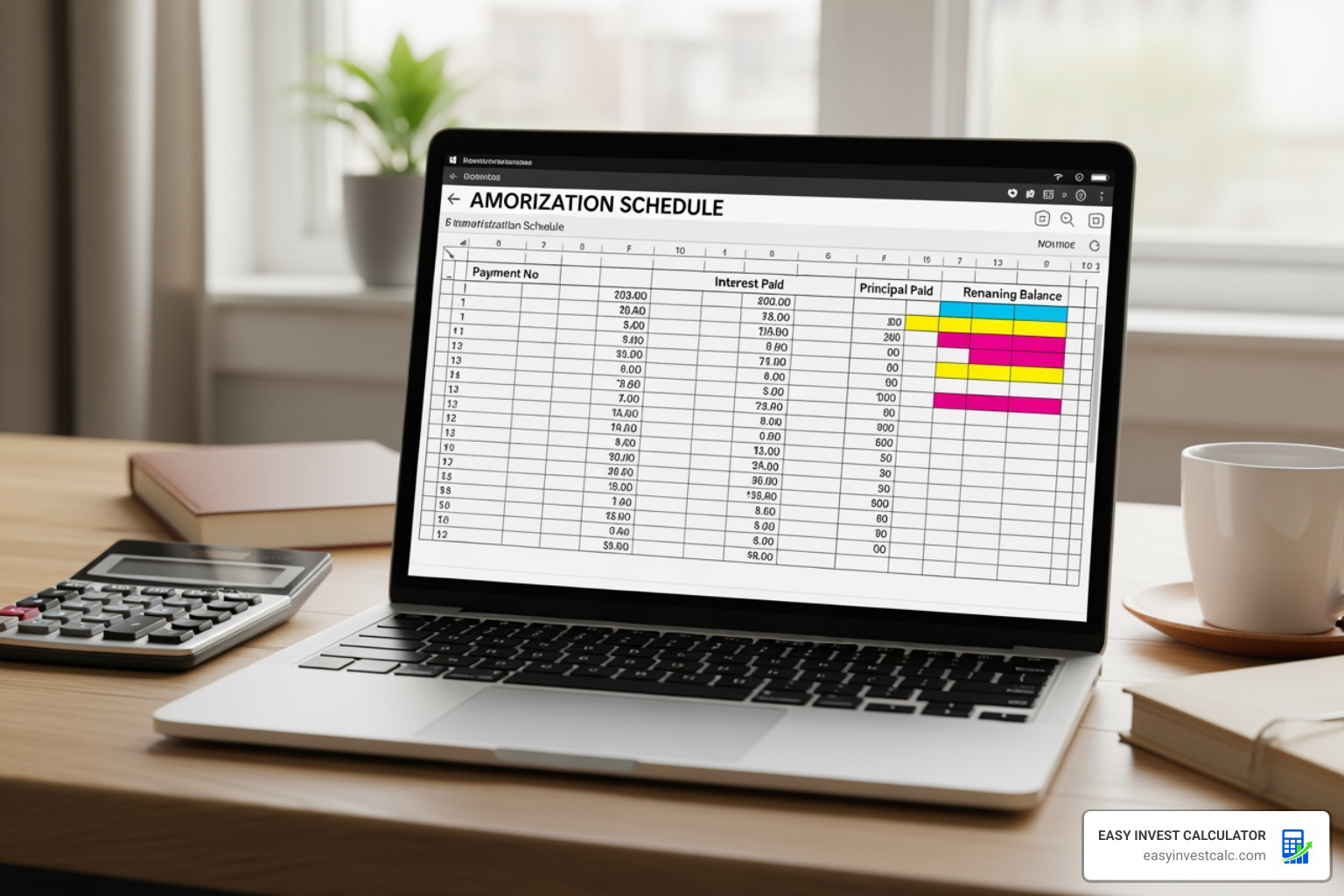
Why an Amortization Schedule with Extra Payments Can Save You Thousands
An amortization schedule with extra payments is one of the most powerful — and most overlooked — tools for cutting the true cost of a loan.
Quick answer: Making extra payments on a loan reduces your principal balance faster. Less principal means less interest charged each month. That saves you money and shortens your payoff date.
Here’s what extra payments can do on common loan scenarios:
| Extra Monthly Payment | Loan Amount | Rate | Interest Saved | Time Saved |
|---|---|---|---|---|
| $50/month | $250,000 | 5% | $21,298 | 2 years 4 months |
| $200/month | $405,000 | 6.625% | $115,823 | ~5.5 years |
| $300/month | $300,000 | 5% | $91,740 | 9 years |
Even small extra payments compound into massive savings over time.
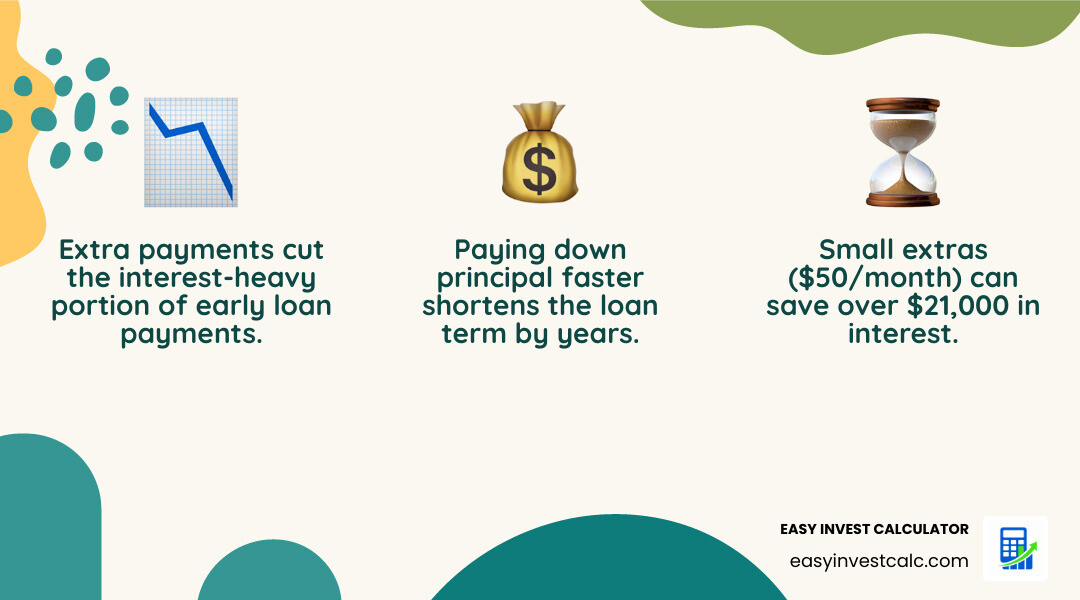
Here’s the thing most people miss: your standard monthly payment is split between interest and principal — and in the early years of a 30-year mortgage, the vast majority goes to interest, not to actually paying down what you owe. That means you can spend years making payments and barely denting the balance.
Extra payments change that math in your favor. By knocking down the principal faster, you reduce the base that interest is calculated on — every single month going forward.
Whether you have a mortgage, car loan, or personal loan, understanding how to read and use an amortization schedule with extra payments is a straightforward way to save real money without refinancing or changing your lifestyle dramatically.
Mastering Your Amortization Schedule with Extra Payments

To master your debt, we first need to pull back the curtain on how banks actually calculate your payments. Most consumer debt—like mortgages, auto loans, and personal loans—uses a “fixed-rate” amortization structure. This means your total monthly payment stays the same, but the internal “ingredients” of that payment change every single month.
When you look at a standard schedule, you’ll see three main columns:
- Interest: The fee the bank charges you for borrowing the money.
- Principal: The actual money you borrowed.
- Ending Balance: What you still owe after the payment is made.
In the beginning, your balance is at its highest. Since interest is calculated as a percentage of that balance, the interest portion of your payment is huge. As you slowly chip away at the principal, the interest charge drops, allowing more of your fixed payment to go toward the principal. It’s a slow-motion snowball effect.
By using an amortization schedule with extra payments, you are essentially “hacking” this snowball. Instead of waiting for the bank’s schedule to slowly tilt in your favor, you force the balance down manually. If you want to see how your current loan stacks up, our EMI Calculator is a great place to start visualizing these numbers.
How an Amortization Schedule with Extra Payments Reduces Interest
The math behind interest savings is surprisingly simple but incredibly impactful. In a standard loan, interest is calculated periodically (usually monthly) based on the remaining principal.
For example, on a $300,000 mortgage at 7%, your first month’s interest is roughly $1,750. If your total payment is $1,996, only $246 actually goes toward your debt. But if you throw an extra $500 at the principal in Month 1, the bank calculates next month’s interest on a smaller number.
This creates a compounding savings effect. That one-time extra $500 doesn’t just save you interest this month; it reduces the interest charged every single month for the remainder of the loan term. It’s like a gift to your future self that keeps on giving. For those interested in the tax side of things, the IRS guidelines on mortgage interest provide details on how these interest payments (and potential deductions) work, though reducing the interest you pay overall is usually the superior financial move.
The Mechanics of Principal-Only Payments
When we talk about extra payments, we are specifically talking about principal-only payments. If you just send an extra check to your bank without instructions, some lenders might treat it as an “early payment” for next month. This doesn’t save you a dime in interest; it just moves your due date.
To truly benefit from an amortization schedule with extra payments, you must ensure the funds are applied to the principal balance.
- Lender Communication: Most modern online banking portals have a specific checkbox for “Principal Only.” If you’re mailing a check, write your loan number and “Apply to Principal” on the memo line.
- Equity Building: Every dollar sent to principal is a dollar of equity you now own in your home or asset. This builds your net worth much faster than a standard savings account might. Speaking of long-term savings, you can compare the growth of your equity to other instruments using our PPF Calculator.
Strategic Methods for Accelerating Loan Payoff

There is no “one size fits all” way to pay off a loan early. The best strategy is the one you can stick to consistently. We’ve found that borrowers usually find success with one of four main methods.
Visualizing Your Amortization Schedule with Extra Payments
- The Monthly Extra: Adding a set amount (like $50 or $100) to every single payment. This is the “set it and forget it” method.
- The Round-Up Method: If your payment is $1,918, you pay $2,000. It’s a small psychological trick that adds up to significant interest savings over 30 years.
- The Bi-Weekly Strategy: Instead of one monthly payment, you pay half every two weeks. Because there are 52 weeks in a year, you end up making 26 half-payments—which equals 13 full monthly payments. This “13th payment” strategy can shave 4 to 8 years off a 30-year mortgage without you ever feeling like you’re paying “extra.”
- The Annual Extra: Using a tax refund or a work bonus to make one large payment per year.
To see how these extra funds compare to traditional savings, check out our FD Calculator to see what that same money would do in a fixed deposit.
Timing: Why Early Payments Matter Most
Here is a “secret sauce” insight: Timing is everything. An extra $1,000 paid in the first year of a mortgage is worth significantly more than $1,000 paid in year 25.
Why? Because that early payment stops interest from accruing on that $1,000 for the next 29 years. In fact, on a 7% mortgage, a single $1,000 extra payment made in Year 1 can save you roughly $6,600 in total interest over the life of the loan.
If you have a lump sum from an inheritance or a bonus, don’t wait. Applying it early maximizes the “interest-killing” power of your money. You can model these one-time injections using our Lumpsum Calculator to see the potential growth or savings. For those planning for retirement and looking to balance loan payoff with income, our SWP Calculator can help you visualize a systematic withdrawal plan.
Quantifying the Benefits: Interest and Time Savings
Let’s look at the cold, hard numbers. The statistics are often shocking to people who have only ever looked at their “minimum payment due.”
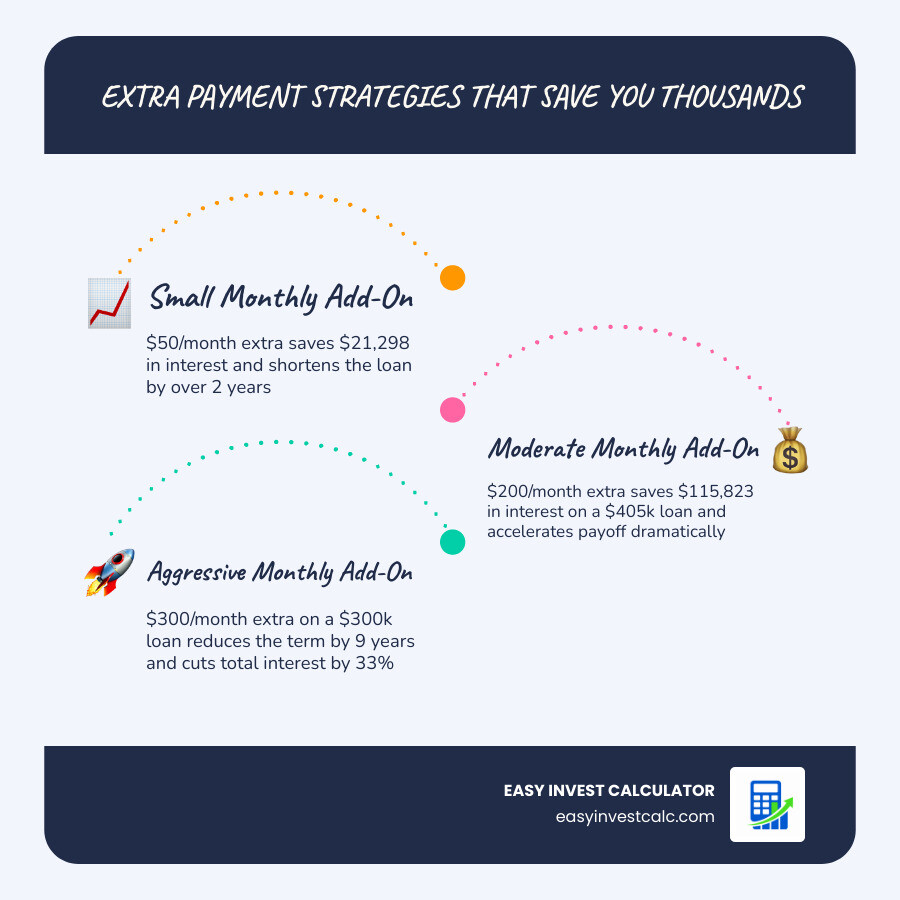
- The Small Effort: On a $250,000 mortgage at 5%, a tiny extra payment of just $50 a month saves you $21,298 in interest and buys you back 2 years and 4 months of your life.
- The Moderate Effort: On a $405,000 loan at 6.625%, adding $200 a month saves a staggering $115,823. That is enough to buy a luxury car, put a child through college, or significantly pad a retirement fund.
- The Aggressive Effort: On a $300,000 loan at 5%, adding $300 a month reduces your term by 9 years. You could be debt-free in 21 years instead of 30.
These aren’t just numbers; they represent freedom. To see how these savings could be redirected into an investment portfolio, explore our SIP Calculator.
Real-World Impact on a $300,000 Mortgage
Let’s dive deeper into that $300,000 mortgage example. Without extra payments, a 30-year loan at 5% will cost you $279,767 in interest alone. You are almost paying for the house twice!
By following an amortization schedule with extra payments and adding $300 monthly, your total interest drops to $188,026. That’s a 33% reduction in the “cost of borrowing.” Instead of the bank keeping that $91,740, you keep it.
This strategy is often more effective for long-term wealth than many conservative investment options. For instance, you can compare these savings to retirement projections using the NPS Calculator.
Comparing 15-Year vs. 30-Year Amortization
Many borrowers ask us if they should just sign up for a 15-year mortgage from the start.
- Pros of 15-year: Lower interest rates (usually 0.25% to 1% lower) and a forced path to debt freedom.
- Pros of 30-year + Extra Payments: Flexibility. If you have a bad month or lose your job, your “required” payment is lower. In good months, you can pay it like a 15-year loan.
A $300,000 loan at 6.5% on a 15-year term saves you over $212,000 in interest compared to a 30-year term, but it increases your monthly bill by about $717. If that jump is too scary, the 30-year loan with an amortization schedule with extra payments gives you the best of both worlds. For more on the psychology of loan terms, the Consumer Financial Protection Bureau has excellent research on how term lengths affect borrower behavior.
Key Considerations and Potential Drawbacks
Before you start throwing every spare penny at your mortgage, we need to talk about the “fine print.” While paying off debt is generally great, there are three things you must check first.
- Prepayment Penalties: Some loans (though rarely modern standard mortgages) charge a fee if you pay them off too early. This is common in some auto loans or “subprime” mortgages. Always check your contract. Usually, these penalties only apply in the first 3–5 years.
- Opportunity Cost: If your mortgage rate is 3% and you can earn 7% in the stock market, math suggests you should invest the money instead. However, the “peace of mind” of a paid-off home is a return that doesn’t show up on a spreadsheet.
- Liquidity: Once you give that money to the bank, you can’t get it back easily. Ensure you have an emergency fund first. You can use our Income Tax Calculator to see how much of your take-home pay is actually available for these strategies.
Evaluating Investment Alternatives
We always recommend a “hierarchy of debt.”
- Step 1: Pay off high-interest credit cards (usually 20%+ interest).
- Step 2: Build a 3-6 month emergency fund.
- Step 3: Maximize any employer-matching retirement contributions.
- Step 4: Use an amortization schedule with extra payments to attack your mortgage or student loans.
If you’re worried about prepayment penalties, the Consumer Financial Protection Bureau provides a clear guide on what is and isn’t allowed under current regulations.
Frequently Asked Questions about Amortization
How do extra payments affect my loan payoff date?
Extra payments go directly toward the principal. Since the loan “ends” when the principal reaches zero, every extra dollar you pay brings that zero-balance date closer. Even a small recurring payment can shave years off a long-term loan.
Can I make extra payments on any type of loan?
Most fixed-rate loans (mortgages, car loans, personal loans) allow for extra payments. However, revolving debt like credit cards doesn’t use a fixed amortization schedule, so the math works differently there. Always verify with your lender that there are no prepayment penalties.
Is it better to pay extra monthly or in one lump sum?
Mathematically, the earlier you make the payment, the more you save. A lump sum at the beginning of the year is slightly better than spreading that same amount over 12 months, because you stop the interest from accruing sooner. However, the “best” method is whichever one you can afford to do consistently.
Conclusion
At EasyInvestCalc, we believe that financial freedom shouldn’t be a mystery. Understanding your amortization schedule with extra payments is the closest thing to a “cheat code” in personal finance. By simply adding a little extra to your principal each month, you can reclaim years of your life and tens of thousands of dollars from the banks.
Our mission is to provide you with the fast, accurate, and user-friendly tools you need to make these decisions with confidence. Whether you’re calculating your next move with our EMI Calculator or planning for a long-term goal, we’re here to make financial planning effortless.
Ready to see your own path to debt freedom? Plug your numbers into our tools today and watch how quickly those extra payments turn into massive savings. Your future, debt-free self will thank you.

Founder of EasyInvestCalc.com with 8+ years of experience in personal finance. Sunita simplifies complex financial mathematics—from SIP compounding to tax planning—empowering Indian investors to make smart, debt-free decisions based on real market mechanics.