
A 10 year home equity loan payment calculator gives you an instant snapshot of what you’ll owe each month — before you ever talk to a lender.
Quick answer: Here’s what you can expect on a 10-year home equity loan:
| Loan Amount | Interest Rate | Est. Monthly Payment | Total Interest Paid |
|---|---|---|---|
| $50,000 | 7.5% | ~$594 | ~$21,300 |
| $50,000 | 8.5% | ~$620 | ~$24,420 |
| $100,000 | 7.5% | ~$1,185 | ~$42,200 |
| $100,000 | 8.5% | ~$1,241 | ~$48,920 |
Estimates only. Your rate depends on credit score, lender, and equity.
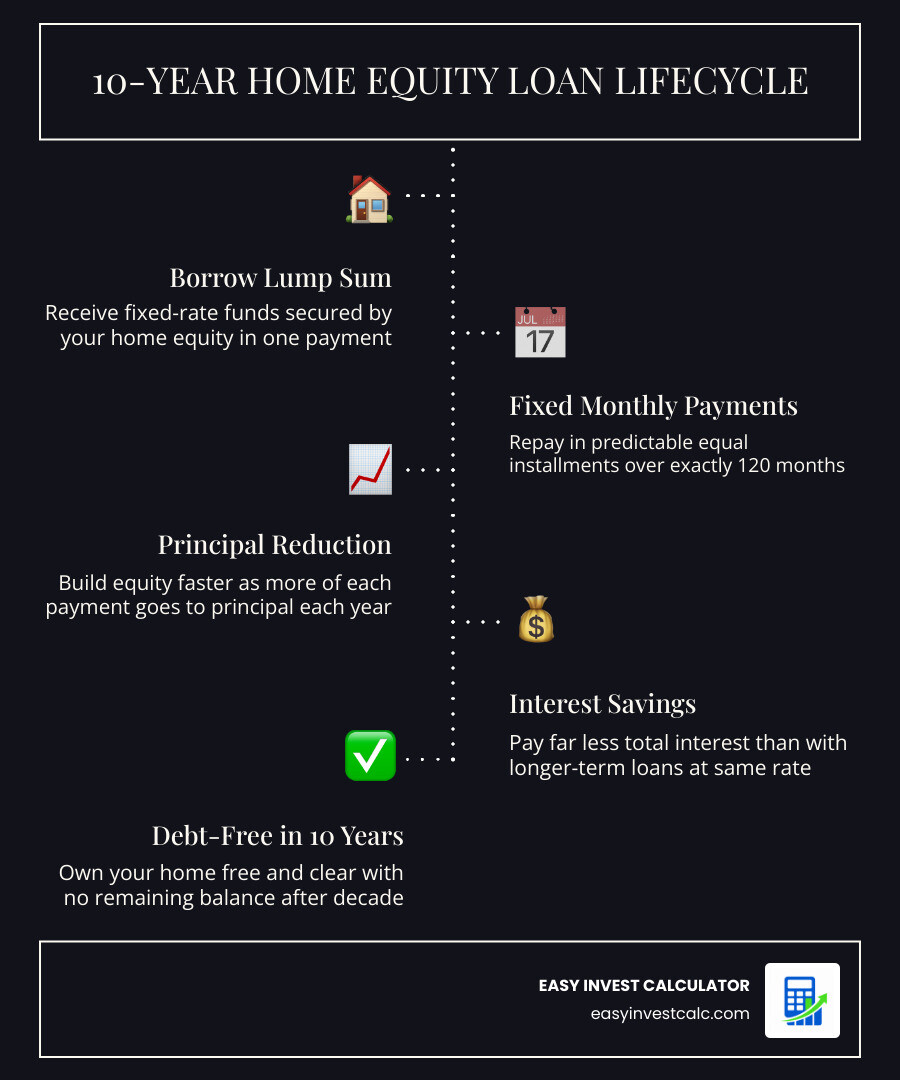
Here’s the thing: a 10-year home equity loan is a fixed-rate, lump-sum loan secured by your home. You borrow once, repay in equal monthly installments, and you’re done in a decade. No variable rates. No surprises.
That predictability is a big deal if you’re juggling a career, a family, and long-term retirement plans.
Compared to a 15- or 30-year loan, the 10-year term means higher monthly payments but far less interest paid overall. A $100,000 loan at 7.5% costs roughly $42,200 in interest over 10 years — versus significantly more stretched over 20 or 30 years.
The calculator makes that tradeoff visible in seconds.
10 year home equity loan payment calculator terms to remember:
- amortization schedule calculator
- amortization schedule with extra payments
- bank loan repayment calculator
Understanding the 10 Year Home Equity Loan Payment Calculator
When we talk about a 10-year home equity loan, we are looking at a powerful financial instrument often called a “second mortgage.” Unlike your primary mortgage, which likely spans 30 years, this loan is designed for a “sprint” toward debt-free status. By using a 10 year home equity loan payment calculator, you are essentially planning a decade-long journey where every payment brings you closer to owning your home outright again.
The mechanics are straightforward: you receive a lump sum of cash upfront. This could be for a kitchen remodel, consolidating high-interest credit card debt, or paying for a child’s college tuition. Because the loan is secured by your home, the interest rates are typically much lower than what you’d find with personal loans or credit cards. At EasyInvestCalc, we believe that Calculating Your Way to Financial Freedom Today starts with understanding these fixed monthly installments.
Unlike a credit card, where the “minimum payment” can keep you in debt for decades, a 10-year home equity loan is fully amortized. This means your monthly check covers both the interest and a portion of the principal. By the end of month 120, your balance is exactly zero. To see how this compares to other installment debts, you might want to check out our EMI Calculator for a broader perspective on monthly obligations.
How to Use a 10 Year Home Equity Loan Payment Calculator
Using our 10 year home equity loan payment calculator isn’t rocket science, but getting the inputs right is the key to an accurate projection. To get started, you’ll need four main pieces of information:
- The Loan Amount: This is the total cash you need. Lenders usually limit this based on your home’s value (more on that later).
- The Interest Rate: As of May 2026, rates are influenced by the broader economy. A 1% difference might not seem like much, but on a $100,000 loan, it can change your payment by $50 to $60 every single month.
- The Loan Term: In this case, you’ll set this to 10 years (or 120 months).
- The Start Date: This helps the calculator generate a precise amortization schedule, showing you exactly when that final payment will happen.
Once you hit “calculate,” the tool doesn’t just give you a single number. It reveals the “soul” of the loan: the amortization schedule. This table breaks down how much of your $1,200 payment is going to the bank (interest) and how much is staying in your pocket (principal/equity). Understanding this math is what keeps You Away From Your Dream Home Loan pitfalls and moves you toward smart equity management.
Comparing 10-Year Terms to HELOCs and Longer Loans
One of the biggest questions we get is: “Why a 10-year loan instead of a HELOC?” A Home Equity Line of Credit (HELOC) is like a credit card for your house. It has a “draw period” (usually 10 years) where you might only pay interest. But once that period ends, you hit the “repayment period,” and your payments can skyrocket. Plus, HELOCs usually have variable rates, meaning your payment could go up if the Federal Reserve raises rates.
In contrast, a 10-year home equity loan is stable. You lock in your rate on day one. Here is how the 10-year term stacks up against other common options:
| Feature | 10-Year Loan | HELOC (30-Year Total) | 20-Year Loan |
|---|---|---|---|
| Interest Rate | Fixed | Variable | Fixed |
| Payment Type | Principal & Interest | Interest-Only (Draw) | Principal & Interest |
| Total Interest | Lowest | Varies (often higher) | Moderate |
| Monthly Payment | Higher | Lower (initially) | Lower |
| Predictability | High | Low | High |
If you are the type of person who likes to know exactly what your budget looks like for the next decade, the 10-year fixed option is often the winner. While shorter terms like 5 years exist, they often come with “sticker shock” monthly payments that can strain a standard household budget.
Calculating Your Borrowing Power and Costs
Before you get too excited about that $150,000 renovation, we need to talk about “Borrowing Power.” Lenders don’t just look at how much you want; they look at how much your home is worth and how much you already owe. This is where the Loan-to-Value (LTV) and Combined Loan-to-Value (CLTV) ratios come into play.

Most lenders are conservative. They typically want your total debt (primary mortgage + new home equity loan) to be no more than 80% to 85% of your home’s appraised value. For example, if your home is worth $500,000, 80% is $400,000. If you still owe $230,000 on your first mortgage, your maximum borrowing power is $170,000 ($400,000 – $230,000).
Using a tool like our Mortgage With Bankrate Amortization Calculator can help you visualize how your primary mortgage balance decreases over time, which in turn increases the amount of equity you can tap into for a 10-year loan.
Factoring in Closing Costs and APR
Don’t let the “sticker price” interest rate fool you. Like any mortgage, a home equity loan comes with closing costs. These typically range from 2% to 5% of the loan amount. You might see charges for:
- Home appraisal (to prove what the house is worth)
- Loan origination fees
- Title search and insurance
- Credit report fees
This is why the Annual Percentage Rate (APR) is so important. While the interest rate tells you the cost of borrowing the money, the APR includes the interest plus those closing costs. If you roll your closing costs into the loan instead of paying them upfront, your 10 year home equity loan payment calculator result will show a slightly higher monthly payment because you are essentially borrowing the money to pay for the loan itself.
For those planning their yearly finances, it’s also wise to use an Income Tax Calculator to see how your overall net income supports these new costs.
Impact of Credit Scores on Your 10 Year Home Equity Loan Payment Calculator Results
Your credit score is the gatekeeper of your interest rate. In home equity, “Good” is okay, but “Exceptional” saves you thousands. Generally, credit tiers look like this:
- 740 – 850 (Exceptional/Very Good): You’ll qualify for the lowest advertised rates.
- 670 – 739 (Good): You’ll qualify, but your rate might be 0.5% to 1% higher.
- 620 – 669 (Fair): You may need to shop around, and rates will be significantly higher.
- Below 620: It becomes very difficult to secure a home equity loan.
Lenders also look at your Debt-to-Income (DTI) ratio. They want to see that your total monthly debt payments (including the new 10-year loan) don’t exceed 43% to 45% of your gross monthly income. If you’re a business owner, this can be trickier, which is where our Mind Your Own Business Loan EMI Calculator can help you separate personal and business debt obligations.
Mastering the Amortization Schedule
The amortization schedule is your roadmap. In a 10-year loan, the early years are “interest-heavy.” Because the interest is calculated based on your remaining balance, and your balance is highest at the start, a larger chunk of your early payments goes to the lender.
However, because the term is only 10 years, you’ll notice that you start “eating” into the principal much faster than you would with a 30-year mortgage. By year five, you are usually paying more toward principal than interest. This rapid equity growth is one of the primary reasons homeowners choose the 10-year path. It’s a similar concept to what you see in The Ultimate Guide to Car Loan Amortization and Monthly Payments, just on a much larger scale with your most valuable asset.
The Power of Extra Payments
One of the “secret weapons” of a 10-year loan is the ability to pay it off even faster. Most home equity loans do not have prepayment penalties (though you should always check the fine print!).
Let’s look at a $100,000 loan at 7.5%. Your standard payment is about $1,185.
- Standard Payoff: 10 years, ~$42,200 total interest.
- Add $200/month: You’ll pay off the loan in roughly 7.5 years and save nearly $10,000 in interest.
That $200 extra monthly “investment” yields a guaranteed return equal to your interest rate. If you’re also managing a rental property, you can use our tools to Calculate Your Rental Yield and Mortgage to see if it makes more sense to put extra cash toward your home equity loan or a different investment.
Tax Implications and Qualification Requirements
We have to talk about the IRS. Since the Tax Cuts and Jobs Act (TCJA) of 2017, the rules for deducting home equity interest have tightened significantly.
The Golden Rule: You can generally only deduct the interest on a home equity loan if the money is used to “buy, build, or substantially improve” the home that secures the loan.
- Deductible: Adding a bedroom, replacing a roof, or remodeling a kitchen.
- NOT Deductible: Paying off credit cards, buying a car, or funding a vacation.
Even if you use the money for home improvements, there are limits. The total amount of mortgage debt (first mortgage + home equity) cannot exceed $750,000 for married couples filing jointly. Always keep your receipts! If you are ever audited, you’ll need to prove that every dollar of that 10-year loan went into the sticks and bricks of your house.

Frequently Asked Questions about 10-Year Equity Loans
Is a 10-year home equity loan better than a 15-year loan?
“Better” depends on your goal. If your goal is to pay the least amount of interest possible and be debt-free quickly, the 10-year loan is superior. However, the monthly payment on a 10-year loan will be significantly higher than a 15-year loan.
For example, on a $50,000 loan at 8%:
- 10-Year Payment: ~$607/month
- 15-Year Payment: ~$478/month
If that extra $129 a month makes your budget too tight, the 15-year loan provides more “breathing room.” You can always use The Only Bond Repayment Calculator Guide You Need to understand how different debt instruments handle interest over time.
Can I get a home equity loan with a 620 credit score?
It is possible, but it’s a steep climb. A 620 score is often the “floor” for many lenders. If you are approved, expect to pay a much higher interest rate — perhaps 10% or 11% in the current May 2026 market. You may also be limited to a lower LTV, perhaps only being allowed to borrow up to 70% of your home’s value. If your score is 620, it might be worth taking six months to pay down credit cards and boost your score before applying to save yourself thousands in the long run.
Is the interest on a 10-year home equity loan tax-deductible?
As mentioned, yes — but only if the funds are used for substantial home improvements. If you use the loan to consolidate debt or pay for a wedding, the interest is not deductible under current May 2026 tax laws. Always consult with a tax professional, as individual circumstances and state-specific laws can vary.
Conclusion
A 10 year home equity loan payment calculator is more than just a math tool; it’s a clarity tool. It takes the “maybe” out of your financial planning and replaces it with “exactly.” By choosing a 10-year term, you are making a conscious decision to prioritize long-term savings and equity growth over short-term cash flow.
At EasyInvestCalc, we want to empower you with the data you need to make these big moves. Whether you’re consolidating debt to simplify your life or finally building that dream deck, knowing your numbers is the first step. Don’t Let the Math Scare You Away From Your Dream Home or your dream financial future.
Ready to see the impact for yourself? Head over to our EMI Calculator and start running the numbers. Your future, debt-free self will thank you.

Founder of EasyInvestCalc.com with 8+ years of experience in personal finance. Sunita simplifies complex financial mathematics—from SIP compounding to tax planning—empowering Indian investors to make smart, debt-free decisions based on real market mechanics.