

A basic mortgage calculator is one of the fastest ways to estimate what you’ll pay each month on a home loan. Before diving deeper, here’s a quick answer:
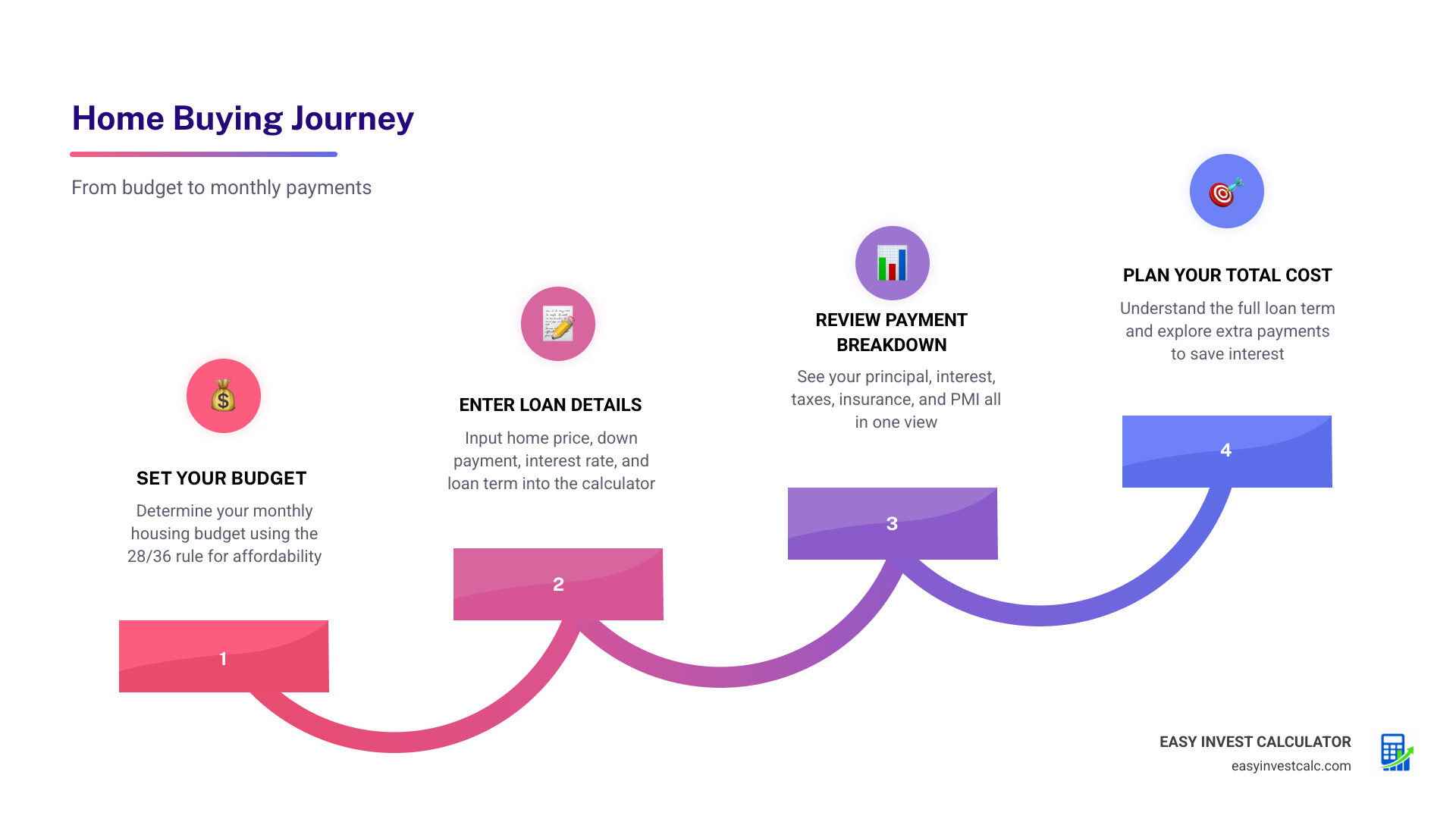
How to use a basic mortgage calculator:
- Enter the loan amount — the home price minus your down payment
- Enter the interest rate — use the current average (6.58% as of May 2026 for a 30-year fixed)
- Enter the loan term — typically 15 or 30 years
- Hit calculate — get your estimated monthly principal and interest payment
Quick example: A $100,000 loan at 6% over 30 years produces a monthly payment of just under $600 in principal and interest.
Buying a home is likely the biggest financial decision you’ll make. Yet most people start the process without a clear picture of what they’ll actually owe each month.
That gap between excitement and financial reality is exactly where a mortgage calculator earns its keep.
The monthly payment you see isn’t just principal and interest. Property taxes, homeowners insurance, and possibly private mortgage insurance (PMI) all stack on top. For busy professionals trying to plan for retirement and homeownership at the same time, missing those extra costs can throw off an entire financial plan.
The good news? Once you understand the inputs, running the numbers takes less than two minutes.
Quick basic mortgage calculator definitions:
- amortization schedule calculator
- bank loan repayment calculator
- amortization calculator with extra payments
How a Basic Mortgage Calculator Works
At its core, a basic mortgage calculator is a digital math whiz that takes your loan details and spits out a monthly obligation. It works by taking the total amount you intend to borrow and spreading both the repayment of that “principal” and the “interest” (the bank’s fee for letting you use their money) over a set period of time.
When you use our tool, you are essentially performing a “loan estimation.” Most people think of their mortgage as one big chunk of debt, but the calculator breaks it down into bite-sized monthly pieces. This process is vital for anyone trying to Calculate Your Rental Yield and Mortgage Repayments Like a Pro or simply trying to figure out if they can afford that extra bedroom for a home office.
At EasyInvestCalc Mortgage Solutions, we believe that financial planning shouldn’t feel like a root canal. Our tools are designed to be fast, accurate, and—dare we say—a little bit of fun to use. By adjusting a few sliders, you can see how a slightly higher down payment might save you thousands in interest over the life of the loan.
Essential Inputs for a Basic Mortgage Calculator
To get an accurate result, you need to feed the calculator the right “ingredients.” If you put in “guesstimates,” you’ll get a “guesstimated” payment, which isn’t helpful when you’re signing a 30-year contract. Here are the five essential inputs:
- Home Price: This is the total purchase price of the property.
- Down Payment: This is the cash you pay upfront. It is usually expressed as a percentage (like 20%) or a flat dollar amount.
- Interest Rate: This is the annual percentage rate (APR) charged by the lender. As of May 2026, the average for a 30-year fixed rate is hovering around 6.58%.
- Loan Term: How many years do you have to pay it back? 30 years is the standard, but 15 years is popular for those who want to be debt-free faster.
- ZIP Code: While it seems intrusive, your location determines your property tax rates and insurance premiums.
Entering these correctly allows you to Calculate Your Rental Yield and Mortgage with precision, ensuring your budget remains intact.
The Standard Amortization Formula
If you want to impress your friends at a dinner party (or perhaps just understand the “why” behind the numbers), the calculator uses a standard amortization formula:
M = P [ i(1 + i)^n ] / [ (1 + i)^n – 1 ]
Wait! Don’t run away. Here is what those letters mean:
- M: Your total monthly payment.
- P: The principal loan amount (the amount you borrowed).
- i: Your monthly interest rate (annual rate divided by 12).
- n: The total number of months in your loan term (e.g., 360 months for a 30-year loan).
This formula ensures that your loan balance hits zero exactly at the end of your term. In the beginning, most of your payment goes toward interest. Toward the end, most of it goes toward principal.
| Feature | 15-Year Fixed Mortgage | 30-Year Fixed Mortgage |
|---|---|---|
| Monthly Payment | Higher | Lower |
| Interest Rate | Typically Lower | Typically Higher |
| Total Interest Paid | Significantly Lower | Significantly Higher |
| Equity Build-up | Fast | Slow |
Understanding Your Monthly Payment Components
When you see the final number on a basic mortgage calculator, it is often referred to as PITI. This stands for Principal, Interest, Taxes, and Insurance.
Most lenders require you to set up an escrow account. This is essentially a side-savings account managed by the bank. Every month, you pay a portion of your annual property taxes and homeowners insurance into this account, and the bank pays those bills for you when they come due. It’s a great way to ensure you aren’t hit with a massive $4,000 tax bill in November that you forgot to save for.
Property taxes are a significant factor. On average, Americans pay about 1.1% of their property’s value in taxes each year. Homeowners insurance is also a must-have, protecting you against fire, theft, and natural disasters. We often say, Don’t Let the Math Scare You Away from Your Dream Home Loan; once you break it down into these four categories, it becomes much more manageable.
Beyond Principal and Interest in a Basic Mortgage Calculator
If you think PITI covers everything, think again! There are a few “hidden” guests that might crash your mortgage party:
- Private Mortgage Insurance (PMI): If your down payment is less than 20%, lenders view you as a higher risk. To protect themselves, they charge you PMI. This typically costs between 0.3% and 1.9% of the loan amount annually.
- HOA Fees: If you’re buying a condo or a home in a planned community, you’ll likely have Homeowners Association fees. These cover amenities like pools, landscaping, or snow removal.
- Annual Assessments: Sometimes local governments or HOAs charge one-time fees for major repairs (like repaving the street).
Mastering Your Mortgage with the EasyInvestCalc Amortization Calculator helps you account for these extras so you aren’t surprised by a monthly bill that is $300 higher than you expected.
Factors That Influence Your Mortgage Costs

Your mortgage payment isn’t just a result of the home’s price; it’s a reflection of your financial health and the current market.
One of the biggest influencers is your credit score. A high score tells the bank you are a reliable borrower, which earns you a lower interest rate. Even a 0.5% difference in your rate can change your buying power by $20,000!
Another key factor is the Loan-to-Value (LTV) ratio. This is the amount you owe compared to what the house is worth. Lenders love to see an LTV of 80% or lower (which means a 20% down payment).
To stay financially healthy, we recommend following the 28/36 rule. This guideline suggests that your housing costs should not exceed 28% of your gross monthly income, and your total debt (including car loans and credit cards) should stay under 36%. This keeps your debt-to-income ratio in a range that lenders find “safe.” For more on how to manage these ratios, check out You Away from Your Dream Home Loan.
Impact of Down Payments and Interest Rates
The tug-of-war between your down payment and the interest rate determines your long-term wealth.
A larger down payment does three things:
- Builds Instant Equity: You own more of the home from day one.
- Lowers Monthly Payments: You are borrowing less money.
- Eliminates PMI: If you hit that 20% threshold, you save hundreds every month.
On the flip side, the APR (Annual Percentage Rate) includes the interest rate plus any lender fees and closing costs (which usually range from 3% to 5% of the loan amount). Understanding these nuances is a core part of The 50-Year Mortgage Survival Guide. While a 50-year mortgage isn’t common, the principles of long-term debt management remain the same: the more you pay upfront, the less you pay over time.
Strategies to Lower Your Monthly Payments
If the number on the basic mortgage calculator looks a bit too high for comfort, don’t panic. You have several levers you can pull to bring that payment down:
- Refinancing: If interest rates drop in the future, you can replace your current loan with a new one at a lower rate.
- Extra Principal Payments: Even adding an extra $100 a month to your payment can shave years off your loan and save you tens of thousands in interest.
- Biweekly Payments: Instead of one monthly payment, pay half every two weeks. Because there are 52 weeks in a year, you’ll end up making 13 full payments instead of 12.
For those looking for extreme flexibility, The 50-Year Mortgage Calculator can show you how different terms affect your cash flow.
Ways to reduce total interest:
- Increase your down payment to at least 20%.
- Choose a 15-year term instead of 30.
- Pay “points” at closing to buy down your interest rate.
- Maintain a credit score above 740 for the best rates.
Comparing Loan Scenarios with a Basic Mortgage Calculator
Not all mortgages are created equal. You have choices:
- Fixed-Rate Mortgage: Your interest rate stays the same for the entire life of the loan. This is great for stability.
- Adjustable-Rate Mortgage (ARM): These often start with a lower rate for the first few years (like 5 or 7 years) and then fluctuate based on market conditions.
- Loan Assumptions: In some cases, you can “assume” or take over the seller’s existing mortgage. This is a gold mine if the seller has a 3% rate from years ago!
- Points: You can pay the lender extra money upfront (discount points) to lower your interest rate for the life of the loan.
Mortgage Planning with the EasyInvestCalc Amortization Tool allows you to run these “what-if” scenarios side-by-side. You might find that paying $3,000 in points today saves you $15,000 over the next decade.
Frequently Asked Questions about Mortgage Calculations
What is the 28/36 rule for housing affordability?
The 28/36 rule is a classic financial guideline used by lenders to determine how much you can afford to borrow. It states that your housing costs (PITI) should not exceed 28% of your gross monthly income (your pay before taxes). Additionally, your total debt (housing costs plus car payments, student loans, and credit card minimums) should not exceed 36% of your gross income.
For example, if you and your partner make a combined $10,000 a month, your mortgage payment should ideally be $2,800 or less, and your total debt should not exceed $3,600.
When is Private Mortgage Insurance (PMI) required?
PMI is typically required on conventional loans when your down payment is less than 20% of the home’s purchase price. It’s important to remember that PMI protects the lender, not you. It ensures the bank gets paid if you default on the loan. Once you have reached 20% equity in your home (either by paying down the principal or through the home’s value increasing), you can usually request to have PMI removed.
How do extra payments affect my loan term?
Extra payments are the “secret sauce” of wealth building. When you pay more than the required monthly amount, that extra cash goes directly toward the principal balance. Because interest is calculated based on the remaining balance, reducing the principal faster means you pay less interest every month thereafter.
Using an amortization schedule, you can see that even a single extra payment per year can shorten a 30-year mortgage by 4 to 5 years. It’s one of the most effective ways to reach financial freedom early.
Conclusion
Navigating home buying can feel like wandering through a maze of numbers and acronyms. However, with a basic mortgage calculator in your toolkit, you can turn that confusion into a clear, actionable plan. At EasyInvestCalc, our mission is to provide you with the financial accuracy you need for effortless planning.
Whether you are a first-time buyer or looking to refinance, knowing your numbers is the first step toward homeownership success. Don’t leave your future to chance—use our user-friendly tools to see exactly where your money is going.
Ready to see your future monthly payment? Calculate your monthly payment now and take the first step toward your dream home.

Founder of EasyInvestCalc.com with 8+ years of experience in personal finance. Sunita simplifies complex financial mathematics—from SIP compounding to tax planning—empowering Indian investors to make smart, debt-free decisions based on real market mechanics.