

Is a ₹30 Lakh Home Loan Right for Your Budget?
The 30 lakh home loan EMI you’ll pay each month depends on three things: your interest rate, your loan tenure, and the repayment structure you choose. Here’s a quick snapshot so you can plan right away:
| Tenure | Interest Rate | Monthly EMI | Total Interest Paid |
|---|---|---|---|
| 10 years | 7.75% | ₹36,003 | ₹13,20,383 |
| 15 years | 8.40% | ₹29,367 | ~₹22,86,060 |
| 20 years | 7.75% | ₹24,628 | ₹29,10,830 |
| 25 years | 7.75% | ₹22,660 | ₹37,97,959 |
| 30 years | 7.25% | ₹20,956 | ₹45,44,123 |
Note: EMIs are approximate and vary by lender and prevailing rates.
Buying a home is one of the biggest financial decisions you’ll ever make. And if you’re like most people, the numbers — interest rates, EMIs, tenures, total repayment — can feel overwhelming fast.
But here’s the truth: the math is simpler than it looks.
Your monthly EMI is just a function of how much you borrow, for how long, and at what rate. Once you understand that, the whole picture becomes much clearer. A ₹30 lakh loan stretched over 30 years cuts your monthly payment nearly in half compared to a 10-year term — but you end up paying more than ₹32 lakh extra in interest over the life of the loan.
That trade-off is what this guide is all about. We’ll walk you through every factor that shapes your EMI, what lenders actually look for, how to save on taxes, and when it makes sense to pay off your loan early.
No jargon. No scary formulas. Just clear answers.
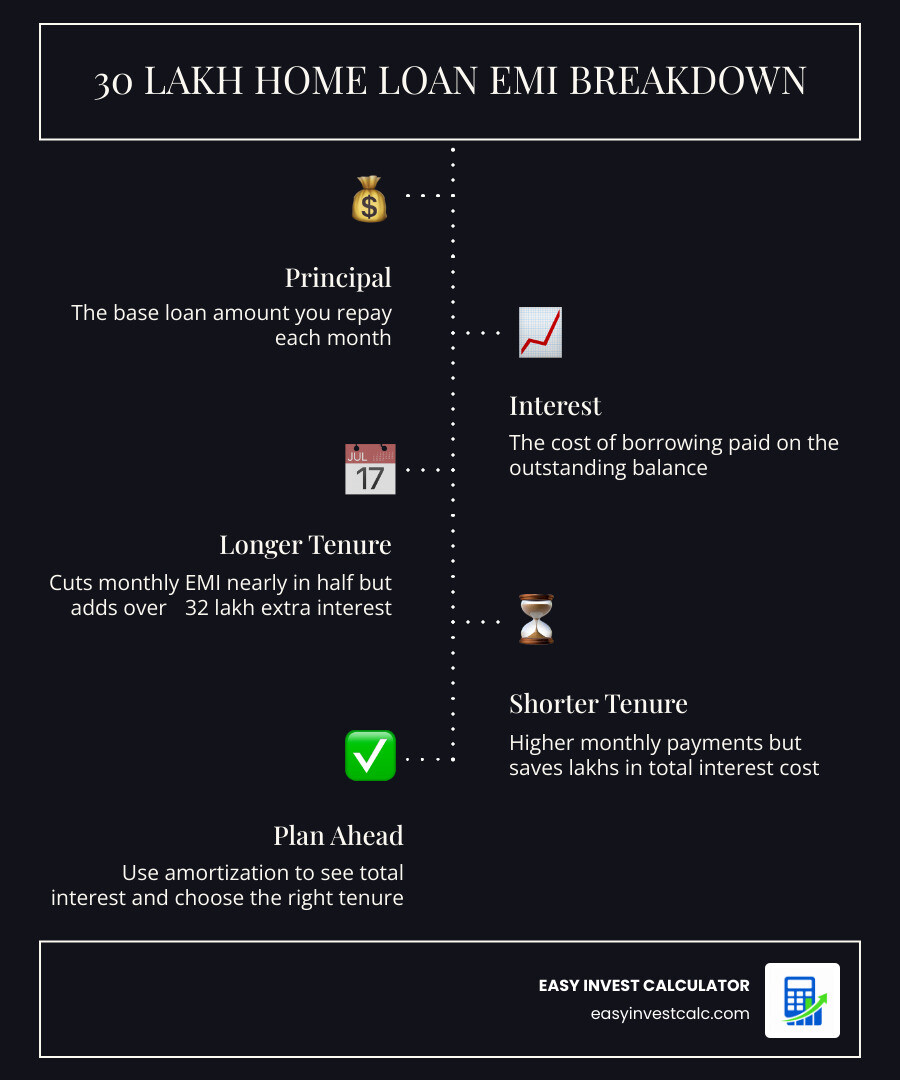
Glossary for 30 lakh home loan emi:
Understanding Your 30 Lakh Home Loan EMI Across Different Tenures
When we talk about a 30 lakh home loan emi, the word “tenure” is essentially the “time” ingredient in your financial recipe. It dictates how much room you have to breathe each month. As of May 2026, the housing market remains competitive, and choosing the right duration for your loan is the most effective way to balance your current lifestyle with your future goals.

If you opt for a shorter tenure, say 10 years, your monthly commitment is higher, but you’ll own your home outright much faster. Conversely, a 30-year tenure is the “budget-friendly” option in terms of monthly cash flow, though it comes with a significantly higher total interest cost.
To help you visualize this, let’s look at how the numbers shift across different periods using a standard interest rate:
| Tenure (Years) | Monthly EMI (at ~8.5%) | Total Interest Payable |
|---|---|---|
| 10 Years | ₹37,190 | ₹14,62,800 |
| 15 Years | ₹29,542 | ₹23,17,560 |
| 20 Years | ₹26,035 | ₹32,48,400 |
| 25 Years | ₹24,157 | ₹42,47,100 |
| 30 Years | ₹23,067 | ₹53,04,120 |
Using our EMI Calculator allows you to plug in your specific interest rate offers to see exactly how these numbers change for your unique situation.
Why Tenure Matters for a 30 Lakh Home Loan EMI
Choosing between a short-term and long-term loan isn’t just about the monthly payment; it’s about the “cost of money.” A shorter tenure significantly reduces the total interest you pay to the bank. Think of it as a “discount” you give yourself for being aggressive with your repayments.
However, we must be realistic. If a high EMI leaves you with zero savings for emergencies or daily expenses, a longer tenure might be the safer bet. You can always use a fixed rate amortization guide to understand how your balance reduces over time, ensuring you aren’t caught off guard by how much of your early payments go toward interest rather than the principal.
Calculating the Total Interest on a 30 Lakh Home Loan EMI
One of the most eye-opening parts of home financing is the amortization schedule. In the initial years of your 30 lakh home loan emi, a massive chunk of your payment goes toward interest. It’s only in the latter half of the loan that you really start “chipping away” at the ₹30 lakh principal.
For example, on a 20-year loan at 7.75%, your total interest is roughly ₹29.1 lakh—almost as much as the loan itself! By using an Amortization Schedule Calculator Principal vs Interest, you can see the month-by-month breakdown. This transparency helps you stay motivated, especially when you see that principal component finally start to climb.
Interest rates are the “price” of borrowing the money. In the current 2026 landscape, rates are influenced heavily by the RBI’s repo rate. Even a small 0.25% change in your interest rate can swing your total repayment by lakhs of rupees.
How Interest Rates and Fees Shape Your Total Repayment
To get the most accurate picture, always calculate your 30 lakh loan EMI using the most recent rates offered by your bank.
Impact of Interest Rate Fluctuations
Most Indian home loans are “floating,” meaning they move up or down with market trends. If the economy sees inflation, your EMI might increase. This is why many borrowers in May 2026 are looking at “Step-up” or “Flexipay” options that allow for lower EMIs in the beginning, which then increase as their salary grows.
Total cost of borrowing isn’t just the interest rate; it’s the sensitivity of your budget to these changes. Always ensure you have a buffer in your monthly budget to handle a potential 1-2% rate hike without losing sleep.
Hidden Costs Beyond the Monthly EMI
When planning for a ₹30 lakh loan, don’t just look at the EMI. There are several “one-time” costs that can take a bite out of your savings:
- Processing Fees: Usually 0.5% to 1% of the loan amount (around ₹15,000 to ₹30,000).
- Stamp Duty & Registration: These vary by state but are essential for legal ownership.
- Insurance Premiums: Lenders often require Home Loan Protection Plans (HLPP) to cover the loan in case of unforeseen events.
- Valuation & Legal Fees: Charges for the bank’s experts to verify the property’s worth and legal standing.
Eligibility Criteria and Essential Documentation
Getting approved for a 30 lakh home loan emi requires more than just a dream; it requires a paper trail. Lenders want to be absolutely sure you can pay them back.

Improving Your Chances for Approval
If you’re worried about eligibility, here are the levers you can pull:
- Credit Score: A score of 750+ is the gold standard. It not only gets you approved but often unlocks lower interest rates.
- Co-applicants: Adding a working spouse or parent can combine your incomes, making a ₹30 lakh loan much easier to qualify for.
- Debt-to-Income Ratio: Lenders prefer that your total EMIs (including car or personal loans) don’t exceed 40-50% of your take-home pay.
- Stability: Banks love seeing at least 2-3 years of steady employment with the same employer or in the same industry.
Smart Repayment Options for Modern Borrowers
In 2026, banks offer more than just standard loans. Look for:
- Overdraft Facilities (MaxGain): Park your surplus savings in your loan account to reduce interest while keeping the money accessible.
- Balance Transfer: If another bank offers a significantly lower rate, you can move your outstanding ₹30 lakh balance to save on interest.
- Interest-Only Periods: Useful for those buying under-construction properties where you only pay interest until possession.
Maximizing Savings with Tax Benefits and Smart Repayment
The government actually helps you pay off your home through tax incentives. Under the current tax laws:
- Section 24(b): You can claim an exemption of up to ₹2 lakh per year on the interest component.
- Section 80C: You can claim up to ₹1.5 lakh on the principal repayment (though this is shared with other investments like PPF or LIC).
To see how these benefits apply over time, check your Amortization Schedule with Extra Payments.
The Power of Extra Payments and Balance Transfers
If you get a year-end bonus or a tax refund, putting it toward your loan principal can work wonders. This is known as “prepayment.” Even one extra EMI payment per year can shave years off a 20-year tenure.
As we often say, extra payments are the secret sauce for debt freedom. By reducing the principal early, you stop the compound interest from snowballing against you.
Managing Financial Stress and Avoiding Default
Life happens. If you find yourself struggling to meet your 30 lakh home loan emi, the worst thing you can do is go silent.
- Emergency Fund: Always keep 3-6 months of EMIs in a liquid account.
- Communicate: Most banks would rather restructure your loan (extend the tenure to lower the EMI) than go through the hassle of repossession.
- Consequences: Defaulting severely damages your credit score, making it nearly impossible to get any loan for several years.
Frequently Asked Questions about 30 Lakh Home Loans
What happens if I default on my EMI payments?
A default is reported to credit bureaus like CIBIL immediately. If you miss three consecutive payments, the loan is classified as a Non-Performing Asset (NPA). The bank then has the legal right under the SARFAESI Act to issue notices and eventually repossess the property to recover their dues.
Can I switch from a floating to a fixed interest rate?
Yes, most lenders allow this for a small conversion fee (usually 0.25% to 0.5% of the outstanding principal). However, in a volatile market like May 2026, fixed rates are often set much higher than floating rates, so calculate the cost-benefit carefully.
Is it better to choose a 20-year or 30-year tenure?
It depends on your age and income. If you are in your 20s or 30s, a 30-year tenure gives you a lower 30 lakh home loan emi, which is easier on your monthly budget. However, if you are closer to retirement, a 20-year tenure ensures you are debt-free before your regular income stops.
Conclusion
Owning a home is about more than just bricks and mortar; it’s about stability and building an asset for your future. While the math of a 30 lakh home loan emi might seem daunting at first, tools like those provided by EasyInvestCalc make it effortless to plan with precision.
By choosing the right tenure, staying disciplined with repayments, and taking full advantage of tax benefits, you can turn that ₹30 lakh liability into a cherished family home. The best time to start planning your path to debt freedom is today.
Ready to see how the numbers look for your dream home? Calculate your EMI now and take the first step toward homeownership with confidence!