
An arm mortgage calculator helps you estimate your monthly payments — both during the low introductory period and after your rate resets — so you’re never caught off guard.
Quick answer for busy readers:
| What you want to know | The short answer |
|---|---|
| What is an ARM? | A home loan with a low fixed rate for 5–10 years, then a variable rate after that |
| What does a calculator show you? | Initial payment, payment after reset, worst-case payment, and how it compares to a fixed-rate loan |
| Key inputs needed | Loan amount, initial rate, index (e.g. SOFR), lender margin, rate caps, adjustment period |
| Biggest risk | Payment “shock” — your monthly cost can jump significantly after the fixed period ends |
| Who benefits most? | People who plan to move or refinance before the rate adjusts |
Here’s the problem most borrowers run into: they see the attractive low introductory rate on an adjustable-rate mortgage and focus only on that first payment. What they don’t see is what happens in year 6, 8, or 11 — when the rate resets based on market conditions.
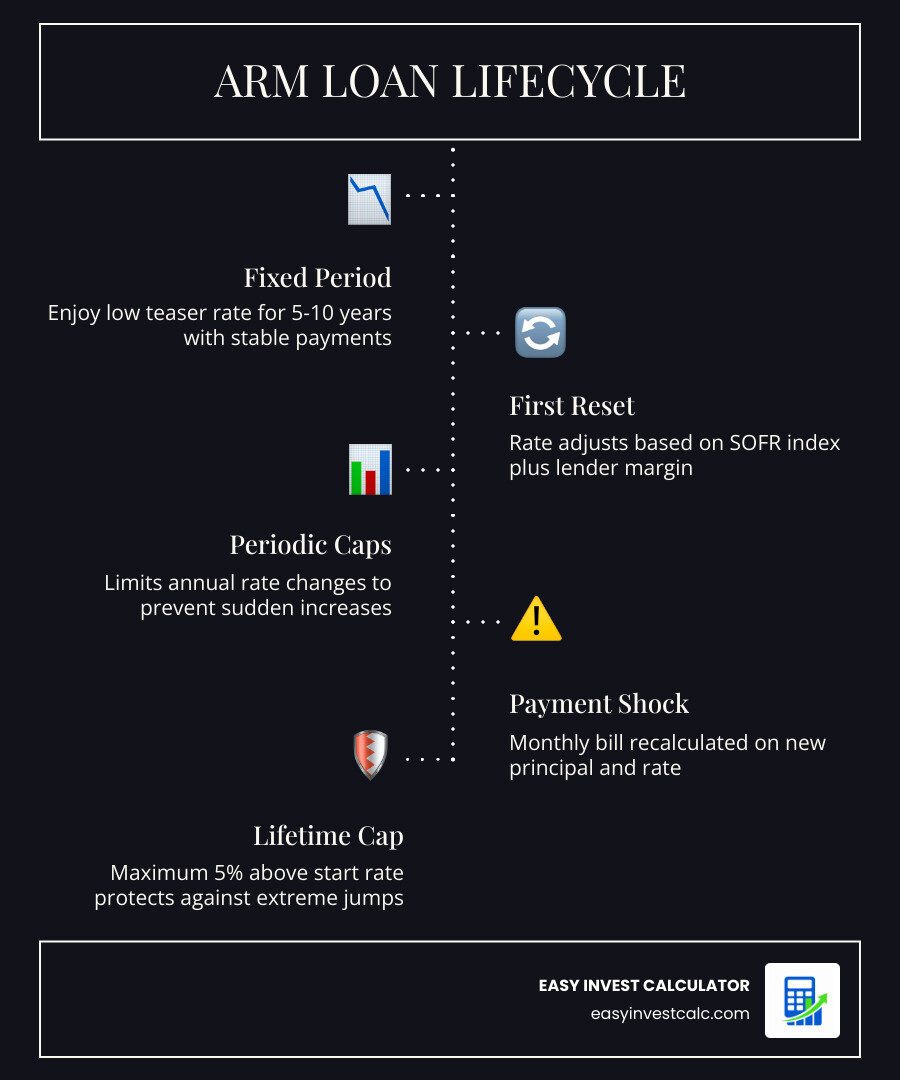
ARMs typically start with a fixed period of 5 to 10 years. After that, the rate adjusts periodically based on a market index (like SOFR) plus a lender margin. And while lifetime caps — often 5% above the starting rate — do limit how high your rate can go, a 5% jump still means a dramatically higher monthly bill.
A good ARM calculator doesn’t just show you the teaser payment. It shows you the full picture: what you owe at reset, what your payment becomes, and what the absolute worst case looks like.
That’s exactly what the Easy Invest Calculator ARM tool is built to do.
Key arm mortgage calculator vocabulary:
- amortization schedule calculator
- amortization schedule with extra payments
- bank loan repayment calculator
Understanding the Mechanics of an ARM Mortgage Calculator
When we talk about an arm mortgage calculator, we aren’t just talking about a simple math machine. We are talking about a crystal ball that helps you peer into the future of your finances. Unlike a fixed-rate mortgage where the payment is etched in stone for 30 years, an ARM is a living, breathing financial product.
To use our tool effectively, you need to understand how it processes data. The calculator takes your loan principal and your initial “teaser” interest rate to establish your starting point. However, the real magic happens when it calculates the “reset.” By looking at the adjustment frequency, the tool determines exactly when your “honeymoon period” ends and the market-based rates take over.
One of the most valuable features of our tool is the detailed amortization schedule. It doesn’t just show you a single number; it breaks down how much of your payment goes toward principal versus interest every single month. This is crucial because, in an ARM, your payment is recalculated based on the remaining balance at the time of the reset. Even if your balance is lower in year seven than it was in year one, a higher interest rate can still cause your payment to skyrocket.

If you are ready to start crunching numbers, you can learn How to Use Our ARM Mortgage Calculator for Accurate Planning to ensure you are capturing every variable.
Essential Inputs for an ARM Mortgage Calculator
To get an accurate result from an arm mortgage calculator, you need to feed it the right ingredients. Garbage in, garbage out, as the old saying goes! Here are the core components you’ll need to have ready:
- The Index: This is the benchmark interest rate that the lender uses to determine your new rate. In May 2026, the most common index is the SOFR (Secured Overnight Financing Rate), though some older loans or specific products might still use the U.S. Treasury rate.
- The Margin: This is a fixed percentage added to the index by your lender. While the index fluctuates with the economy, the margin stays the same for the life of the loan. Typically, this is between 2.5% and 3.0%.
- The Fully Indexed Rate: This is simply the Index + Margin. If the SOFR is 4% and your margin is 2%, your fully indexed rate is 6%.
Understanding these inputs allows you to see how your loan behaves compared to traditional products. For instance, you might want to try Mastering Your Mortgage with the EasyInvestCalc Amortization Calculator to see how these adjustments impact your long-term equity build-up.
Advanced Scenario Modeling with an ARM Mortgage Calculator
The true power of an arm mortgage calculator lies in its ability to model “what-if” scenarios. We always recommend that our users look at the worst-case path. This involves inputting the lifetime caps — the absolute maximum your interest rate can reach.
Most ARMs have a 5% lifetime cap. If you start at 6%, your rate can never go above 11%. While 11% sounds scary, seeing that number in your monthly budget now is much better than being surprised by it five years down the road. This phenomenon is known as “payment shock,” and it’s the number one reason people struggle with adjustable rates.
Additionally, we can look at periodic adjustments. How much can the rate jump in a single year? Usually, there is a 2% cap on any single adjustment. By modeling these steps, you can plan your savings accordingly. For those using ARMs for business, you might also want to Calculate Your Rental Yield and Mortgage to see if the property remains profitable even if the rate hits its peak.
Hybrid ARM Structures: 5/1, 7/1, and 10/1 Explained
Most adjustable mortgages today are “Hybrid ARMs.” This means they act like a fixed-rate mortgage for a set number of years (the “honeymoon”) before becoming adjustable.
The numbers (5/1, 7/1, 10/1) tell you exactly how long that honeymoon lasts:
- 5/1 ARM: Your rate is fixed for the first 5 years. It then adjusts once every year (the “1”).
- 7/1 ARM: Fixed for 7 years, then adjusts annually.
- 10/1 ARM: Fixed for a full decade, then adjusts annually.
In recent years, you may also see the “5/6” or “7/6” notation. This simply means the rate adjusts every 6 months after the fixed period, which is becoming the standard for SOFR-indexed loans.
| ARM Type | Fixed Period | Adjustment Frequency | Best For… |
|---|---|---|---|
| 5/1 or 5/6 | 5 Years | 1 Year / 6 Months | Short-term owners or flippers |
| 7/1 or 7/6 | 7 Years | 1 Year / 6 Months | Families planning a move before middle school |
| 10/1 or 10/6 | 10 Years | 1 Year / 6 Months | Maximum safety with a lower initial rate |
Choosing the right structure is about timing. If you know you’ll be out of the house in four years, a 5/1 ARM is essentially a discounted 30-year loan for you. However, if you’re staying longer, you’ll want to check out The 50-Year Mortgage Survival Guide to understand how long-term debt management works.
How Interest Rates Adjust: Indexes, Margins, and Caps
Understanding how your rate moves is vital to avoiding financial stress. When your fixed period ends, the lender doesn’t just pick a number out of a hat. They use a specific formula: Index + Margin = Your New Rate.

However, there are “safety nets” called caps that prevent the rate from moving too fast:
- Initial Adjustment Cap: Limits how much the rate can rise the very first time it changes (often 2% or 5%).
- Periodic Adjustment Cap: Limits how much the rate can rise in any subsequent adjustment period (usually 2%).
- Lifetime Cap: The “ceiling” that the rate can never cross (often 5% above the start rate).
It’s important to note that when the rate adjusts, the lender recalculates your payment based on the current balance and the remaining term of the loan. This is why the payment can jump even if you’ve paid down a lot of principal. For a look at even more complex loan structures, you might find our guide on Balloon Mortgages: The High-Stakes Amortization Guide useful for comparison.
Evaluating the Pros and Cons of Adjustable-Rate Mortgages
Why would anyone choose a loan that could go up in price? The answer is simple: initial affordability.
In high-cost markets like California, Hawaii, and New York, even a 0.5% or 1% difference in interest rates can mean hundreds of dollars in monthly savings. For many buyers in these regions, an ARM is the only way to fit a mortgage into their monthly budget.
The Pros:
- Lower Initial Payments: You get a “discount” compared to 30-year fixed rates.
- Flexibility: Perfect if you plan to sell or refinance within a few years.
- Falling Rate Potential: If market rates drop, your ARM rate might actually go down without you having to pay for a refinance.
The Cons:
- Rate Risk: Rates could go up significantly, leading to payment shock.
- Complexity: There are more “moving parts” than a standard fixed loan.
- Refinance Risk: If your home value drops or your credit worsens, you might not be able to refinance out of the ARM before the rate resets.
To see how these savings look over a longer timeline, you can use The 50-Year Mortgage Calculator to compare different amortization lengths.
Who Should Choose an ARM in 2026?
As of May 2026, ARMs remain a strategic choice for specific types of borrowers. We generally recommend them for:
- Short-term Homeowners: If you are in a “starter home” or a military family expecting relocation.
- Home Flippers: Investors who will buy, renovate, and sell within 12–24 months.
- Career Climbers: People who expect their income to grow significantly before the reset period.
- Real Estate Investors: Those looking to maximize cash flow in the early years of a rental property.
Conversely, if you are a “worrywart” who loses sleep over market fluctuations, or if you are on a fixed income with no room for budget increases, a fixed-rate mortgage is almost always the better path.
Frequently Asked Questions about ARMs
What is a SOFR ARM?
SOFR stands for the Secured Overnight Financing Rate. It is the modern benchmark that replaced the old LIBOR index. It is based on actual transactions in the U.S. Treasury repurchase market, making it a very transparent and reliable index. Most ARMs originated in 2026 use SOFR as their primary reference point.
How much can my monthly payment increase?
This depends entirely on your lifetime cap. If you have a $400,000 loan and your rate jumps from 5% to 10% (a common 5% lifetime cap), your principal and interest payment could increase by nearly 60%. This is why using an arm mortgage calculator to see the “worst-case” payment is so critical before you sign your closing papers.
Is an ARM better than a fixed-rate mortgage?
There is no “better,” only “better for your situation.” An ARM is better if you want the lowest possible payment today and don’t plan to keep the loan for 30 years. A fixed-rate mortgage is better if you want the peace of mind that your payment will never change, regardless of what happens to the economy. It’s a trade-off between opening savings and reset risk.
Conclusion
Navigating adjustable-rate mortgages doesn’t have to be a gamble. By using an arm mortgage calculator, you can move from “guessing” to “knowing.” Whether you are looking at a 5/1 hybrid to save money on a starter home or a 10/1 ARM to balance affordability and safety, the key is to understand the caps, the index, and your own timeline.
At EasyInvestCalc, we believe in making complex financial planning effortless. Our tools are designed to give you the fast, accurate data you need to make the best decision for your family’s future.
Ready to see how an ARM fits into your budget? Calculate your monthly payments with our EMI Calculator and take the first step toward mastering your mortgage today!
“`html “`
Founder of EasyInvestCalc.com with 8+ years of experience in personal finance. Sunita simplifies complex financial mathematics—from SIP compounding to tax planning—empowering Indian investors to make smart, debt-free decisions based on real market mechanics.