
A 5 year loan calculator is one of the fastest ways to figure out exactly what a short-term loan will cost you — before you sign anything.
Quick answer: How to use a 5-year loan calculator
- Enter your loan amount (e.g., $20,000 or $50,000)
- Enter your annual interest rate (e.g., 5% or 6%)
- Set the loan term to 5 years (60 months)
- Hit calculate — you’ll instantly see your monthly payment and total interest
Common 5-year loan payment examples:
| Loan Amount | Interest Rate | Monthly Payment | Total Interest |
|---|---|---|---|
| $15,000 | 6.00% | $290.87 | $2,452.20 |
| $20,000 | Typical | $388.99 | $3,339.11 |
| $50,000 | Typical | $949.30 | $6,957.95 |
| $90,000 | Typical | $1,627.20 | $7,632.01 |
| $200,000 | 5.05% | $3,778.83 | $26,730.00 |
Taking on a loan — whether it’s for a car, debt consolidation, or a short-term mortgage — can feel like staring at a math problem you didn’t sign up for. Most people just want to know two things: What will I pay each month? And how much is this actually going to cost me?
A 5-year loan term hits a sweet spot for many borrowers. It keeps monthly payments manageable while dramatically cutting the total interest you’d pay compared to longer terms like 10 or 30 years.
In May 2026, with borrowing costs still top of mind for most households, knowing your exact numbers before you commit to a loan isn’t just smart — it’s essential.
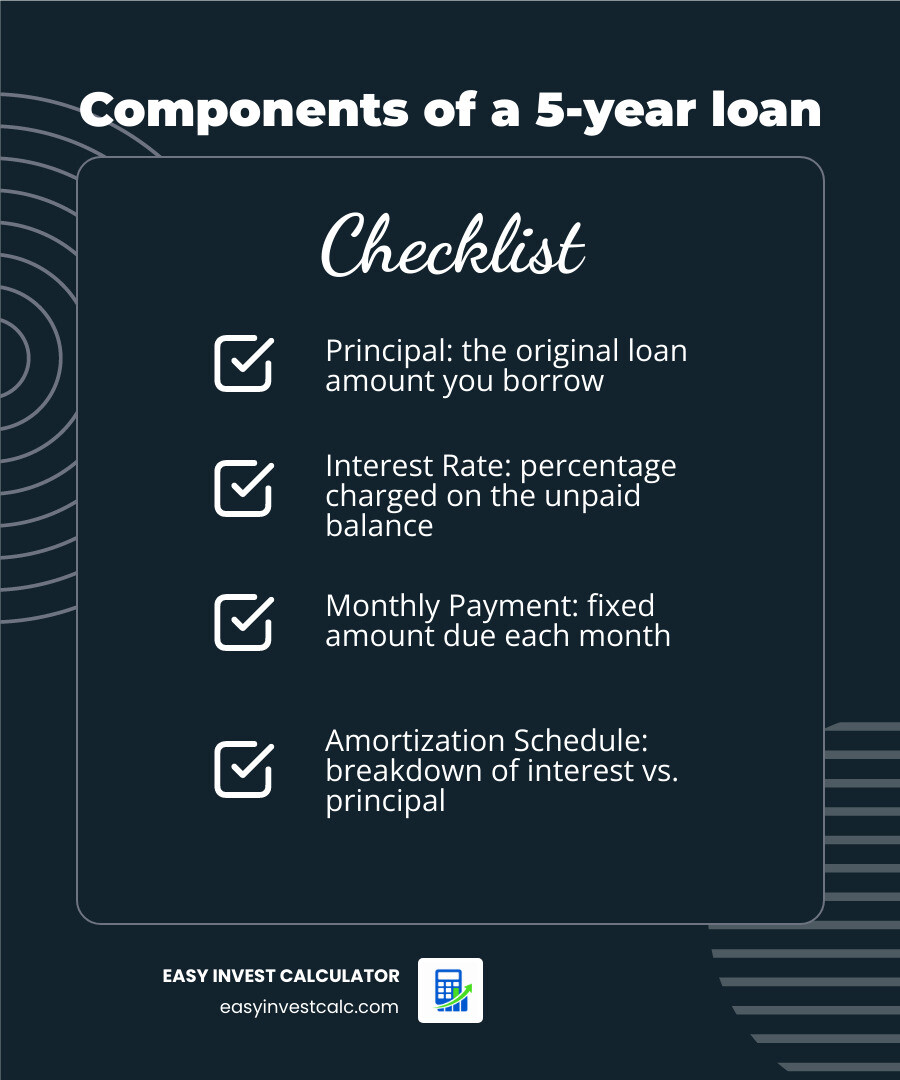
Key 5 year loan calculator vocabulary:
Understanding the 5 Year Loan Calculator
When we talk about a 5 year loan calculator, we are referring to a digital tool designed to break down a debt that must be repaid in full over exactly 60 months. Whether you are looking at an EMI Calculator for a personal expense or a specialized mortgage tool, the logic remains the same: it takes your total “principal” (the amount you actually borrowed) and spreads it across five years of payments.
The beauty of a 5-year term is its simplicity. Unlike 30-year mortgages where the finish line feels like it’s in a different century, a five-year loan offers a visible light at the end of the tunnel. It is a commitment to “short-term pain for long-term gain,” where higher monthly payments lead to a debt-free life much sooner.

How a 5 Year Loan Calculator Works
Behind the user-friendly buttons of our 5 year loan calculator lies a standard mathematical formula known as the loan amortization formula. Don’t worry, we handle the heavy lifting so you don’t have to dust off your high school algebra book.
The calculator works by taking your annual interest rate and dividing it by 12 to find your monthly rate. It then uses the total number of periods (60 months) to determine a fixed monthly payment that ensures the balance hits zero exactly at the end of the term. This process involves “monthly compounding,” where the interest for the next month is calculated based on the remaining principal. To learn more about how these agreements are structured, you can explore understanding loan terms and conditions.
Using a 5 Year Loan Calculator for Different Loan Types
A 5-year term is incredibly versatile. We see it used most commonly in the following areas:
- Auto Loans: This is the “gold standard” for car financing. While some lenders offer 7 or 8-year car loans, these often lead to being “underwater” (owing more than the car is worth). Using an Auto Amortization Schedule for a 5-year term ensures you build equity in your vehicle faster.
- Personal Loans: Often used for home improvements or medical bills, these are typically unsecured loans. A 5-year window provides enough time to keep payments low without the debt lingering for a decade.
- Debt Consolidation: If you are juggling high-interest credit card debt, moving that balance into a fixed 5-year loan can save you thousands in interest and provide a clear payoff date.
- 5-Year Mortgages: While rare for a primary home purchase, these are common for land purchases, small commercial properties, or as the final “sprint” for homeowners who are refinancing to pay off their house early.
How to Calculate Payments and Total Interest
Calculating your payment isn’t just about the sticker price of the loan. You need to look at the “Total Cost of Borrowing.” This includes the interest rate (the cost of the principal) and the APR (Annual Percentage Rate), which includes additional fees like broker or origination costs.
To get a deep dive into how these payments are structured over time, check out The Ultimate Guide to Fixed Rate Amortization.
Comparison Table: 5-Year Loan Scenarios
To help you visualize the impact of loan size, here is a breakdown of typical 5-year loan costs at May 2026 market rates:
| Loan Amount | Monthly Payment | Total Interest Paid | Total Repayment |
|---|---|---|---|
| $20,000 | $388.99 | $3,339.11 | $23,339.11 |
| $50,000 | $949.30 | $6,957.95 | $56,957.95 |
| $90,000 | $1,627.20 | $7,632.01 | $97,632.01 |
| $200,000 | $3,778.83 | $26,730.00 | $226,730.00 |
Note: Estimates based on typical market rates and 5.05% for the $200k example.
When calculating for a mortgage, the 5 year loan calculator usually focuses on Principal and Interest (P&I). You will need to manually add property taxes, homeowners insurance, and potentially HOA fees to find your true “out-of-pocket” monthly cost.
Factors Affecting Your Monthly Payment
Why does your neighbor get a 5% rate while you’re offered 7%? Several moving parts influence the results you’ll see on a 5 year loan calculator:
- Credit Score: This is the biggest lever. A higher score proves to the lender that you are a low-risk borrower, earning you a lower interest rate.
- Down Payment: For auto or home loans, putting more money down reduces the “Loan-to-Value” (LTV) ratio. Lenders love low LTVs because they have more security.
- Market Rates: These are influenced by the Federal Reserve’s policies. You can track scientific research on interest rate cycles to see if rates are trending up or down.
- Loan Type: Unsecured personal loans usually carry higher rates than secured loans (like a car or home loan) because there is no asset for the bank to seize if you stop paying.
The Role of the Amortization Schedule
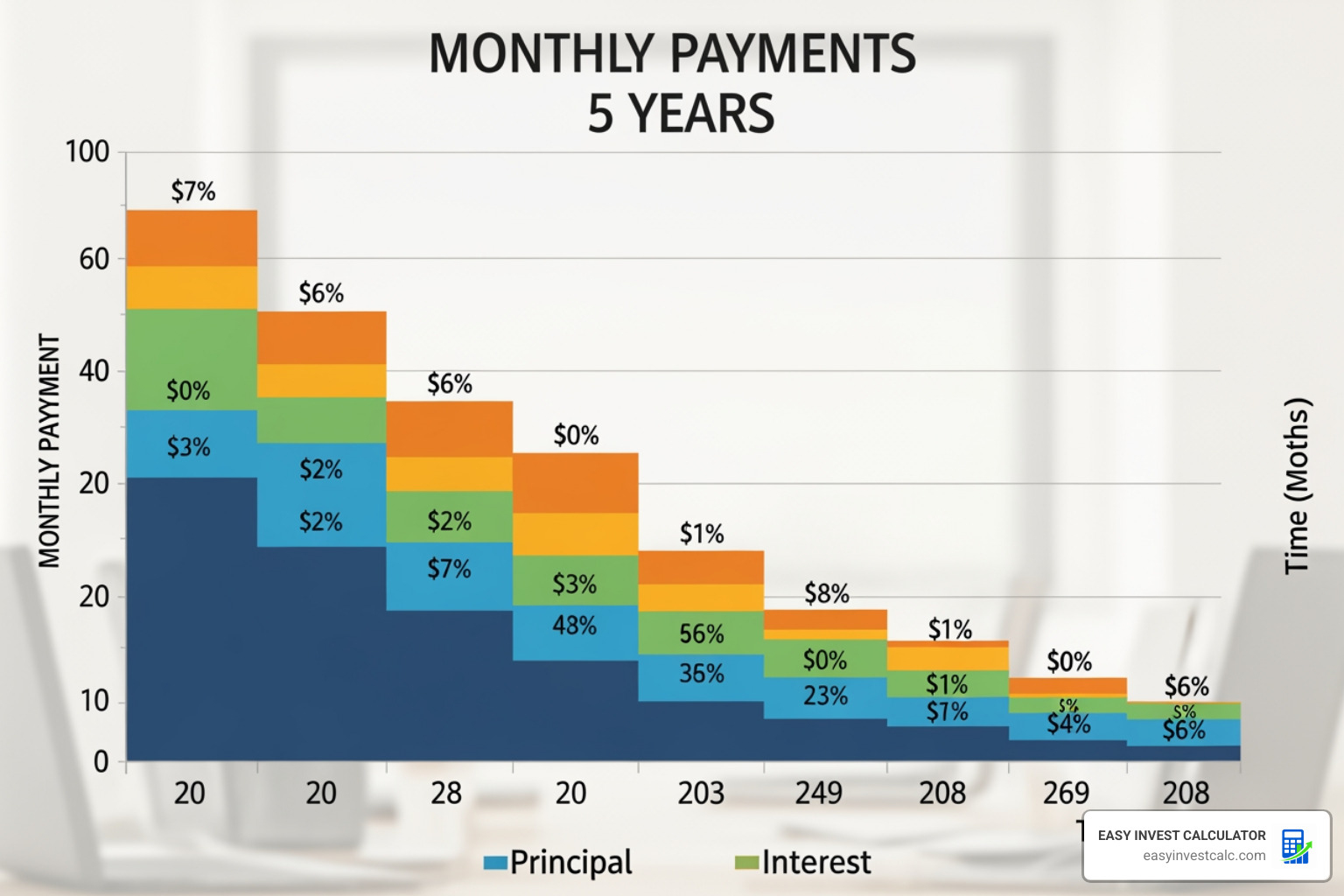
An amortization schedule is essentially a roadmap for your loan. It lists every single one of your 60 payments and shows exactly how many cents of every dollar go toward interest versus the principal balance.
In the early months of a 5-year loan, your payments are “interest-heavy.” This means a larger portion of your check goes to the bank’s profit. As the balance drops, the interest portion shrinks, and your principal reduction accelerates. Using an Amortization Schedule with Extra Payments can help you see exactly when you’ll “cross the line” where more of your money goes toward the balance than the interest.
Benefits of 5-Year Terms vs. Longer Options
Choosing a 5-year term over a 15 or 30-year term is one of the most powerful wealth-building moves you can make. While a 30-year mortgage offers a lower monthly payment, the total interest cost is staggering.
For example, a $200,000 loan at 6% over 30 years would cost you over $231,000 in interest alone—more than the original loan! That same loan over 5 years would cost roughly $32,000 in interest. By choosing the shorter term, you effectively “save” nearly $200,000.
Other benefits include:
- Faster Equity: You own your asset (car or home) outright much sooner.
- Improved Debt-to-Income (DTI) Ratio: Once the loan is paid off in 60 months, your DTI drops significantly, making it easier to qualify for other financing.
- Financial Flexibility: Being debt-free in 5 years frees up your cash flow for investing or retirement.
Impact of Extra Payments on Payoff Dates
Even if you are locked into a 5-year term, you aren’t stuck with a 5-year timeline. If you get a tax refund or a bonus at work, applying that money as a “principal-only” payment can shave months off your debt.
By using our Amortization Calculator with Extra Payments, you can see how adding just $50 or $100 extra each month can save you hundreds in interest. Just be sure to check your loan contract for “early payoff penalties”—though these are becoming rarer in May 2026, some lenders still charge them to recoup lost interest.
Common Questions Regarding Short-Term Financing
What factors affect the monthly payment on a 5-year loan?
The three main pillars are the loan amount, the interest rate (driven by your credit score), and any origination fees. For mortgages, you must also consider “escrow” items like property taxes and insurance which are often bundled into the monthly bill.
How much total interest will I pay over the life of the loan?
This depends entirely on your rate and amount. Based on our research:
- $200,000 at 5.05%: ~$26,730 in interest.
- $50,000 at typical rates: ~$6,957 in interest.
- $15,000 at 6%: ~$2,452 in interest.
Can I use this for a 5-year mortgage?
Yes, but be aware of how they are structured. Some 5-year mortgages are “balloon loans,” where you make payments for 5 years but then owe a massive lump sum at the end. Others are simply the final 5 years of a traditional mortgage. Most people use a 5 year loan calculator for mortgages when they are planning to pay off their home aggressively or are buying a lower-cost property like a modular home or land.
Conclusion
At EasyInvestCalc, we believe that financial clarity shouldn’t be a luxury. The fintech industry is evolving rapidly, but the fundamentals of debt remain the same: the faster you pay it back, the more money stays in your pocket.
Using a 5 year loan calculator is the first step toward taking control of your financial future. Whether you are using our EMI Calculator to plan a debt consolidation or mapping out your next vehicle purchase, our goal is to provide fast, accurate, and user-friendly tools for effortless planning.
Five years might seem like a long time today, but with a solid plan and the right tools, you’ll be celebrating your “Debt-Free Day” before you know it. Start your calculation today and see how close financial freedom really is!

Founder of EasyInvestCalc.com with 8+ years of experience in personal finance. Sunita simplifies complex financial mathematics—from SIP compounding to tax planning—empowering Indian investors to make smart, debt-free decisions based on real market mechanics.