
A 25 year mortgage calculator is the fastest way to estimate your monthly payments, total interest, and full cost of homeownership before you ever speak to a lender. Here’s a quick answer to what most people want to know:
How to calculate your 25-year mortgage payment:
- Start with your loan amount — home price minus your down payment
- Enter your interest rate — in Canada, the best insured 5-year fixed rate is currently around 3.94%
- Set the amortization to 25 years — that’s 300 monthly payments
- Choose your payment frequency — monthly, bi-weekly, or accelerated bi-weekly
- Add extras if needed — property tax, home insurance, and CMHC insurance (required if your down payment is under 20%)
Example estimates (principal & interest only):
| Loan Amount | Rate | Monthly Payment | Total Interest |
|---|---|---|---|
| $250,000 | 5.0% | ~$1,462 | ~$188,600 |
| $400,000 | 5.0% | ~$2,339 | ~$301,800 |
| $450,000 | 5.5% | ~$2,438 | ~$281,300 |
With national home prices projected to average $698,881 in 2026, getting this math right isn’t optional — it’s essential. Whether you’re buying your first home or refinancing, understanding your 25-year amortization up front saves you from costly surprises at closing and beyond.
The 25-year term is actually the most common amortization period in Canada — and for good reason. It balances manageable monthly payments with meaningful interest savings compared to a 30-year loan. But the numbers can still feel overwhelming without the right tool in your corner.
That’s exactly what this guide walks you through.
25 year mortgage calculator terms to remember:
- amortization schedule calculator
- amortization schedule with fixed monthly payment
- annual amortization calculator
How to Use a 25 Year Mortgage Calculator for Financial Planning
Planning a home purchase is about more than just finding a house you love; it’s about ensuring the numbers fit your lifestyle for the next two and a half decades. When we use a 25 year mortgage calculator, we aren’t just looking for a single number. We are building a roadmap for our financial future.
To get the most accurate results, you need to input specific data points. First is the home price. In May 2026, the market has seen a projected 2.8% increase in average sale prices, making accurate entry vital. Next, you must factor in your down payment. If you put down less than 20%, our calculator will help you understand how mortgage default insurance is added to your loan balance.
Interest rates are the next critical variable. Even a small fluctuation—say, from 3.79% to 3.94%—can change your monthly obligation by dozens of dollars and your total interest by thousands. By using The Ultimate Guide to Fixed Rate Amortization, you can see how a locked-in rate provides the stability needed for long-term budgeting.

Calculating Total Interest with a 25 Year Mortgage Calculator
One of the biggest “aha!” moments for our users happens when they look at the total interest paid over 25 years. On a $300,000 mortgage at 5% interest, you might be surprised to learn that you’ll pay nearly $192,211 in interest alone.
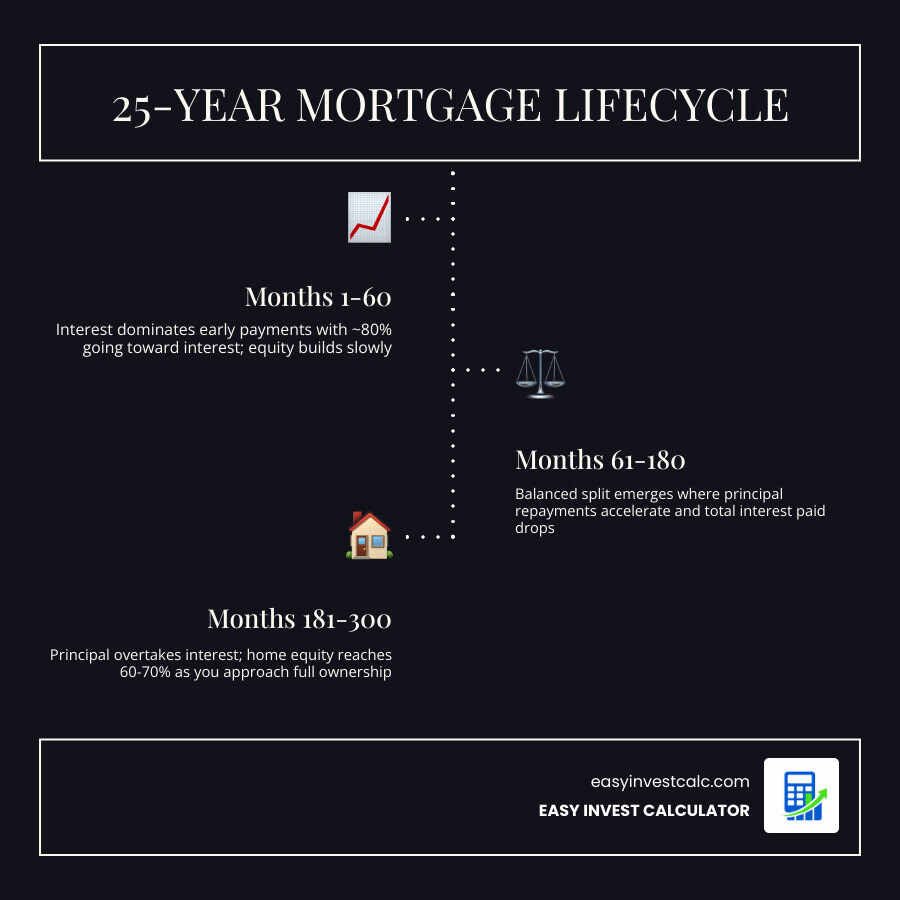
Your principal amount is the actual money you borrowed, but the interest cost is what you pay the bank for the privilege of borrowing it. A 25 year mortgage calculator breaks these down so you can see that in the early years, a larger portion of your check goes toward interest. As time goes on, you begin to “chip away” at the principal faster.
Payment frequency also plays a massive role. Switching from monthly to bi-weekly payments doesn’t just help with cash flow—it can fundamentally change your interest profile. To see how these costs stack up year by year, we recommend checking out our Master Your Yearly Budget with an Annual Amortization Calculator.
Why a 25 Year Mortgage Calculator is Essential for 2026 Buyers
As we navigate the housing market in 2026, the landscape has shifted. National home sales are forecast to rise 5.1%, reaching approximately 494,500 transactions this year. With more competition and higher prices, home affordability is the keyword for every buyer.
The 25-year term remains the “gold standard” for Canadian homeowners. While 30-year terms have become more accessible for first-time buyers and new constructions as of late 2024, the 25-year amortization remains the most popular because it helps you build equity faster.
In a market where the average price is hovering near $698,881, you need to know exactly how much house you can afford without being “house poor.” Using a tool like ours—much like Mastering Your Mortgage with the Bankrate Amortization Calculator—allows you to stress-test your own budget against current 2026 trends before you sign on the dotted line.
Comparing 25-Year and 30-Year Amortization Periods
When choosing between a 25-year and a 30-year mortgage, you are essentially trading time for money. A 30-year mortgage offers lower monthly payments, which can be a lifesaver for your monthly cash flow. However, the 25-year mortgage is the powerhouse of interest savings.
| Feature | 25-Year Amortization | 30-Year Amortization |
|---|---|---|
| Monthly Payment | Higher | Lower |
| Total Interest | Significantly Lower | Significantly Higher |
| Equity Building | Faster | Slower |
| Loan Payoff | 5 Years Sooner | 5 Years Later |
| Interest Rate | Often 0.15% Lower | Slightly Higher |
By choosing the shorter term, you aren’t just saving on the interest rate itself; you are removing five full years of interest accumulation. For a $250,000 loan, a 25-year term could save you over $25,000 in total interest compared to a 30-year term. To see this breakdown for your specific numbers, use our Amortization Schedule Calculator Principal vs Interest.
Benefits of a Shorter Amortization
The most obvious benefit of a 25-year mortgage is reaching debt freedom five years earlier. Imagine what you could do with five years of no mortgage payments—retirement savings, travel, or helping children with their own education.
Furthermore, lenders often offer slightly lower interest rates for 25-year terms compared to 30-year terms. Because the lender is taking on risk for a shorter period, they pass some of those savings on to you. This “double whammy” of a lower rate and a shorter timeline results in massive total savings over the life of the loan.
Drawbacks of a 25-Year Term
We have to be realistic: the 25-year term comes with higher monthly payments. For a $340,000 loan at 3.8%, the 25-year payment is roughly $152 higher per month than the 30-year option. For families on a tight budget, that $152 might be the difference between a comfortable month and a stressful one.
There are also qualification hurdles. Because the monthly payment is higher, your Debt-to-Income (DTI) ratio will be higher. This means you might qualify for a smaller total loan amount on a 25-year schedule than you would on a 30-year schedule. If you are trying to buy in a high-priced market like Toronto or Vancouver, this could limit your housing options.
Factors That Determine Your Mortgage Payments in 2026
Your mortgage payment isn’t just a reflection of the house price. In 2026, several external and internal factors dictate what you actually pay each month.

First, your credit score is paramount. To secure the best rates in today’s market, a score of 680 or higher is generally required. If your score is lower, you might face higher interest rates, which our 25 year mortgage calculator can help you visualize.
Then there is the stress test. Even if you find a great rate of 3.94%, lenders must qualify you at a higher rate (usually the contract rate plus 2%) to ensure you can still afford the home if rates rise. Don’t forget the “hidden” costs of homeownership: property taxes and home insurance. These are often bundled into your monthly payment (PITI: Principal, Interest, Taxes, and Insurance). While we focus on homes, if you’re also managing other debts, you might find The Ultimate Amortization Calculator Car Loan helpful for balancing your total monthly debt load.
The Impact of Down Payments and CMHC Insurance
Your down payment is the single biggest lever you can pull to change your mortgage math. In Canada, the minimum down payment is 5% for the first $500,000 of a home’s value and 10% for the portion above that.
However, if you put down less than 20%, you are required to purchase mortgage default insurance (CMHC). This protects the lender, not you, but you are the one who pays the premium. This premium is typically added to your mortgage balance, meaning you pay interest on your insurance for the next 25 years! By reaching that 20% threshold, you eliminate this cost entirely and often secure better interest rates. With 2026 price projections showing a national average of $698,881, a 20% down payment would be roughly $139,776.
Interest Rate Trends and the Bank of Canada
As of early 2026, the Bank of Canada has held the overnight rate at 2.25%. This has led to a stabilization of mortgage rates, with the best insured five-year fixed rate sitting around 3.94%.
When using a 25 year mortgage calculator, you’ll need to choose between fixed and variable rates. Fixed rates offer the peace of mind that your payment won’t change for the duration of your term (usually 5 years). Variable rates fluctuate with the Bank of Canada’s prime rate. In 2026, many buyers are leaning toward fixed rates to protect against the volatility seen in previous years.
How to Shorten Your Loan Term with Strategic Payments
What if you have a 25-year mortgage but want to pay it off in 20? You don’t need to refinance to make that happen. Strategic payments are the “secret sauce” to debt freedom.
The most popular method is the accelerated bi-weekly payment. Instead of paying once a month, you pay half of your monthly amount every two weeks. Because there are 52 weeks in a year, you end up making 26 half-payments, which equals 13 full monthly payments. That one “extra” payment per year can shave years off your amortization and save you tens of thousands in interest. To see how this works for your specific loan, try our Amortization Schedule with Extra Payments.
Leveraging Prepayment Privileges
Most Canadian mortgages come with prepayment privileges. This typically allows you to pay down a certain percentage of the original principal (often 10% to 20%) each year without penalty.
When you make a lump sum payment, 100% of that money goes toward the principal. This immediately reduces the balance that interest is calculated on, creating a snowball effect of savings. Even small, consistent “extra” payments can make a huge difference. As we like to say, Extra Payments are the Secret Sauce for Debt Freedom.
Using an Amortization Schedule for Long-Term Planning
An amortization schedule is a table that shows every single payment over the 25-year life of the loan. It’s a powerful psychological tool. Seeing your “Remaining Balance” drop each month provides the motivation to keep going.
Our 25 year mortgage calculator generates a full schedule that tracks:
- Payment Date: Exactly when the money leaves your account.
- Principal Paid: How much of the house you actually own now.
- Interest Paid: How much you gave the bank this month.
- Total Interest to Date: The cumulative cost of the loan.
Tracking these numbers allows you to plan for the future, such as knowing exactly what your balance will be when it’s time to renew your mortgage term. For the most detailed tracking, use our Amortization Calculator with Extra Payments.
Frequently Asked Questions about 25-Year Mortgages
What is the difference between mortgage term and amortization?
This is the most common point of confusion for new buyers. The amortization period (e.g., 25 years) is the total amount of time it will take to pay off the loan in full. The mortgage term (e.g., 5 years) is the length of your current legal agreement with the lender, including your interest rate. At the end of each term, you renew your mortgage at the current market rates until the 25-year amortization is complete.
How much can I save by switching to accelerated bi-weekly payments?
On a $300,000 mortgage at 5% interest, switching to accelerated bi-weekly payments can save you approximately $23,000 in interest and shorten your 25-year mortgage by about 3.5 years. It is one of the most effective ways to build equity without feeling a major pinch in your lifestyle.
Can I get a 25-year mortgage with a 5% down payment?
Yes! In Canada, you can obtain a 25-year mortgage with as little as 5% down for the first $500,000 of the home’s price. However, you will be required to pay for CMHC insurance, and your monthly payments will be higher because you are borrowing a larger percentage of the home’s value.
Conclusion
Mastering your mortgage math is the first step toward true financial independence. In the 2026 housing market, where the national average price is projected to reach $698,881, using a 25 year mortgage calculator provides the clarity you need to move forward with confidence.
At EasyInvestCalc, we believe that financial planning should be effortless. Our tools are designed to give you fast, accurate, and user-friendly insights into your investments, loans, and taxes. Whether you are looking to save thousands in interest through accelerated payments or simply want to know if a 25-year term fits your monthly budget, we are here to help.
Ready to see how the numbers look for your dream home? Start your home ownership journey with our EMI Calculator and take control of your financial future today.

Founder of EasyInvestCalc.com with 8+ years of experience in personal finance. Sunita simplifies complex financial mathematics—from SIP compounding to tax planning—empowering Indian investors to make smart, debt-free decisions based on real market mechanics.