
Why Every Business Owner Needs a Business Loan EMI Calculator Before Borrowing
A business loan EMI calculator is one of the smartest tools you can use before signing any loan agreement. It tells you exactly how much you’ll pay each month — so you can borrow with confidence, not guesswork.
Quick Answer: How to Use a Business Loan EMI Calculator
- Enter the loan amount — how much you want to borrow
- Enter the interest rate — your lender’s annual rate (typically 6.8%–99% depending on the lender type)
- Enter the loan tenure — repayment period in months (e.g., 12 to 60 months)
- Get your EMI — the calculator instantly shows your monthly payment, total interest, and total repayment amount
Example: A ₹20 lakh business loan at 15% interest over 60 months works out to roughly ₹47,580 per month.
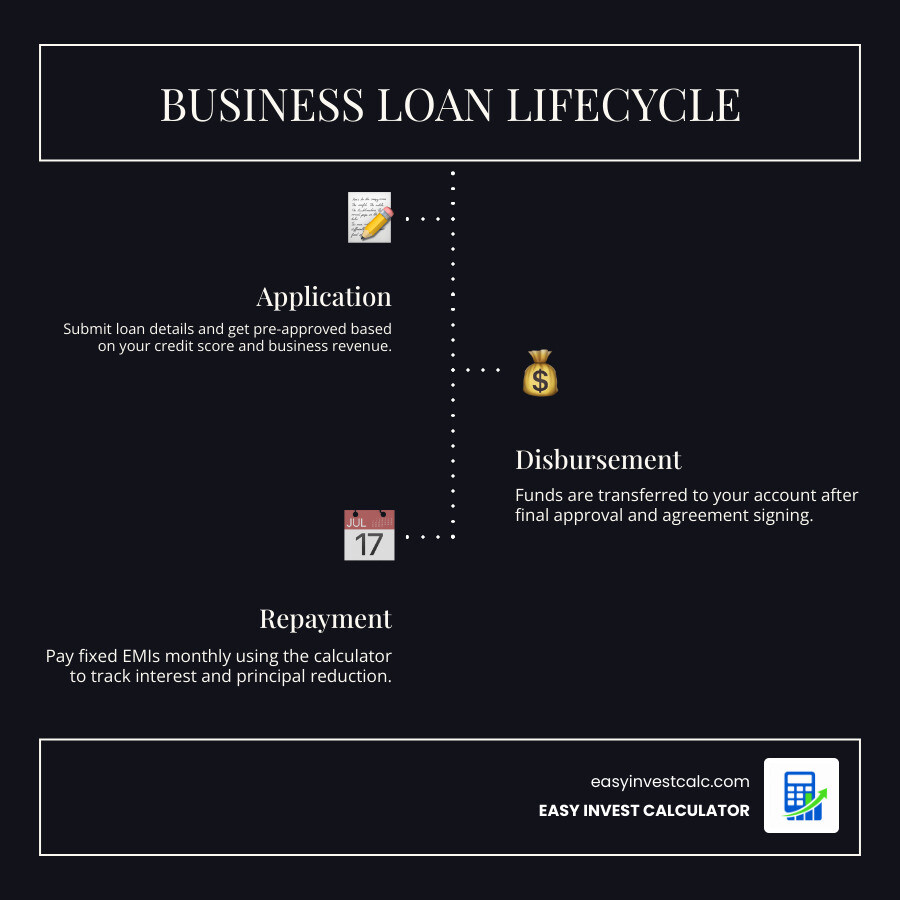
Taking a business loan is a big decision. And the monthly repayment — your EMI (Equated Monthly Installment) — directly affects your cash flow every single month for years.
Miss this step, and you could end up with payments that squeeze your working capital dry.
Get it right, and you can plan your growth, manage seasonal dips, and stay firmly in control of your finances.
This guide walks you through everything — from the EMI formula to smart strategies for reducing your repayment burden.
Handy business loan emi calculator terms:
- amortization schedule calculator
- amortization schedule with extra payments
- bank loan repayment calculator
What is a Business Loan EMI Calculator and How Does It Work?

At its core, a business loan EMI calculator is a specialized financial tool designed to help entrepreneurs estimate their Equated Monthly Installments (EMI). When you take out a business loan, you aren’t just paying back the money you borrowed; you are also paying for the “privilege” of using that money, which we call interest.
The calculator works by processing three primary inputs:
- Principal Amount: The total sum of money you intend to borrow.
- Interest Rate: The annual percentage rate (APR) charged by the lender.
- Tenure: The duration over which you plan to repay the loan, often referred to as the amortization period.
Once you plug these numbers into our EMI Calculator, it uses a mathematical algorithm to spread the total cost (principal plus interest) over the chosen number of months.
In business, this is a vital part of cash flow management. Unlike a personal loan where you might just check if you can afford the bill out of your salary, a business owner must ensure that the “Debt Service”—the cash required to cover the repayment of interest and principal—doesn’t exceed the business’s ability to generate income. By using a calculator, you can see if a loan is a stepping stone to growth or a potential anchor that might drag down your daily operations.
The Formula: How to Calculate EMI for a Business Loan
While most of us prefer the speed of an online tool, understanding the “math under the hood” can give you a deeper appreciation for how your debt works. The standard formula used by a business loan emi calculator to determine monthly installments is:
EMI = [P x R x (1+R)^N] / [(1+R)^N – 1]
Where:
- P = Principal loan amount
- R = Monthly interest rate (Annual rate / 12 / 100)
- N = Number of monthly installments (Tenure in months)
For example, if you borrow money at a 12% annual rate, your “R” would be 0.01 (12 divided by 12 months, then divided by 100).
Manual Calculation vs. Automation
Calculating this manually is, frankly, a bit of a headache. It involves complex exponents that are easy to get wrong on a standard handheld calculator. Furthermore, a manual calculation doesn’t easily show you the “Reducing Balance” effect—where your interest is calculated on the remaining principal each month rather than the original amount.
To see how your payments are split between paying off the debt and paying the bank’s fees, you should look at an Amortization Schedule Calculator: Principal vs Interest. This schedule shows you exactly how much of your ₹47,580 (from our earlier example) goes toward the bank’s pocket versus how much actually reduces your debt.
Understanding the Cost Spectrum
The type of lender you choose drastically changes the “R” in your formula. As of May 2026, the gap between traditional banks and online lenders remains significant.
| Lender Type | Typical APR Range | Best For |
|---|---|---|
| Traditional Banks | 6.8% – 13.25% | Established businesses with high credit |
| SBA Loans | 9.75% – 13.25% | Long-term growth and fixed assets |
| Online Lenders | 14% – 99% | Quick cash, short-term needs, lower credit |
Factors Affecting Your Monthly Repayments and Total Interest
It would be nice if the interest rate was the only thing that mattered, but several variables can shift your EMI up or down.
- Credit Score: This is the lender’s primary yardstick for risk. A higher score often unlocks lower interest rates, which directly reduces your EMI.
- Loan Tenure: It’s a double-edged sword. A longer tenure (like the 25 years allowed for some SBA 7(a) loans) makes your monthly EMI smaller and more manageable. However, it significantly increases the total interest you pay over the life of the loan.
- DSC Ratio (Debt Service Coverage Ratio): Lenders use this to see if your business generates enough net income to cover the new debt. A ratio of 1.25 or higher is generally the “gold standard” for approval.
- Collateral: Secured loans (where you pledge assets like property or equipment) usually come with lower rates than unsecured loans because the lender has a safety net.
- Factor Rates: Some short-term lenders use “factor rates” (expressed as decimals like 1.2) instead of percentages. To compare these fairly, you’ll need to convert them to an APR. For instance, a 1.2 factor rate on a $50,000 loan means you owe $60,000 total.
- Processing Fees: Many lenders charge 1% to 6% upfront. If these fees are “rolled into” the loan, your principal increases, and so does your EMI.
If you want to play with these variables yourself, you can learn how to Excel at Debt: Building Your Own Amortization Schedule to see how a slight change in interest or a small fee can change your long-term outlook.
Strategic Financial Planning with a business loan emi calculator
Using a business loan emi calculator isn’t just about checking a box for an application; it’s a core part of your strategic planning. As a business owner in May 2026, you have to account for shifting market conditions and seasonal demand.
When you know your exact EMI, you can map it against your revenue cycles. If your business is seasonal—say, a landscaping company or a holiday retail shop—you need to ensure you have enough working capital to cover EMIs during the “slow” months. Some lenders even offer “step-up” or “step-down” EMIs that align with your expected cash flow.
Furthermore, you should use an Income Tax Calculator in conjunction with your loan planning. Why? Because the interest portion of your business loan is often tax-deductible as a business expense. This effectively reduces the “true cost” of the loan, as it lowers your taxable net income.
Benefits of Using an Online business loan emi calculator
- Instant Results: No waiting for a loan officer to call you back with a quote.
- Error-Free: Removes the risk of manual mathematical blunders.
- Comparison Tool: You can easily compare a high-interest, short-term online loan against a low-interest, long-term bank loan.
- Negotiation Leverage: When you know the numbers, you can walk into a bank and say, “I know my EMI should be around X at this rate; can you do better?”
Understanding the Limitations of a business loan emi calculator
While these tools are incredibly accurate for the math they perform, they have limits. Most calculators do not automatically include:
- GST or Taxes: Depending on your region, there might be taxes on processing fees.
- Floating Rates: If you have a variable interest rate, your EMI could change in the future if market rates rise.
- Prepayment Penalties: Some lenders charge you a fee if you try to pay the loan off too early (they want that interest income!).
- Eligibility Variance: Just because the calculator says you can afford a ₹10 lakh loan doesn’t mean a lender will agree to give it to you.
How to Reduce Your Business Loan EMI and Interest Burden
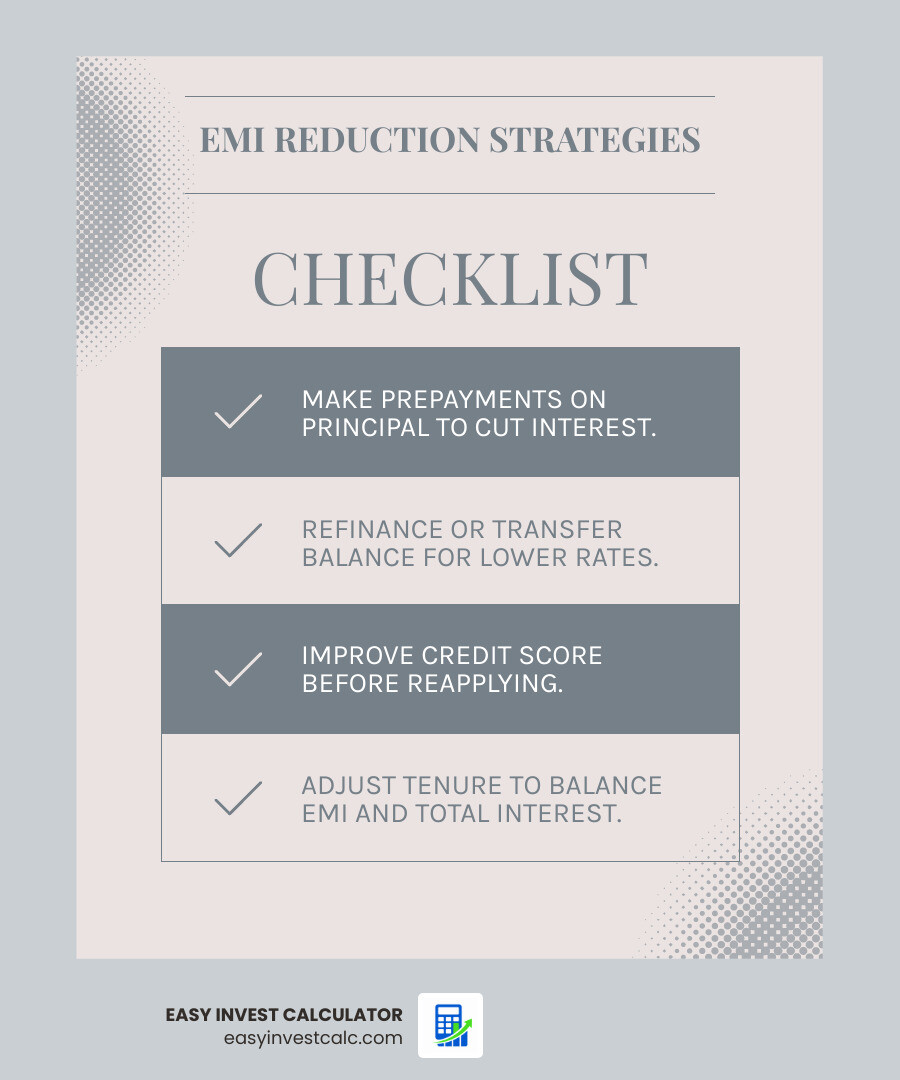
If the numbers coming out of the business loan emi calculator look a bit scary, don’t panic. There are several ways to lighten the load:
- Make Prepayments: If you have a windfall month, putting extra money toward the principal can drastically reduce your future interest. We call this Extra Payments: The Secret Sauce for Debt Freedom.
- Refinancing/Balance Transfer: If your business has grown and your credit score has improved since you took the loan, you might be able to move your debt to a new lender with a lower interest rate.
- Improve Your Credit: Sometimes, waiting six months to improve your credit score before applying can save you thousands in interest.
- Tenure Adjustment: While a shorter tenure increases your monthly EMI, it slashes the total interest. If your cash flow is strong, choose the shortest tenure you can comfortably afford.
- Debt Consolidation: If you have multiple small, high-interest loans (like credit cards or equipment leases), consolidating them into a single business term loan can often lower your total monthly payout.
Frequently Asked Questions about Business Loan EMI Calculators
What is a good Debt Service Coverage Ratio (DSCR) for loan approval?
Most traditional lenders, like Citizens Bank, look for a DSCR of 1.25 or higher. This means your business has $1.25 in net income for every $1.00 of debt payment. It provides a 25% “buffer” to ensure that even if business dips slightly, you can still make your payments. You calculate this by dividing your annual net cash income by your total annual debt service.
Can I change my EMI amount during the loan tenure?
Typically, your EMI is fixed for the duration of the loan if you have a fixed-rate agreement. However, many lenders allow “part-prepayments.” When you pay a lump sum toward the principal, you can often choose to either reduce your future monthly EMI amount or keep the EMI the same and shorten the loan tenure. Always check your lender’s specific restructuring policy.
Are business loan interest payments tax-deductible?
Yes, in many jurisdictions, the interest component of your business loan is considered a legitimate business expense. This means you can deduct the interest paid from your gross income, which reduces your overall tax liability. You generally cannot deduct the principal repayment portion, only the interest.
Conclusion
At EasyInvestCalc, we believe that financial clarity is the foundation of business success. Whether you are looking to purchase new machinery, expand your office, or simply manage seasonal inventory, using a business loan emi calculator is the first step toward a responsible repayment strategy.
As we move through May 2026, the lending landscape continues to offer diverse options—from microloans for startups to massive SBA 7(a) loans for established enterprises. By taking the time to plan your repayments today, you ensure that your business growth is sustainable and your financial stability remains unshakeable.
Ready to see where your business stands? Use our EMI Calculator today and take the guesswork out of your next big move.

Founder of EasyInvestCalc.com with 8+ years of experience in personal finance. Sunita simplifies complex financial mathematics—from SIP compounding to tax planning—empowering Indian investors to make smart, debt-free decisions based on real market mechanics.