
What a Bond Repayment Calculator Actually Tells You (And Why It Matters)
A bond repayment calculator is one of the most useful tools you can use before buying a home. It shows you exactly how much you’ll pay each month on a home loan — based on the purchase price, interest rate, deposit, and loan term you enter.
Here’s what a bond repayment calculator gives you instantly:
| Input | What It Does |
|---|---|
| Purchase price | Sets the total loan amount you need |
| Deposit amount | Reduces the loan and can lower your interest rate |
| Interest rate | Determines how much you pay to borrow |
| Loan term (years) | Affects monthly payment size and total interest paid |
| Output: Monthly instalment | Your estimated payment every month |
For example, a R1 million home loan at the current prime rate over 20 years gives you a clear monthly number to work with — before you ever speak to a bank.
But here’s what most people don’t realise: that monthly number is just the starting point. Transfer fees, bond registration costs, initiation fees, and the impact of making even small extra payments can dramatically change what your bond actually costs you over time.
This guide walks you through all of it — clearly, without the jargon.
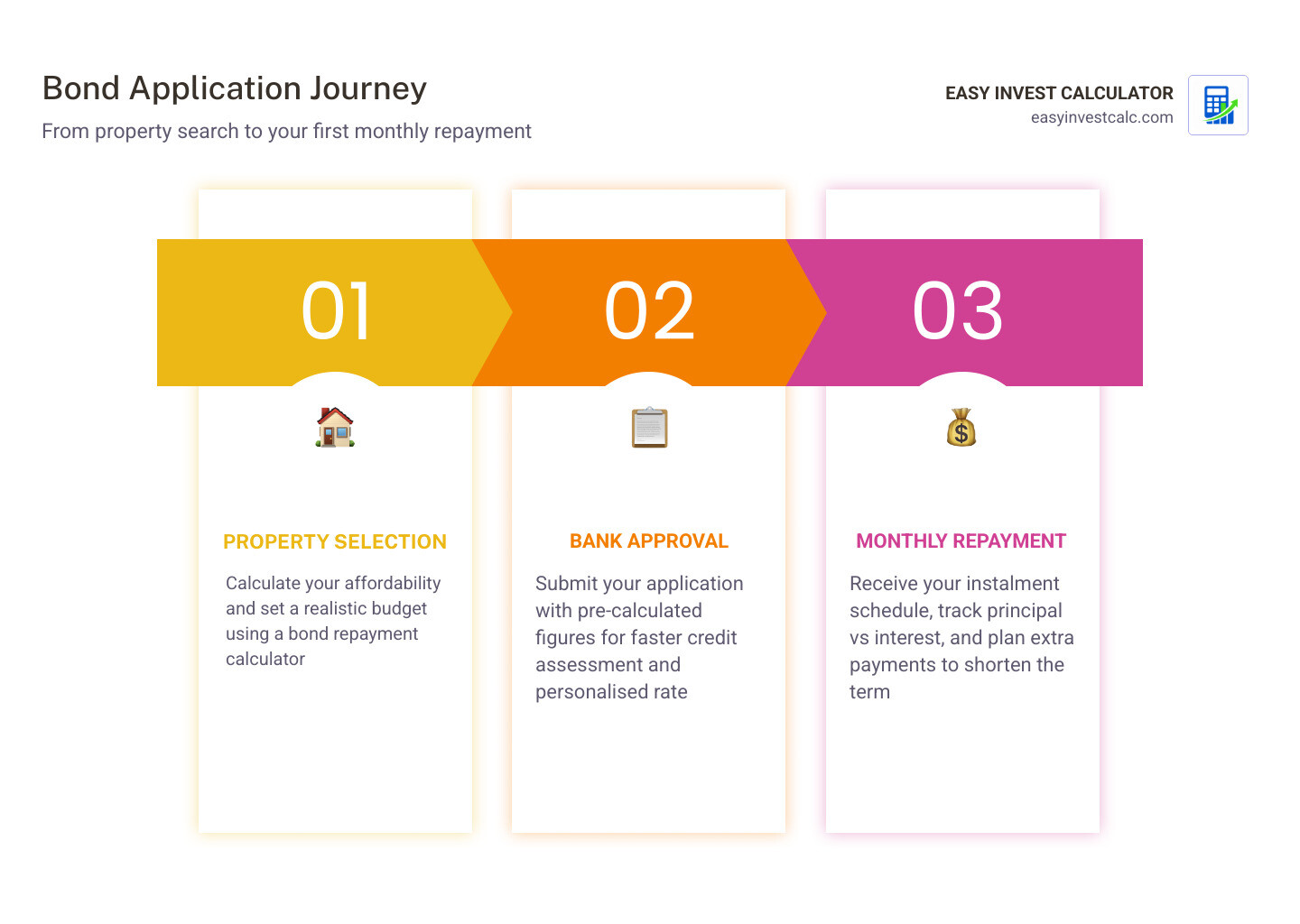
Understanding the Bond Repayment Calculator and How It Works
At its heart, a bond repayment calculator is a mathematical bridge between your dream home and your monthly budget. In May 2026, with the property market moving quickly, having this data at your fingertips is no longer a luxury—it is a necessity.
The calculator works by taking your total loan amount and applying an amortization formula. This formula determines how much of your monthly instalment goes toward paying off the “principal” (the actual money you borrowed) and how much goes toward the “interest” (the bank’s fee for lending it to you).
If you use our EMI Calculator, you will notice that in the early years of your bond, a massive chunk of your payment goes toward interest. It feels a bit like running on a treadmill; you are putting in the effort, but the balance barely moves. However, as the years go by, the ratio shifts, and you start chipping away at the principal much faster. This process is known as mortgage amortization.
Understanding this mechanics helps you realize that your “monthly instalment” isn’t just one flat fee—it’s a living calculation that changes every month based on your remaining balance.

Key Factors Influencing Your Monthly Bond Repayments
Several “levers” determine what that final monthly number looks like. Understanding these can help you decide whether a property is truly affordable or if it will leave you “house poor.”
- The Prime Rate: This is the benchmark interest rate. When the South African Reserve Bank changes this rate, your bond repayment usually changes along with it (unless you have a fixed-rate bond).
- Your Credit Profile: Banks don’t give everyone the same rate. If you have a stellar credit history, you might get “Prime minus 1%.” If your credit is shaky, you might pay “Prime plus 2%.”
- Loan-to-Value (LTV) Ratio: This is fancy talk for how much of the home’s value you are borrowing. A 100% loan means the bank is taking more risk, which often results in a higher interest rate.
When considering these factors, it is helpful to distinguish between Good Debt vs Bad Debt. A bond is generally considered good debt because property tends to appreciate over time, but only if the repayments don’t swallow your entire paycheck.
The Impact of Interest Rates and Deposits
Never underestimate the power of a small percentage. Research shows that a tiny 0.25% interest rate cut on a R1 million home loan can save you almost R40,000 over a 20-year term. That is a lot of money for a seemingly small change!
Putting down a deposit is the single most effective way to lower your monthly costs. Not only does it reduce the total amount you borrow, but it also signals to the bank that you are a lower-risk borrower. This often leads to a more favorable interest rate offer. Even if you qualify for a 100% loan, putting down even 5% or 10% can save you hundreds of thousands in interest over the life of the loan.
Choosing the Right Loan Term
Most people default to a 20-year (240 months) term, but 30-year bonds have become increasingly popular for affordability. However, there is a massive trade-off.
| Feature | 20-Year Term | 30-Year Term |
|---|---|---|
| Monthly Payment | Higher | Lower (More affordable) |
| Total Interest Paid | Significantly Lower | Significantly Higher |
| Equity Building | Fast | Very Slow |
While a 30-year term gives you more breathing room in your monthly budget, you will end up paying back more than double the original house price in interest alone. If you can afford the higher monthly payment of a 20-year term, it is almost always the smarter financial move.

Hidden Costs: Beyond the Monthly Instalment
One of the biggest mistakes first-time buyers make is forgetting about the “entry costs.” You don’t just need the bond repayment amount; you need a “war chest” of cash to actually get the keys.
When you use a bond repayment calculator, keep in mind that these additional costs are usually paid upfront:
- Transfer Duties: A tax paid to the government on properties above a certain value.
- Conveyancing Fees: What you pay the attorneys to transfer the property into your name.
- Bond Registration Fees: What you pay the attorneys to register the bond at the Deeds Office.
- Bank Initiation Fee: A compulsory once-off fee (around R6,000) that banks charge to process your application.
If you find yourself struggling with existing debt before applying for a bond, it may be worth looking into the Debt Counseling Process: How to Prepare for Debt to clear your slate first. Banks are very strict about your debt-to-income ratio, and having too many store cards or personal loans can sink your application.
Strategies to Pay Off Your Bond Faster
If you want to reach “debt freedom” before your hair turns grey, you need a strategy. The standard bank-calculated payment is designed to keep you paying for the full term. But you can beat the system.
By using an Amortization Schedule with Extra Payments, you can see exactly how much time you can shave off your loan. The secret lies in the interest-to-loan ratio. Every extra Rand you pay goes directly toward the principal, skipping all the interest that would have been charged on that amount for the next 15 years.
The Power of Small Extra Contributions
You don’t need to be a millionaire to pay off your bond early. Small, consistent amounts make a world of difference.
Consider this: Extra payments of just R250 per month on a R300,000 mortgage (at 6.5% interest) can save you a staggering R124,194 in interest and shorten your loan term by 9 years and 5 months.
That is the “secret sauce” we talk about in our guide on Extra Payments: The Secret Sauce for Debt Freedom. Even an extra R100 per month can save over $30,000 (or the local currency equivalent) on a typical 30-year mortgage.
Frequency and Lump Sum Tactics
Another pro tip is changing your payment frequency. Instead of paying once a month, try bi-weekly payments (half your instalment every two weeks). Because there are 52 weeks in a year, you end up making 26 half-payments, which equals 13 full monthly payments. This simple trick can cut 4 to 7 years off a 30-year mortgage.
Additionally, use “windfalls.” A single extra $5,000 (or R50,000) payment applied directly to the principal can save you between $15,000 and $20,000 in future interest. Think of your tax refund or your annual bonus as a “get out of debt free” card.
Frequently Asked Questions about Bond Repayment Calculators
How accurate is a bond repayment calculator compared to bank quotes?
A bond repayment calculator provides a very high-quality estimate based on standard industry formulas. However, a bank quote is a personalized offer. The bank will look at your specific credit score, your income stability, and the type of property you are buying. While the calculator gets you in the right ballpark, the bank’s final quote is what you’ll actually sign for.
Do I need a deposit to use a bond repayment calculator?
No, you can set the deposit to zero. Many South African banks currently offer 100% loans, meaning they will finance the full purchase price. However, using the calculator to compare a 0% deposit versus a 10% deposit will show you exactly how much extra interest you’ll be paying for that convenience.
Can I include transfer costs in my bond calculation?
Generally, no. Most banks require you to pay transfer and bond registration costs in cash upfront. However, some “105% loans” exist for first-time buyers where the bank includes these costs in the loan. If you are doing this, you will be paying interest on those fees for the next 20 years!
Conclusion
Navigating the property market in May 2026 requires more than just a dream; it requires a solid plan. A bond repayment calculator is your first step toward financial empowerment. It allows you to move from “I wonder if I can afford this” to “I know exactly how this fits into my budget.”
At EasyInvestCalc, we believe that financial planning should be effortless. Whether you are using our EMI Calculator to test different scenarios or looking for ways to pay off your home faster, we are here to provide the tools you need to build a secure future.
Don’t let the numbers intimidate you. With the right strategy and a bit of extra contribution each month, that house key will be yours—and the house will be fully paid for sooner than you think!

Founder of EasyInvestCalc.com with 8+ years of experience in personal finance. Sunita simplifies complex financial mathematics—from SIP compounding to tax planning—empowering Indian investors to make smart, debt-free decisions based on real market mechanics.