
Why a Car Loan Repayment Calculator Is Your First Step to Smart Vehicle Financing
A car loan repayment calculator tells you exactly what you’ll pay each month — and how much the loan costs in total — before you ever set foot in a dealership.
Here’s what it does in plain terms:
| Input | What You Enter |
|---|---|
| Vehicle price | The sticker price or negotiated cost |
| Down payment | What you pay upfront |
| Trade-in value | Credit from your current car |
| Interest rate (APR) | Your lender’s rate based on your credit |
| Loan term | How many months you’ll repay |
What you get back:
- Your estimated monthly payment
- Total interest paid over the life of the loan
- A full amortization schedule showing every payment
This matters more than ever in 2026. The average new car loan sits at $28,657 with a 13.80% APR over 63 months. On a used car, that average rate climbs to 16.20%. Those numbers add up fast — and most buyers don’t realize how much they’re paying until it’s too late.
The good news? Running the numbers takes less than two minutes. And the savings from doing it first can be significant — shoppers who compare loan offers save an average of $2,346.
This guide walks you through everything: how the calculator works, which inputs matter most, how your credit score affects your rate, and the strategies that help you pay less interest and get out of debt faster.
How a Car Loan Repayment Calculator Works

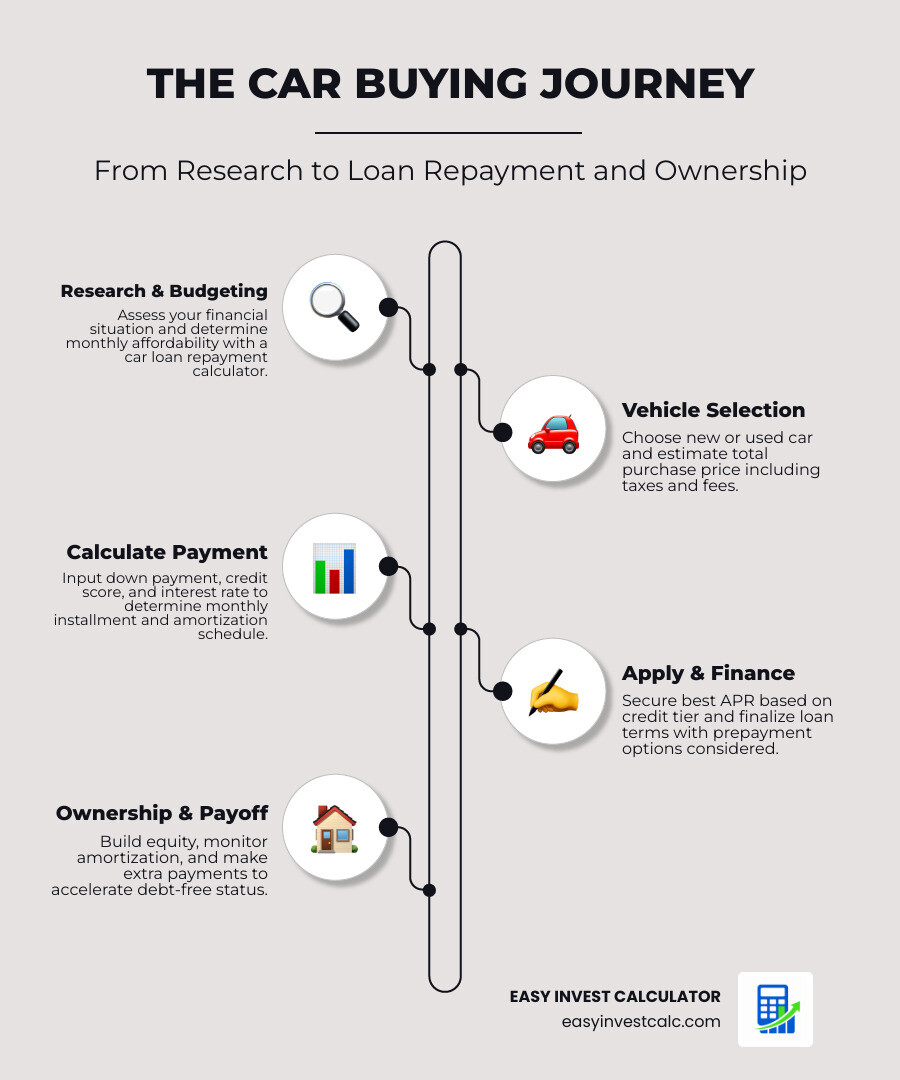
At its core, a car loan repayment calculator is a mathematical bridge between the car you want and the budget you have. It takes the “loan principal”—the actual amount of money you borrow—and applies a monthly interest rate over a specific period.
Most people think of their car payment as one flat chunk of money, but it’s actually a carefully balanced equation. We use the EMI Calculator (Equated Monthly Installment) method to show how your payments are split. In the beginning, a larger portion of your check goes toward interest. As time goes on, more of your money starts eating away at the principal. This transparency is vital for debt management; it allows you to see exactly when you’ll start building real equity in your vehicle.
Essential Inputs for Your Car Loan Repayment Calculator
To get an accurate result, you can’t just guess. The “garbage in, garbage out” rule applies here. You need to gather specific data points:
- Purchase Price: This isn’t just the MSRP. It’s the negotiated price of the car.
- Down Payment: The cash you’re bringing to the table. A higher down payment is the fastest way to lower your monthly bill.
- Trade-in Value: If you’re swapping your old ride, this acts like a second down payment.
- Sales Tax and Fees: Don’t forget these! Depending on where you live, taxes and registration fees can add thousands to the loan.
- Dealer Incentives: Rebates or “cash back” offers should be subtracted from the purchase price.
For a deeper dive into how these fees are structured, you can explore Simplified pricing and fees to ensure you aren’t missing any hidden costs.
Understanding the Amortization Process
Amortization sounds like a scary word, but it’s just a fancy way of saying “killing off the debt.” Each month, your lender calculates interest based on your remaining balance. As you pay down the principal, the interest charge gets smaller.
When you use our Amortization Schedule with Extra Payments, you can visualize this timeline. You’ll see that a 60-month loan and an 84-month loan look very different on paper. While the 84-month loan has a smaller monthly payment, the “interest accrual” is much higher, meaning you could end up paying for the car twice over if you aren’t careful.
The Impact of Interest Rates and Credit Scores
Your credit score is the single most powerful factor in determining your APR (Annual Percentage Rate). In May 2026, the gap between “Super Prime” and “Deep Subprime” borrowers is massive.
Think of it this way: Borrowing money is a product, and your credit score is the “discount coupon” or “surcharge” applied to that product. Understanding whether you are taking on Good Debt vs Bad Debt depends largely on the interest rate you secure.
| Credit Tier | Credit Score | New Car APR | Used Car APR |
|---|---|---|---|
| Super Prime | 781-850 | 4.88% | 7.43% |
| Prime | 661-780 | 6.51% | 9.65% |
| Nonprime | 601-660 | 9.77% | 14.11% |
| Subprime | 501-600 | 13.34% | 19.00% |
| Deep Subprime | 300-500 | 15.85% | 21.60% |
As you can see, a borrower with excellent credit might pay $4,000 in interest over five years, while someone with poor credit could pay over $15,000 for the exact same car! This is why shopping around can save you an average of $2,346.
New vs. Used Car Loan Repayment Calculator Variables
Should you buy new or used? A car loan repayment calculator helps you decide by highlighting the hidden trade-offs.
New cars generally offer lower interest rates (averaging 13.80% in 2026), but they suffer from brutal depreciation—losing about 20% of their value in the first year alone. Used cars have higher rates (averaging 16.20%), but the previous owner already took the “depreciation hit.”
When calculating your repayments, used cars might require a higher “repair reserve” in your monthly budget, even if the loan payment itself is lower. Certified Pre-Owned (CPO) vehicles often offer a middle ground: better warranties than typical used cars and slightly better financing terms.
How Down Payments Influence Your Total Cost
We always recommend the “20% Rule.” Putting 20% down does three vital things:
- Prevents Negative Equity: This is when you owe more than the car is worth (being “upside-down”).
- Lowers Interest: Lenders see you as lower risk, which can drop your APR.
- Eliminates the need for Gap Insurance: If the car is totaled, you won’t be stuck paying off a loan for a car you can’t drive.
If you put $0 down on a $40,000 car, you might pay $6,771 in total interest. If you put $8,000 down (20%), that interest drops to $6,018. That’s $753 saved just by paying a bit more upfront!
Strategies to Save Money and Pay Off Your Loan Faster
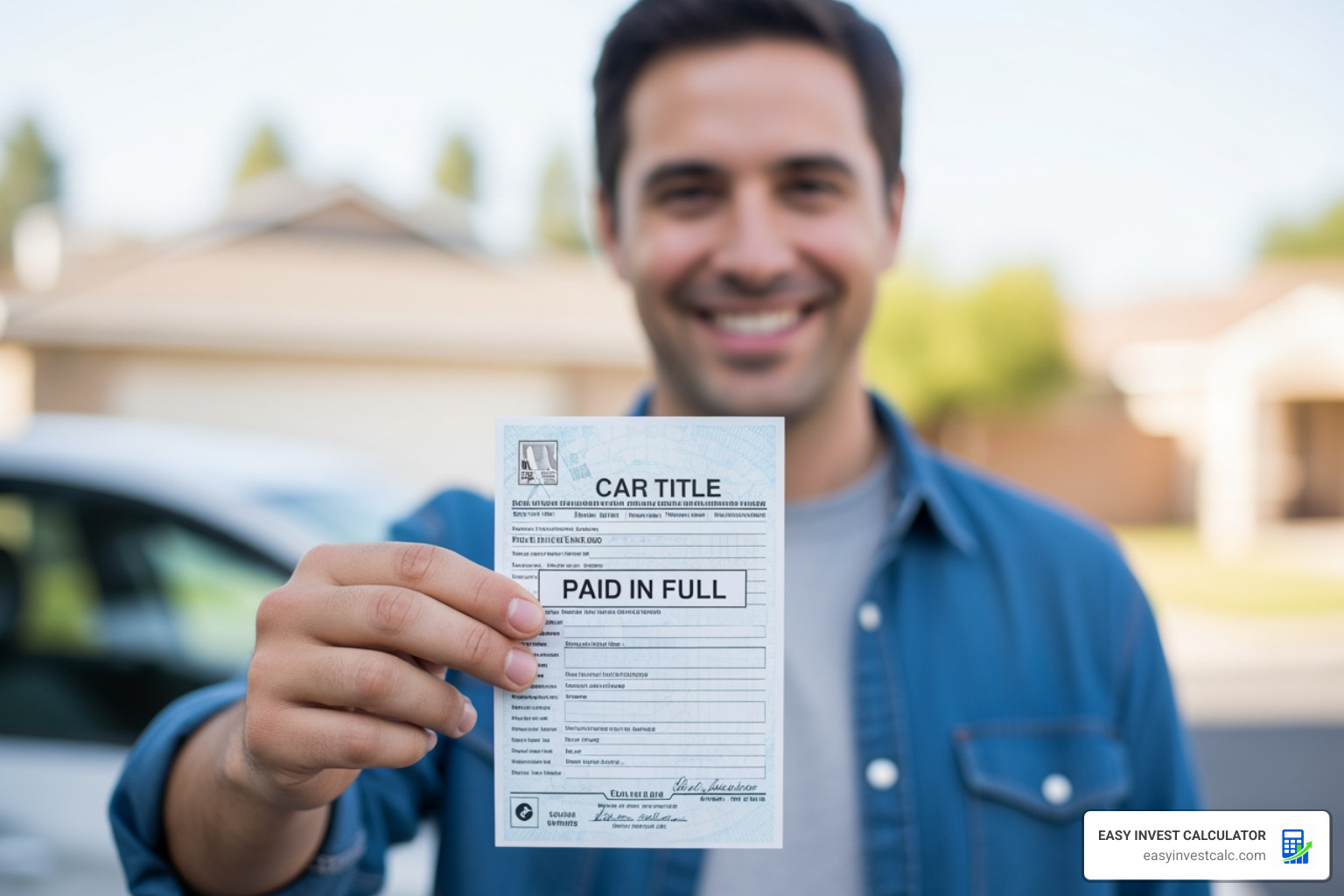
Once you’ve used the car loan repayment calculator to secure your loan, your goal should be to get rid of it as fast as possible. Every month you shave off the end of your loan is money back in your pocket.
One of the most effective methods is making “principal-only” payments. By sending even an extra $50 or $100 a month specifically toward the principal, you reduce the balance that interest is calculated on. We call Extra Payments: The Secret Sauce for Debt Freedom because of how quickly it compounds your savings.
Other strategies include:
- Bi-weekly payments: Making half-payments every two weeks results in 13 full payments a year instead of 12.
- Refinancing: If your credit score has improved since you bought the car, you might qualify for a much lower rate.
- Rounding up: If your payment is $462, pay $500. It’s a small change that makes a big dent over 60 months.
Comparing Financing Options: Cash Back vs. Low Interest
Dealerships often give you a choice: “Would you like the $3,000 rebate or 0% financing?”
It sounds like a trick question, but the car loan repayment calculator provides the answer. On a $20,000 loan at 5% for 60 months, you’ll pay about $2,645 in interest. In this case, the 0% financing is actually worth more than the $3,000 rebate because you save more on the interest than you would have gained from the cash. However, if the interest was only $1,500, you’d take the cash! Always run the numbers for both scenarios.
Determining Your True Vehicle Affordability
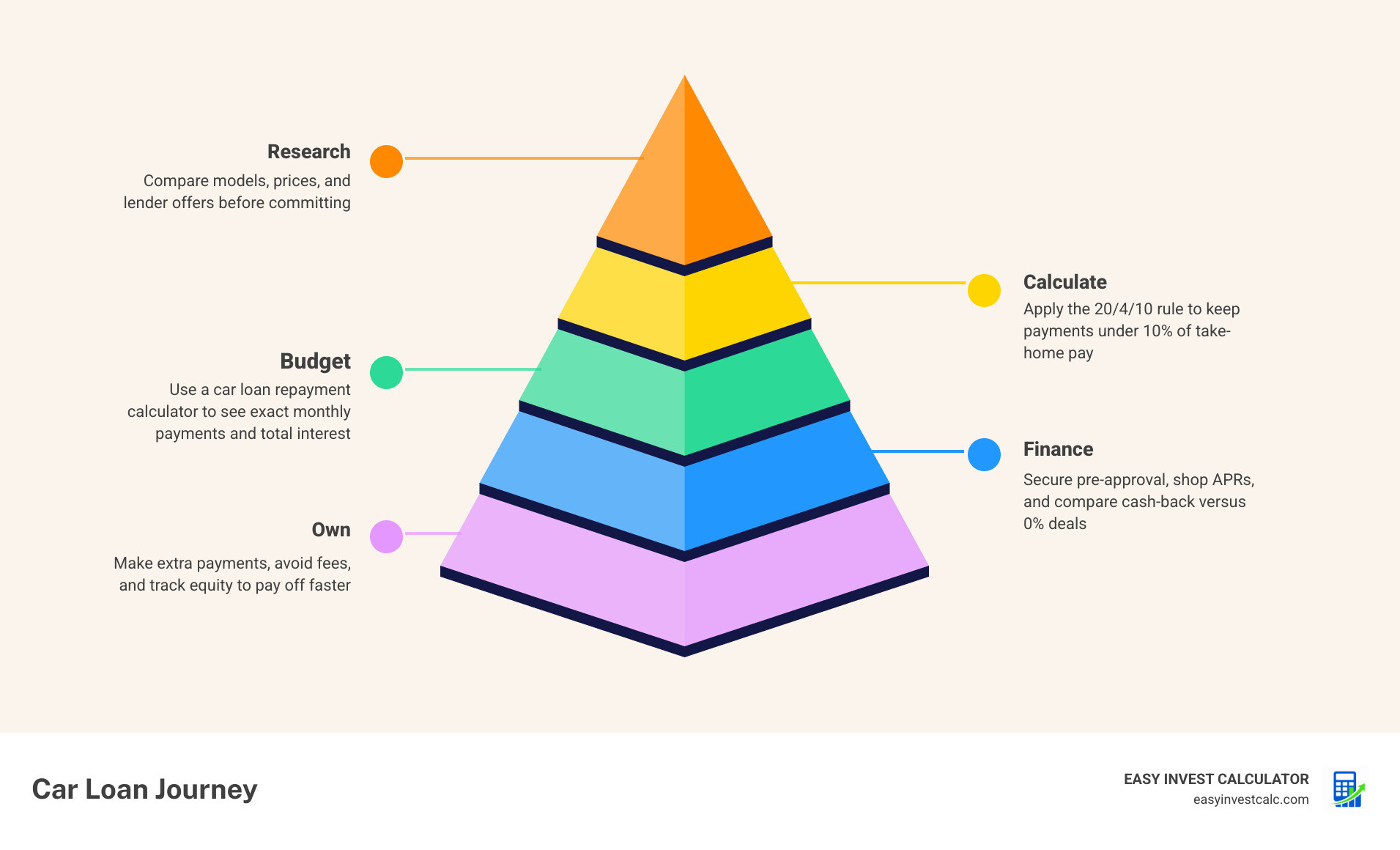
We like the 20/4/10 rule:
- 20% down payment.
- 4 year loan term (48 months).
- 10% of your monthly take-home pay for all vehicle costs.
Your car payment isn’t your only expense. The average annual ownership cost in 2026 is $4,507.11. This includes fuel, insurance, taxes, and repairs. If your calculator says your loan payment is $500, your real monthly cost is likely closer to $850.
Common Mistakes to Avoid When Financing a Vehicle
The biggest mistake we see? Focusing only on the monthly payment.
Dealers love to ask, “What monthly payment are you looking for?” If you say $400, they might give it to you—but by stretching the loan to 84 or 96 months. You’ll end up paying thousands extra in interest and will likely be “upside-down” on the loan for years.
Other pitfalls include:
- Junk Fees: Watch out for “phantom” add-ons like fabric protection, nitrogen-filled tires, or etched VINs. These can add $2,000+ to your loan principal.
- Skipping Pre-approval: Always get a quote from a credit union or bank before going to the dealer. This gives you negotiating leverage.
- Rolling over Negative Equity: If you owe $5,000 more on your trade-in than it’s worth, don’t add that $5,000 to your new loan. You’re just digging a deeper hole.
Frequently Asked Questions about Car Loans
How much of my income should go toward a car payment?
Ideally, your car payment should be no more than 10% of your take-home pay. If you earn $5,000 a month after taxes, your payment should be $500 or less. If you include insurance and fuel, try to keep the total under 20%. This ensures you have enough left over for savings and other living expenses.
Does a trade-in reduce the sales tax I pay?
In most states, yes! If you buy a $30,000 car and trade in a vehicle worth $10,000, you only pay sales tax on the $20,000 difference. This can save you hundreds of dollars. However, five states (Alaska, Delaware, Montana, New Hampshire, and Oregon) don’t charge vehicle sales tax at all, and a few others don’t allow the trade-in credit, so check your local laws.
Can I pay off my car loan early without penalties?
Most modern auto loans are “simple interest” loans, which means there is no penalty for paying them off early. However, some “precomputed interest” loans (usually from “buy-here-pay-here” lots) might charge you the full interest regardless of when you pay. Always ask your lender: “Is there a prepayment penalty?” before signing.
Conclusion
Financial empowerment starts with information. By using a car loan repayment calculator, you take the power away from the dealership’s “finance office” and put it back into your own hands.
Whether you are looking to buy your first car or refinance an existing high-interest loan, our tools at EasyInvestCalc are designed to give you fast, accurate, and user-friendly results. Don’t guess your way into debt—calculate your way to freedom.
Ready to see your numbers? Head over to our EMI Calculator and start planning your debt-free journey today. Drive away happy, knowing you got the best deal possible!