

An auto mortgage calculator is the fastest way to see the real cost of financing a vehicle — not just the number a dealer puts in front of you.
Quick answer — how to estimate your car loan payment:
| Input | What to Enter |
|---|---|
| Vehicle price | Sticker price + taxes + fees |
| Down payment | Ideally 20% of the purchase price |
| Trade-in value | Current market value (check KBB or Edmunds) |
| Loan term | 36, 48, 60, 72, or 84 months |
| APR | Based on your credit score (see rates below) |
2026 average new car loan rates by credit tier:
| Credit Score | New Car APR |
|---|---|
| 781–850 (Super prime) | ~4.88% |
| 700–739 (Prime) | ~6.5% |
| 300–500 (Deep subprime) | ~15.85% |
Here’s the problem most buyers run into: the dealer shows you a monthly payment. It looks manageable. What they don’t show you is that insurance, fuel, and maintenance can add $300–$600 more per month on top of that figure.
With the average new car price sitting at $47,640 in 2026, and more than 70% of new auto loans stretching beyond 60 months, getting the math wrong can cost you thousands — or leave you owing more than your car is worth.
This guide walks you through exactly how to use an auto mortgage calculator the right way, so you can borrow smart and stay in control of your money.
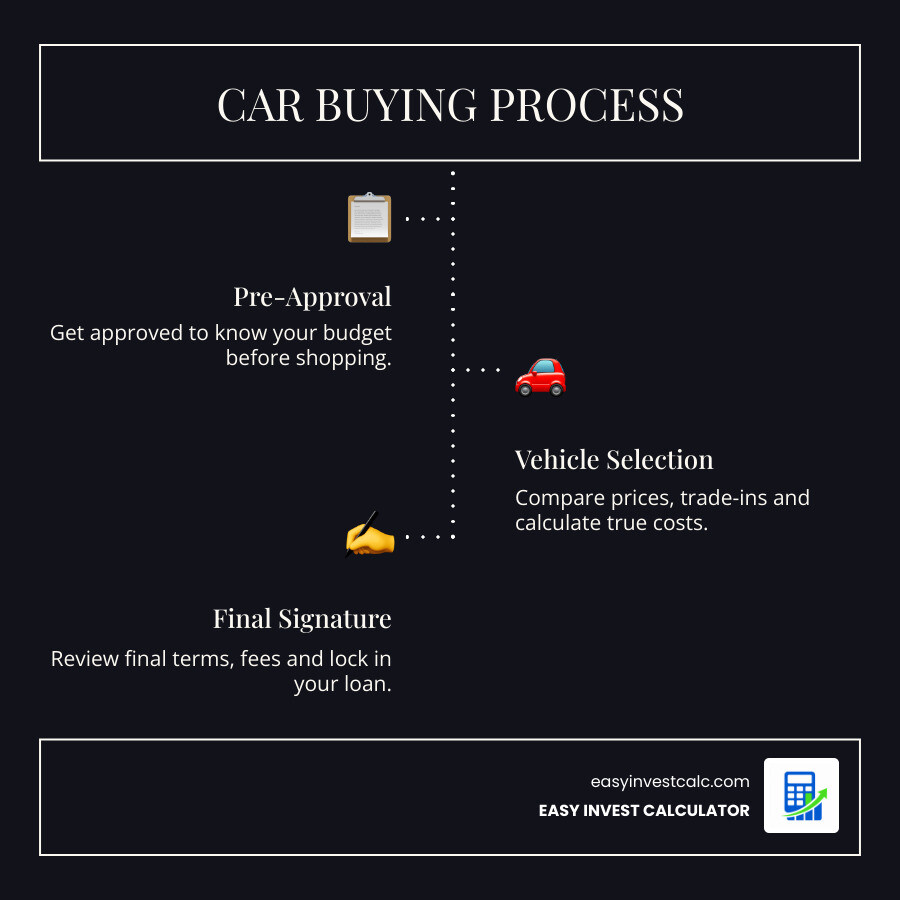
Easy auto mortgage calculator glossary:
How to Use an Auto Mortgage Calculator to Save Thousands

Using an auto mortgage calculator isn’t just about plugging in numbers; it’s about modeling your financial future. When we look at a car deal, we have to consider several moving parts that dictate the final price you pay.
- Principal Amount: This is the total amount you are borrowing. It’s not just the price of the car; it includes sales tax, dealer fees, and any add-ons, minus your down payment and trade-in value.
- Interest Rate (APR): This is the cost of borrowing the money, expressed as a percentage. In 2026, even a 1% difference in APR can save you over $1,200 on a standard $40,000 loan.
- Loan Term: This is the duration of the loan, usually expressed in months (e.g., 36, 48, 60, 72, or 84).
To get the most accurate results, we recommend using a specialized tool like carpaymentcalculator.app to see how these variables interact. The mathematical magic happens through a fixed-rate payment formula:
Monthly Payment = P [ r(1 + r)^n ] / [ (1 + r)^n – 1 ]
Where P is the principal, r is the monthly interest rate, and n is the number of months. If that looks like alphabet soup, don’t worry—that’s what our tools are for! Beyond the monthly payment, you should always review an amortization schedule. This schedule shows you exactly how much of each payment goes toward the interest versus the principal. Early in the loan, your payments are “front-loaded” with interest, meaning you aren’t building much equity in the car for the first year or two.
How Interest Rates and Down Payments Impact Your Auto Mortgage Calculator
We often get asked: “Is the interest rate the same as the APR?” Not quite. The APR (Annual Percentage Rate) includes the interest rate plus any mandatory loan fees. Per the Truth in Lending Act, lenders must disclose the APR, and that is the number you should always plug into your auto mortgage calculator.
To stay financially healthy, we advocate for the 20/4/10 rule:
- 20% Down Payment: This prevents you from being “upside-down” (owing more than the car is worth) the moment you drive off the lot.
- 4-Year Term: Keeping the loan to 48 months minimizes interest.
- 10% of Income: Your total car costs (payment, insurance, gas) should not exceed 10% of your gross monthly income.
If you can’t hit 20% down, even a 10% down payment significantly reduces your total interest cost. For example, on a $45,000 car, putting $9,000 down can save you over $1,500 in interest over the life of a 5-year loan compared to putting nothing down. You can see these savings in action by using our auto loan calculator to compare different down payment scenarios.
Using an Auto Mortgage Calculator to Compare 72 and 84-Month Terms
In May 2026, 84-month loans have become shockingly common. Dealers love them because they make an expensive $60,000 truck look “affordable” at $850 a month. But here is the catch: the total interest paid on an 84-month loan can be double that of a 60-month loan.
Long-term loans are what we call “Danger” territory. Why? Because cars are depreciating assets. A new car typically loses 20% of its value in the first year and 60% over five years. If you take a 72 or 84-month loan, you will likely have “negative equity” for the majority of the loan term. If you need to sell the car or if it gets totaled in an accident, you’ll have to pay the bank out of pocket just to close the loan.
Before signing for a long term, check an auto amortization schedule to see how slowly your principal balance drops. You might find that after three years of payments, you still owe 75% of the car’s original price!
2026 Market Realities: Rates, Credit Scores, and the OBBBA Deduction
The 2026 credit market has shifted, and your credit score is the single biggest factor in your monthly payment. Lenders have tightened underwriting, meaning “Prime” status now requires a higher score than it did a few years ago.
2026 Average Auto Loan Rates by Credit Tier:
| Credit Category | Credit Score | New Car APR | Used Car APR |
|---|---|---|---|
| Super Prime | 781–850 | 4.88% | 7.43% |
| Prime | 700–739 | 6.50% | 9.10% |
| Non-Prime | 600–659 | 8.40% | 11.50% |
| Deep Subprime | 300–500 | 15.85% | 21.60% |
One bright spot for 2026 buyers is the OBBBA (One Big Beautiful Bill Act). Signed into law in 2025, this act provides a federal tax deduction for auto loan interest on qualifying vehicles.
Who qualifies for the OBBBA 2026 deduction?
- Vehicle Type: Must be a new vehicle assembled in the United States (check the VIN; it usually starts with 1, 4, or 5).
- Deduction Limit: You can deduct up to $10,000 per year in interest.
- Income Limits: The deduction begins to phase out for single filers making over $100,000 or married couples filing jointly making over $200,000.
- Status: This is an “above-the-line” deduction, meaning you don’t need to itemize your taxes to claim it!
Using a car loan repayment calculator can help you estimate your annual interest so you can project your tax savings. For a prime borrower buying a $55,000 US-made SUV, the OBBBA deduction could result in a tax refund increase of several hundred dollars per year.
Managing Trade-ins, Fees, and the True Cost of Ownership

The most dangerous phrase in a dealership is “What do you want your monthly payment to be?” This allows the dealer to hide high interest rates and “junk fees” by simply extending the loan term. To avoid this, we must look at the “out-the-door” price.
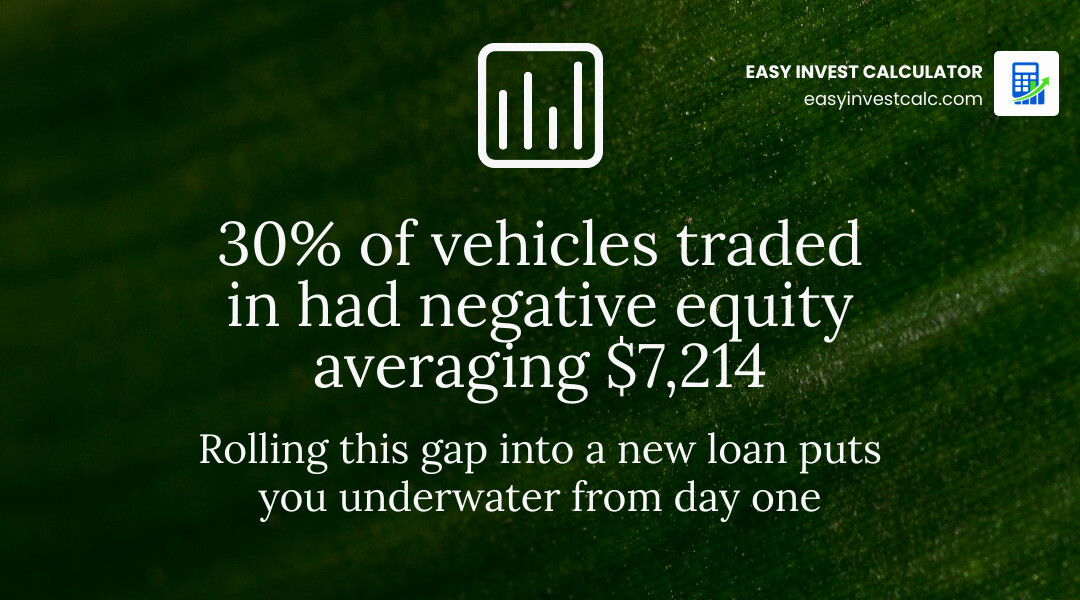
The Negative Equity Trap At the end of 2025, data showed that 30% of vehicles traded in had negative equity averaging $7,214. If you owe $30,000 on your current car but the dealer only offers you $23,000, that $7,000 “gap” doesn’t disappear. It gets rolled into your new loan.
If you use an auto mortgage calculator on a $40,000 car but roll in $7,000 of negative equity, you are now financing $47,000 for a $40,000 asset. You are “underwater” from day one.
Hidden Costs to Include:
- Sales Tax: Most states charge 5% to 9%. 45 states allow you to subtract your trade-in value from the purchase price before calculating tax.
- Dealer Fees: Documentation fees can range from $100 to $1,000 depending on the state.
- Registration and Title: These are government fees that vary by weight and vehicle type.
- Protection Plans: GAP insurance, extended warranties, and tire protection can add $30 to $100 to your monthly payment.
The “True Cost” Beyond the Payment The loan payment is only about 60% of what it actually costs to own a car. To find your true monthly budget, add these 2026 averages:
- Insurance: $150–$250/month
- Fuel/Charging: $100–$200/month
- Maintenance: $50–$100/month
If your auto mortgage calculator says $600, your real-world cost is likely closer to $950. Always use our auto loan calculator to factor in these extras before you sign the dotted line.
Frequently Asked Questions
What is the OBBBA 2026 auto loan interest tax deduction?
The One Big Beautiful Bill Act allows taxpayers to deduct up to $10,000 in auto loan interest annually for new, US-assembled vehicles purchased between 2025 and 2028. It is an above-the-line deduction, but it does have income phase-outs starting at $100,000 for single filers.
How does negative equity affect my new car loan?
Negative equity (being “underwater”) occurs when you owe more on your trade-in than it is worth. This balance is added to your new loan principal, increasing your monthly payment and total interest paid. It also makes it harder to sell the new car later because you will still owe the “rolled-over” debt.
Why is an 84-month loan term considered “danger” territory?
An 84-month loan (7 years) is risky because the car’s value drops much faster than the loan balance. You will likely have negative equity for 5 or 6 years. Additionally, the total interest cost on an 84-month loan is significantly higher than on a 48 or 60-month loan, often adding thousands of dollars to the total price of the vehicle.
Conclusion
At EasyInvestCalc, we believe that financial empowerment starts with accurate data. Buying a car is one of the biggest financial decisions you’ll make, and the stakes in 2026 are higher than ever with rising vehicle prices and complex tax laws like the OBBBA.
By using an auto mortgage calculator, you stop being a “payment buyer” and start being a “smart borrower.” You can see through dealership shells games, account for negative equity, and ensure your new ride fits comfortably within your long-term financial goals. Don’t leave your bank account to chance—take control of the math before you take the keys.
Calculate your monthly payment now and drive away with confidence!

Founder of EasyInvestCalc.com with 8+ years of experience in personal finance. Sunita simplifies complex financial mathematics—from SIP compounding to tax planning—empowering Indian investors to make smart, debt-free decisions based on real market mechanics.