
What a 30 Year Mortgage Calculator Actually Tells You (And Why It Matters)
A 30 year mortgage calculator is the fastest way to find out what a home will really cost you each month — before you ever talk to a lender.
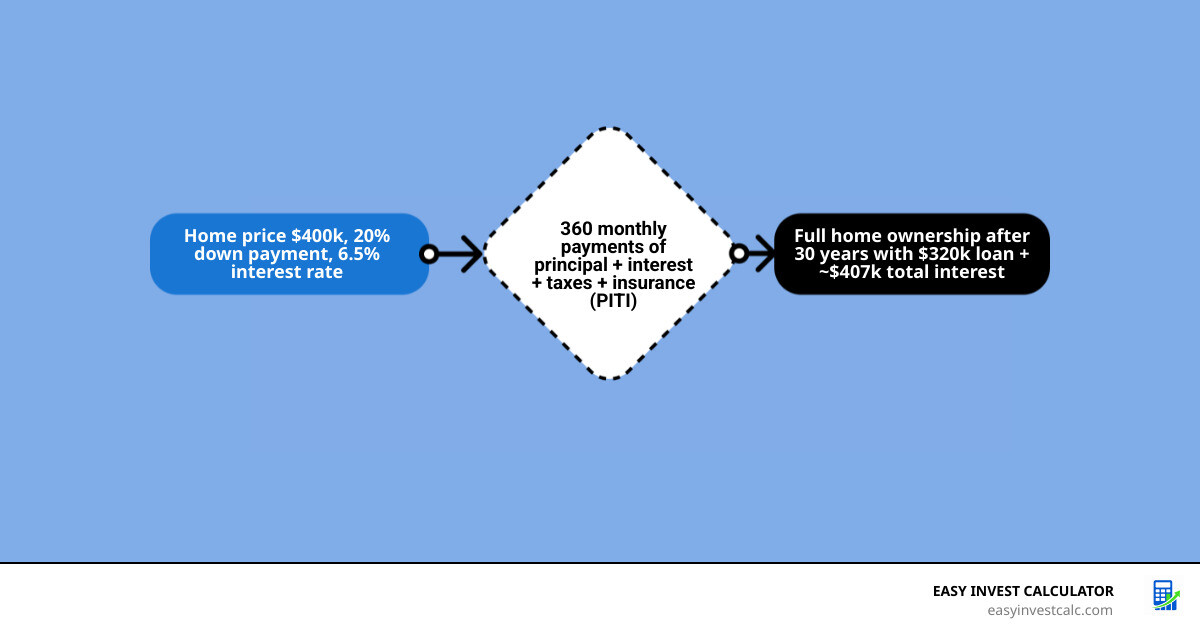
Quick Answer: How to Calculate Your 30-Year Mortgage Payment
Use this formula or plug your numbers into a calculator:
| Input | Example |
|---|---|
| Home price | $400,000 |
| Down payment (20%) | $80,000 |
| Loan amount | $320,000 |
| Interest rate (2026 avg.) | 6.5% |
| Monthly P&I payment | ~$2,023 |
| Add property tax (~1.1%/yr) | +$367/mo |
| Add homeowners insurance | +$125/mo |
| Total monthly payment (PITI) | ~$2,515 |
Most people look at a listing price and think they know their monthly payment. They don’t.
The real number includes four things: principal, interest, property taxes, and insurance — often called PITI. On a $400,000 home, that can add $500 or more on top of what a basic calculation shows.
Here’s what makes the 30-year mortgage so popular: it’s the most common home loan in the United States, representing 70% to 90% of all mortgages. The lower monthly payments compared to shorter loan terms make homeownership accessible for millions of people — even if it means paying more interest over time.
In 2026, with 30-year fixed rates sitting around 6.5–7.0%, knowing exactly what you can afford before you start house hunting isn’t just helpful — it’s essential.
Simple 30 year mortgage calculator word guide:
- amortization schedule calculator
- amortization schedule with extra payments
- annual amortization calculator
How to Use a 30 Year Mortgage Calculator Step-by-Step
Think of using a 30 year mortgage calculator as training for the marathon of homeownership. You wouldn’t run 26.2 miles without checking your pace, and you shouldn’t sign a 30-year contract without checking the math. At EasyInvestCalc, we believe in making this process as smooth as possible.

Step 1: Enter the Home Price
Start with the “sticker price” of the home. In May 2026, the market has stabilized, but prices remain a significant factor in your overall debt-to-income ratio. This is the total purchase price before any down payments are subtracted.
Step 2: Set Your Down Payment
Your down payment is the cash you bring to the table. Most people aim for 20% to avoid Private Mortgage Insurance (PMI), but many loans allow for as little as 3% or 3.5% down. Don’t Let the Math Scare You Away from Your Dream Home by thinking you need a massive pile of cash; there are programs designed to help.
Step 3: Input the Interest Rate
As of May 2026, national averages for a 30-year fixed mortgage are hovering between 6.3% and 6.8%. Even a 0.5% difference can change your monthly payment by over $100 and save (or cost) you $37,000 over the life of the loan.
Step 4: Choose the Loan Term
Since we are focused on the marathon, you’ll select “30 years” (or 360 months). This term offers the lowest monthly payment compared to 15-year or 20-year options, giving you more “breathing room” in your monthly budget.
Step 5: Include the “Hidden” Costs
To get a truly accurate estimate, you must include:
- Property Tax: On average, Americans pay about 1.1% of their property’s value annually.
- Homeowners Insurance: Lenders require this to protect the asset.
- HOA Fees: If you’re buying a condo or a home in a planned community, these fees are non-negotiable.
- ZIP Code: This often helps the calculator estimate local tax rates more accurately.
By following these steps, you can Calculate Your Rental Yield and Mortgage Repayments Like a Pro and walk into a lender’s office with confidence.
Understanding the PITI Components of Your Monthly Payment
When you use a 30 year mortgage calculator, the result isn’t just one big blob of money. It is a cocktail of different financial obligations. Understanding these components—Principal, Interest, Taxes, and Insurance (PITI)—is vital for long-term planning.
Principal and Interest (The Core)
The Principal is the actual amount you borrowed. The Interest is the “rent” you pay to the bank for using their money. In the early years of a 30-year mortgage, a massive portion of your payment goes toward interest. For example, on a $320,000 loan at 6.5%, your first payment might see $1,733 going to interest and only $290 going toward the principal.
Taxes and Insurance (The Escrow)
Most lenders require an escrow account where they collect 1/12th of your annual property taxes and homeowners insurance each month.
- Property Taxes: These vary wildly by state—from 0.28% in Hawaii to over 2% in New Jersey.
- Homeowners Insurance: Expect to pay between $1,200 and $2,000 per year for a standard single-family home.
Private Mortgage Insurance (PMI)
If your loan-to-value (LTV) ratio is higher than 80% (meaning you put down less than 20%), you’ll likely pay PMI. This protects the lender, not you. It typically costs between 0.3% and 1.9% of the loan amount annually.
| Feature | 30-Year Fixed | 15-Year Fixed |
|---|---|---|
| Monthly Payment | Lower (e.g., $2,023) | Higher (e.g., $2,790) |
| Total Interest Paid | Significantly Higher | Significantly Lower |
| Interest Rate | Slightly Higher | Slightly Lower |
| Equity Building | Slower | Much Faster |
For a detailed look at how these numbers shift over time, you can use our Mortgage with Bankrate Amortization Calculator to see the month-by-month breakdown. You can also stay updated on the latest Scientific research on mortgage market trends to ensure your interest rate inputs are realistic for the 2026 economy.
Strategies to Win the Marathon: Paying Off Your Loan Faster
The biggest downside of a 30-year mortgage is the total interest. Over 360 payments, you might end up paying back double what you borrowed. However, you aren’t stuck in that marathon pace forever. You can “sprint” at certain points to finish early.
The Power of Extra Payments
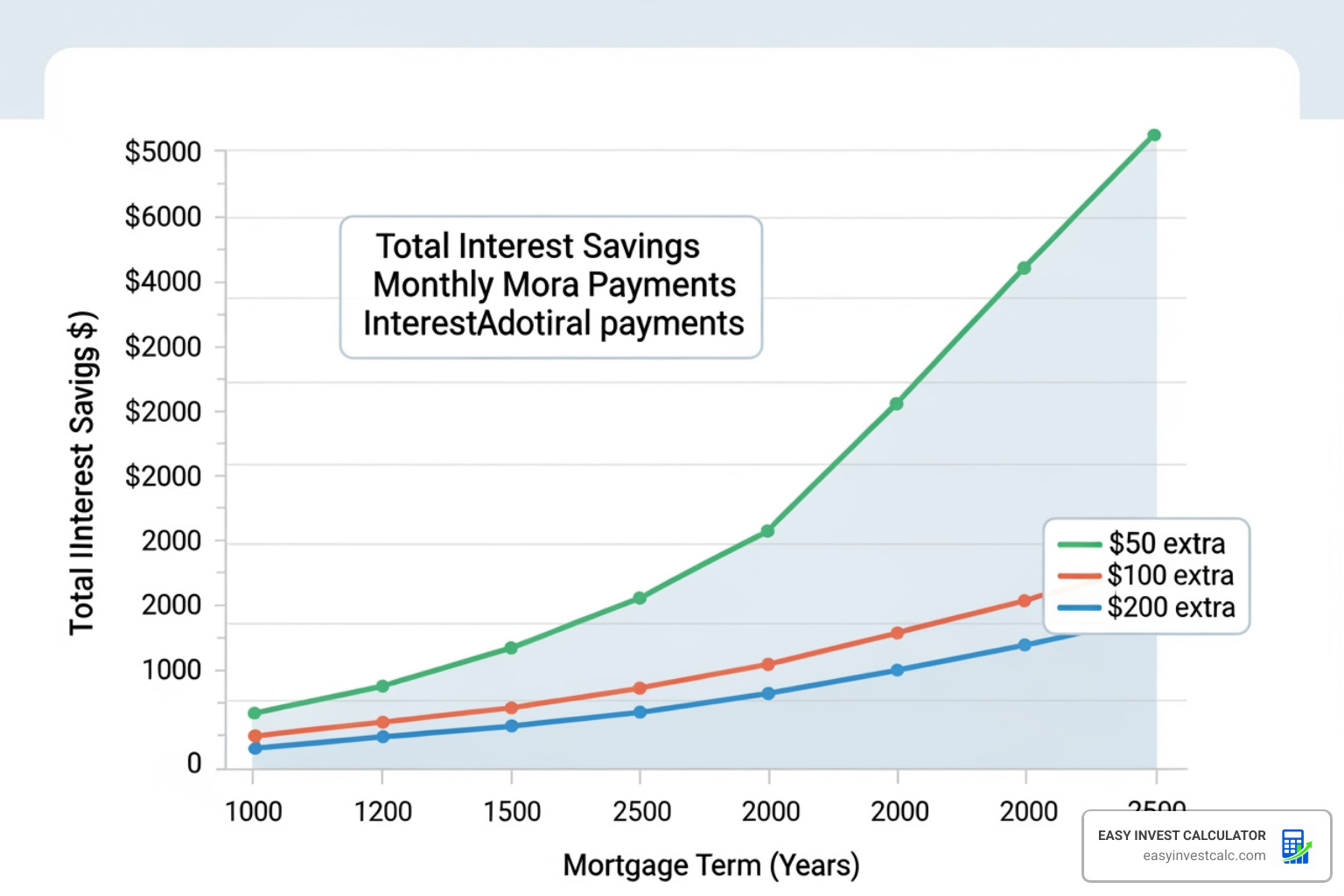
Making even one extra principal payment per year can shave 4 to 5 years off your loan term. Because of how amortization works, extra payments made early in the loan have an outsized impact. They stop interest from ever accruing on that portion of the principal.
Bi-Weekly Payment Schedules
Instead of one monthly payment, you make half a payment every two weeks. This results in 26 half-payments, or 13 full payments per year. This simple trick can save over $66,000 in interest on a $300,000 loan and cut your payoff date by several years.
Using an Amortization Schedule
To visualize these savings, we recommend you Master Your Yearly Budget with an Annual Amortization Calculator. Seeing the “Remaining Balance” drop faster than the bank’s schedule is a great motivator.
Lump-Sum Payments and Refinancing
If you receive a bonus or inheritance, applying it directly to the principal can drastically alter your loan’s trajectory. Alternatively, if rates drop significantly below the 2026 average of 6.5%, refinancing into a 15-year term could save you hundreds of thousands of dollars, though your monthly payment will rise. Don’t let the complexity of these moves keep You Away from Your Dream Home Loan strategy; use a calculator to run the “what-if” scenarios.
Navigating the 2026 Housing Market and Loan Types
The mortgage market in 2026 is diverse. While the 30-year fixed remains king, the type of loan you choose changes how your 30 year mortgage calculator results look.
Conventional vs. Government-Backed
- Conventional Loans: These are not insured by the government. They usually require higher credit scores but offer more flexibility once you hit 20% equity.
- FHA Loans: Popular for first-time buyers, these allow for a 3.5% down payment. However, they require mortgage insurance premiums (MIP) for the life of the loan in many cases.
- VA and USDA Loans: These often offer 0% down payment options for eligible veterans or rural homebuyers. They typically have some of the lowest interest rates on the market.
The 28/36 Rule
Lenders in 2026 still lean heavily on the 28/36 rule. This suggests that your housing costs (PITI) should not exceed 28% of your gross monthly income, and your total debt (including car loans and credit cards) should not exceed 36%. If you earn $100,000 a year, your monthly housing budget should be around $2,333.
Assumable Mortgages: A 2026 Trend
Interestingly, roughly 23% of active mortgages in 2026 (about 12.2 million loans) are “assumable.” This means a buyer can take over the seller’s existing mortgage—potentially keeping a 3% or 4% rate from the “COVID era” rather than taking a new loan at 6.5%. While these are mostly FHA, VA, or USDA loans, they are a powerful tool for affordability.
Before you commit, it’s wise to Calculate Your Rental Yield and Mortgage if you plan to ever use the property as an investment. Also, remember to budget 2% to 5% of the home price for closing costs, which are the one-time fees paid at the end of the marathon.
Frequently Asked Questions about the 30 Year Mortgage Calculator
When is PMI removed in a 30 year mortgage calculator?
On a conventional loan, Private Mortgage Insurance (PMI) is not permanent. By law, lenders must automatically cancel PMI when your loan balance is scheduled to reach 78% of the original value of your home. However, you can usually request to have it removed once you reach 80% equity (an LTV of 80%) through a new appraisal or extra payments. A 30 year mortgage calculator that includes an amortization table will show you exactly which year and month you’ll hit that 80% threshold.
How do interest rates in 2026 affect my 30 year mortgage calculator estimate?
In 2026, the Federal Reserve’s actions to combat inflation have kept rates in the 6.3% to 6.8% range. This is significantly higher than the record lows of 2021, but lower than the peaks of 2023. Every 1% increase in interest rates reduces your purchasing power by about 10%. This means if rates go up, you have to look for a cheaper house to keep the same monthly payment. Our calculator helps you “stress test” your budget by seeing how a potential rate hike would impact your monthly PITI.
Can I use a 30 year mortgage calculator for an ARM?
You can, but only for the initial “fixed” period. An Adjustable-Rate Mortgage (ARM) might start with a lower rate for the first 5, 7, or 10 years. After that, the rate adjusts based on market conditions. While an ARM might look attractive on a 30 year mortgage calculator initially, you must be prepared for “payment shock” if rates are higher when the adjustment period begins. Most experts recommend the 30-year fixed-rate mortgage for the peace of mind that your “Principal and Interest” payment will never change.
Conclusion
The journey to homeownership is a marathon, not a sprint. A 30 year mortgage calculator is your most valuable training partner, helping you pace your finances and avoid “hitting the wall” with unexpected costs like taxes, insurance, or HOA fees.
At EasyInvestCalc, we provide the tools you need to see the finish line clearly. Whether you are using our detailed amortization tables to see how extra payments could save you $70,000 in interest, or simply checking your basic affordability, we are here to simplify the math.
Ready to see your numbers? Use our emi-calculator to get started today and take the first step toward your dream home with total financial clarity. The best time to understand your mortgage is before you sign it!

Founder of EasyInvestCalc.com with 8+ years of experience in personal finance. Sunita simplifies complex financial mathematics—from SIP compounding to tax planning—empowering Indian investors to make smart, debt-free decisions based on real market mechanics.