
Why Your Auto Amortization Schedule Can Save You Thousands
An auto amortization schedule is a complete, month-by-month breakdown of every loan payment you’ll make — showing exactly how much goes to interest, how much reduces your balance, and when you’ll be debt-free.
Here’s what an auto amortization schedule tells you at a glance:
| Column | What It Means |
|---|---|
| Payment # | Which month’s payment it is |
| Payment Amount | Your fixed monthly payment |
| Interest Portion | Amount paid to the lender as interest |
| Principal Portion | Amount that reduces your loan balance |
| Remaining Balance | What you still owe after that payment |
Most borrowers only know their monthly payment. But that number alone hides a lot. On a typical car loan, your early payments go mostly toward interest — not toward owning more of your car. That changes slowly over time as your balance drops.
This matters because small decisions — your loan term, down payment, or even paying bi-weekly instead of monthly — can mean the difference between paying $3,562 or $4,267 in total interest on the same loan.
If you’re financing a car right now, or planning to, understanding how amortization works puts you in control of one of the largest purchases you’ll make.
What is an Auto Amortization Schedule and How Does It Work?
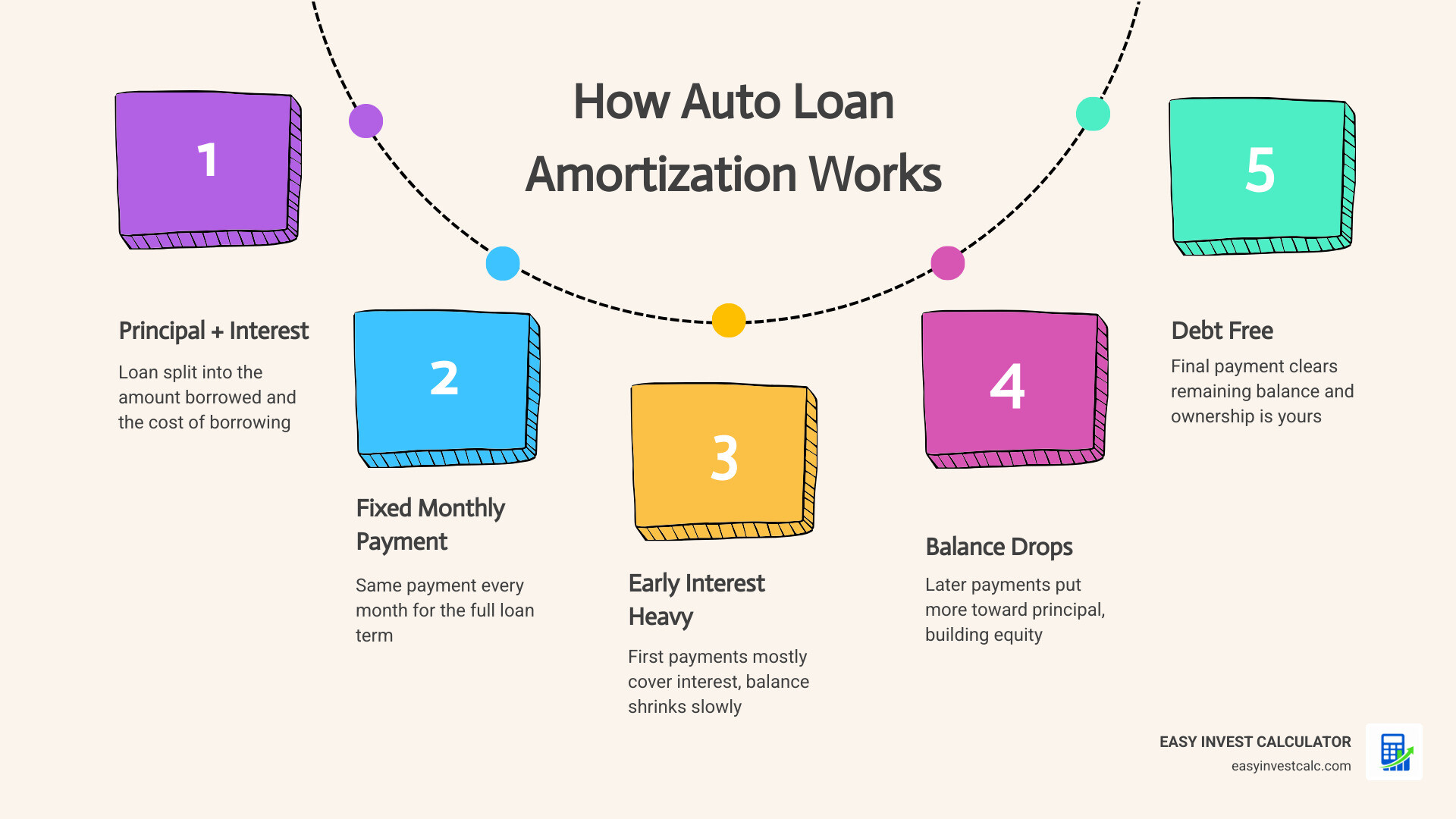
At its core, an auto amortization schedule is a roadmap for your debt. When you take out a car loan, you aren’t just paying back the price of the car (the principal); you’re also paying for the privilege of borrowing that money (the interest).
Amortization is the process of spreading those payments out over a set period. Unlike a credit card, which is revolving debt, a car loan is an “installment loan.” This means the monthly payment is usually fixed, but the way that payment is sliced up changes every single month.
Understanding Simple Interest
Most modern auto loans use a simple interest formula. This means interest is calculated based on the balance you owe on the day the payment is due. Because your balance is highest at the beginning of the loan, your interest charges are also highest during those first few months. As you chip away at the principal, there is less “balance” for the interest rate to grab onto, so more of your money starts going toward the actual car.
To see how these numbers look for your specific budget, you can use our EMI Calculator to get an instant estimate of your monthly commitment.

The Mechanics of an Auto Amortization Schedule
How do we actually get these numbers? It’s not magic; it’s math. The formula for a monthly payment takes into account the total loan amount ($P$), the monthly interest rate ($i$), and the total number of months ($n$).
Each month, the lender looks at your remaining balance and multiplies it by your interest rate (divided by 12). That’s the interest portion. They subtract that from your total payment, and whatever is left over is the principal portion that actually reduces your debt.
Comparison: The Cost of Time (May 2026 Market Rates)
In May 2026, we are seeing a significant difference in total costs based on the loan term. Let’s look at a $30,000 loan at a standard interest rate of around 7%.
| Loan Term | Monthly Payment | Total Interest Paid |
|---|---|---|
| 48 Months | $719 | $4,496 |
| 60 Months | $593 | $5,591 |
As you can see, stretching the loan out by just one year lowers your monthly bill by $126, but it costs you an extra $1,095 in interest. This is why the auto amortization schedule is so vital—it reveals the “hidden” cost of lower monthly payments.
APR vs. Interest Rate: Understanding the Difference
When you’re looking at your schedule, you might see two different percentages: the interest rate and the APR (Annual Percentage Rate). It is easy to confuse them, but they aren’t the same thing.
- Interest Rate: This is the base cost of borrowing the principal.
- APR: This is the “all-in” cost. It includes the interest rate plus any lender fees, origination charges, or documentation fees.
The APR is the most transparent number to use when comparing offers from different lenders. If one bank offers a 6% rate with $500 in fees and another offers 6.2% with zero fees, the APR will tell you which one is actually cheaper over the life of the loan.
Factors That Shape Your Loan Repayment
Your auto amortization schedule isn’t just a generic document; it’s a reflection of your financial health and the choices you make at the dealership.
Credit Scores and Interest Rates
Your credit score is the biggest lever in determining your interest rate. According to recent data from May 2026, the gap is massive:
- Excellent Credit (781-850): Average rates are around 4.88%.
- Deep Subprime (300-500): Average rates skyrocket to 15.85%.
On a $20,000 loan, that difference in interest can mean thousands of dollars staying in your pocket—or going to the bank.

The Role of Down Payments and Vehicle Condition
A down payment is your first line of defense against high interest. By putting money down, you reduce the starting principal.
- Example: On a $45,000 MSRP car, a $9,000 down payment at 6.40% interest results in $6,162 in total interest. If you increase that down payment to $12,000, your interest cost drops to $5,648. That’s a $514 saving just for paying more upfront!
Vehicle condition also matters. New cars typically qualify for lower interest rates than used cars because they are easier for the bank to value and resell if you default. However, used cars depreciate more slowly, which can help you stay “right-side up” on your loan.
Strategies to Pay Off Your Car Loan Faster
You are not stuck with the original schedule the bank gave you. You have the power to “hack” your amortization.
Principal-Only Extra Payments
The most effective way to save money is to make extra payments. When you pay more than the minimum, you should specify that the extra money goes toward the principal. This reduces the balance immediately, meaning the bank has less to charge interest on next month.
We call this Extra Payments: The Secret Sauce for Debt Freedom. Even an extra $50 a month can shave months off your loan and save you hundreds in interest. You can model these scenarios using our Amortization Schedule with Extra Payments tool.
Bi-Weekly vs. Monthly Payment Schedules
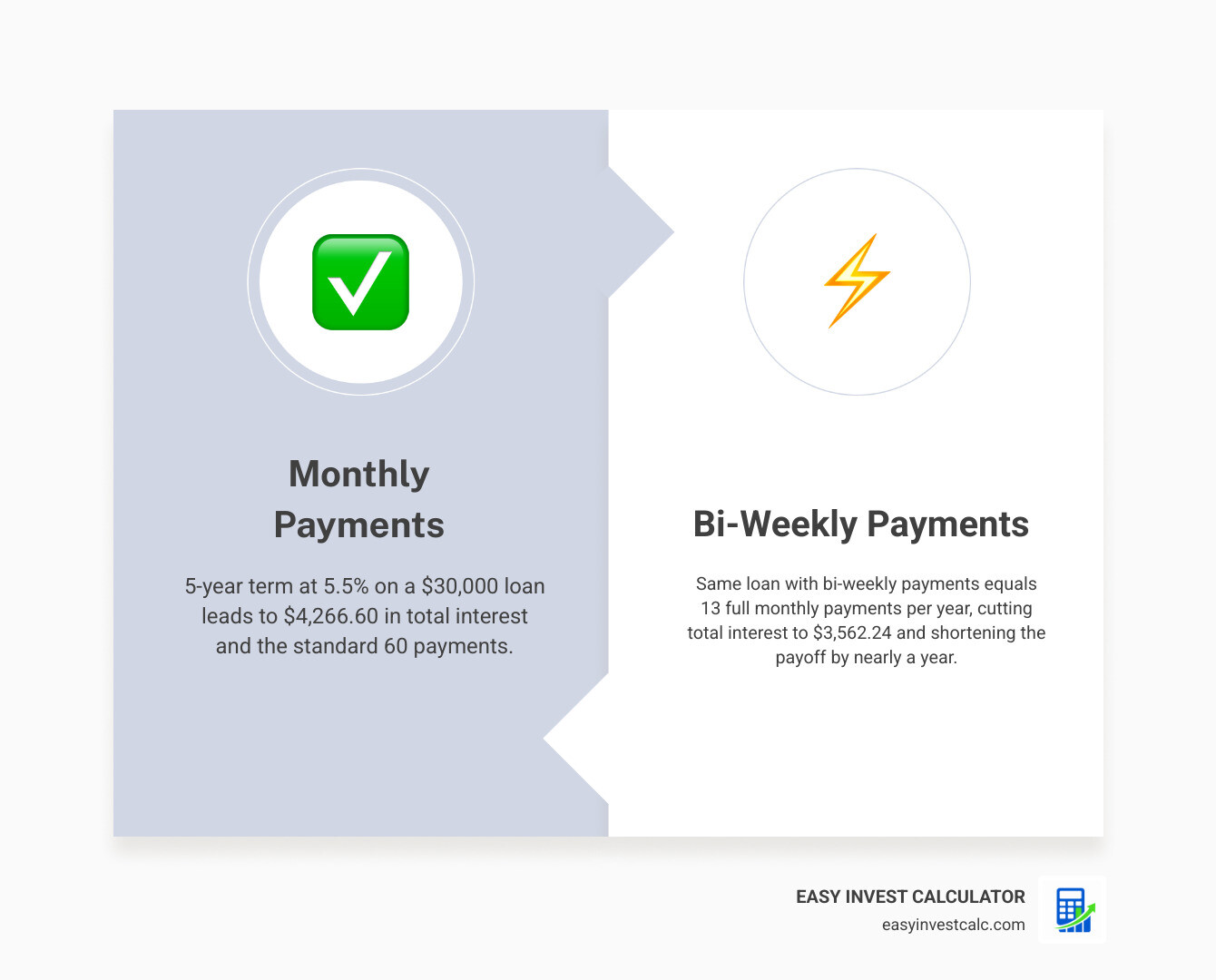
Many people choose to pay bi-weekly (every two weeks) instead of once a month. Since there are 52 weeks in a year, you end up making 26 half-payments, which equals 13 full monthly payments.
That “extra” month of payment goes entirely toward principal. On a $30,000 car at 5.5% for 5 years:
- Monthly Payments: Total interest = $4,266.60
- Bi-Weekly Payments: Total interest = $3,562.24
By simply changing the frequency, you save over $700 and pay the car off nearly a year early! If you’re used to saving in a fixed deposit, you might use our FD Calculator to compare if that extra cash is better spent on your loan or an investment.
When to Consider Refinancing Your Auto Loan
If interest rates have dropped since you bought your car, or if your credit score has improved significantly, refinancing could be a smart move. Refinancing replaces your old loan with a new one, usually at a lower rate. This generates a brand-new auto amortization schedule that could lower your monthly payment and your total interest cost. Just be sure to check for any prepayment penalties on your current loan first!
Avoiding the Trap of Negative Equity
One of the scariest terms in car buying is “negative equity,” often called being “upside-down” or “underwater” on a loan. This happens when you owe the bank more than the car is actually worth.
Why Does This Happen?
Vehicles are depreciating assets. A new car can lose 15-20% of its value in the very first year. Because an auto amortization schedule is “back-loaded” (meaning you pay mostly interest at the start), your loan balance drops slowly while the car’s value drops quickly.
How to Stay Safe:
- Aim for 20% Down: This creates an immediate “buffer” of equity.
- Keep Terms Short: Try to keep your loan to 60 months or less. 84-month loans are a recipe for negative equity.
- Gap Insurance: If you have a low down payment, gap insurance covers the “gap” between what you owe and what the car is worth if it gets totaled.
Frequently Asked Questions about Auto Amortization
Can I change my amortization schedule without refinancing?
Technically, the “contracted” schedule stays the same, but your effective schedule changes every time you make an extra payment. By paying more toward the principal, you are manually shortening the term and reducing the total interest, even if the bank’s paperwork hasn’t changed.
Why is my interest so high at the beginning of the loan?
This is simply how simple interest works. Interest is a percentage of what you owe. Since you owe the most on Day 1, the interest charge is at its peak. As you pay down the balance, the interest “fee” gets smaller and smaller.
Does paying a few days early actually save money?
Yes! Because most auto loans accrue interest daily, paying your bill 5 or 10 days before the due date reduces the average daily balance for that month. Over a 60-month loan, these “early” days can add up to real savings.
Conclusion
Understanding your auto amortization schedule is the difference between being a passive borrower and a smart investor in your own future. By knowing how your payments are split between principal and interest, you can make informed decisions about loan terms, down payments, and extra payments.
At EasyInvestCalc, we believe that financial clarity shouldn’t be complicated. Whether you are looking to buy a new sedan or a rugged truck, use our tools to plan your path to debt freedom. Calculate your monthly payment now and take the first step toward owning your car—instead of your car owning you.
Frequently Asked Questions (FAQs)
What is an auto amortization schedule?
An auto amortization schedule is a detailed table that shows every car loan payment over the full loan term. It breaks down how much of each payment goes toward interest and principal while also displaying the remaining balance after every payment.
How does an auto amortization schedule work?
The schedule calculates monthly payments based on the loan amount, interest rate, and repayment period. Early payments mainly cover interest, while later payments reduce more of the principal balance.
Can extra payments reduce my car loan interest?
Yes. Making extra payments directly toward the principal can reduce the total interest paid and help you pay off your auto loan faster.
Is bi-weekly payment better than monthly payment?
Bi-weekly payments can help reduce interest costs because you make the equivalent of one extra monthly payment each year, which lowers the principal balance faster.
What is the difference between APR and interest rate?
The interest rate is the cost of borrowing the loan amount, while APR includes both the interest rate and additional lender fees, giving a more complete picture of the total borrowing cost.
Can I refinance my car loan later?
Yes. Refinancing may help lower your monthly payments or reduce total interest if market rates decrease or your credit score improves.
Why do early loan payments mostly go toward interest?
Auto loans usually use simple interest calculations. Since the loan balance is highest at the beginning, the interest portion is also highest during the early months.
How can I avoid negative equity on a car loan?
You can reduce the risk of negative equity by making a larger down payment, choosing a shorter loan term, and avoiding excessive financing periods.

Founder of EasyInvestCalc.com with 8+ years of experience in personal finance. Sunita simplifies complex financial mathematics—from SIP compounding to tax planning—empowering Indian investors to make smart, debt-free decisions based on real market mechanics.