

Rajesh Kumar, a senior manager in Bangalore, earned Rs 2.5 lakh monthly. He had no debts and a good lifestyle. Yet, he always wondered: where did all the money go?
This wasn’t about earning too little or spending too much. It was a clarity crisis.
The real challenge isn’t earning enough. It’s knowing where our money goes each month. Money vanishes into EMIs, subscriptions, weekend trips, and unexpected costs.
Financial expert Dave Ramsey says: “A budget is telling your money where to go instead of wondering where it went.” The 50/30/20 budgeting rule does just that. It turns confusion into clarity with a simple three-part system.
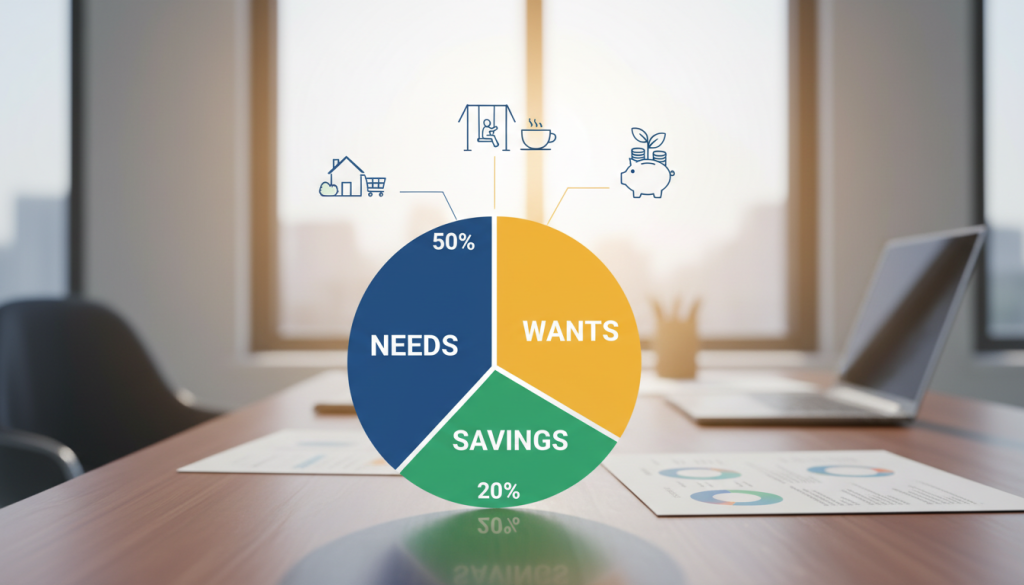
This rule splits your salary into three parts: 50% for needs, 30% for wants, and 20% for wealth creation through budgeting. It’s easier than tracking money in fifteen categories. This method stays simple for years.
Most financial plans fail because they’re too hard to keep up. The beauty of this system is its simplicity. It requires just three decisions and allocations for lasting financial discipline.
Key Takeaways
- The “clarity crisis” affects even high-earning Indian professionals who lack visibility into their monthly expenditure patterns
- Simple financial systems prove more sustainable than complex tracking methods that typically collapse within three weeks
- The framework allocates 50% for essential needs, 30% for lifestyle choices, and 20% towards systematic savings and investments
- This approach works across various income levels in India, from Rs 50,000 to Rs 10 lakh monthly earnings
- Financial clarity emerges not from deprivation but from intentional allocation of resources across three distinct categories
- Long-term wealth accumulation depends on consistent implementation, not complicated budgeting spreadsheets
Understanding the Foundation of Smart Money Management
Smart money management starts with one key idea: structure turns financial chaos into wealth. Without a plan, even those who earn a lot wonder where their money goes each month. The 50/30/20 rule brings this structure with simple math.
This budgeting method isn’t just a trend from abroad. It tackles the big challenge every Indian family faces—balancing needs, wants, and long-term security. It works for all income levels and life stages.
What Makes the 50/30/20 Rule Effective for Wealth Building
The 50/30/20 rule works because of its simple math. Whether you make Rs 50,000 or Rs 5 lakh a month, the same percentages apply. As your income grows, so does your wealth-building power, without needing to change the formula.
This method changes how you think about saving. Instead of saving what’s left after spending, you spend what’s left after automating your savings first.
“Most people save what is left after spending. The 50-30-20 rule inverts this: you spend what is left after saving. That single reversal is worth more than any investment decision.”— Hemant Beniwal, CFP, CTEP, Founder of RetireWise
This change happens through automation. On the day you get paid, 20% goes straight to savings. It’s not what’s left after spending—it’s the first part of your income.
Consider a senior executive making Rs 3 lakh a month. Their 20% goes to savings, which is Rs 60,000 a month.
| Investment Period | Monthly Investment (20%) | Assumed CAGR | Wealth Created |
|---|---|---|---|
| 15 years | Rs 60,000 | 12% | Rs 3.02 crore |
| 20 years | Rs 60,000 | 12% | Rs 5.94 crore |
| 25 years | Rs 60,000 | 12% | Rs 11.32 crore |
This wealth comes from just the 20% savings. The numbers assume a 12% return, which is possible with diversified mutual funds. Increasing SIPs with salary hikes can grow your wealth even more.
This method works because it’s easy, flexible, and keeps you going. Unlike detailed budgeting, you only need to check your spending every three months. This makes it easier to stick to.
Why Indian Households Need Structured Financial Planning
Indian families face unique money challenges that make planning key. Joint family expenses can be unpredictable. Social spending on weddings and festivals can also derail budgets.
Big festivals mean big expenses all year. Diwali, Durga Puja, Onam, Pongal—each festival brings extra costs. Without a plan, these celebrations can clash with saving goals.
Education costs are another big challenge. From exam coaching to university fees, parents face growing expenses. Healthcare costs add to the pressure, making insurance vital.
As incomes rise, so do lifestyle expectations. Upgraded homes, fancy cars, and holidays become more common. Without a plan, these expenses can eat up all your income growth, leaving savings stagnant.
Variable income adds complexity. Many professionals get bonuses and performance pay. These irregular amounts need careful handling to avoid overspending.
The 50/30/20 rule tackles these challenges with clear rules. Festival spending comes from the 30% wants bucket. Education gets a dedicated share in the 20% savings. Bonus income is split using the same percentages, stopping the excuse for unplanned spending.
The Psychology Behind Percentage-Based Budgeting
Percentage-based budgeting makes budgeting easier than tracking every expense. You manage just three buckets instead of dozens. This simplifies budgeting and reduces the stress that leads to budget failures.
This method works because it aligns with how we naturally think about money. Behavioural economics shows we naturally divide money into different mental categories. The 50/30/20 rule fits with this natural tendency.
The three-bucket system lets you enjoy spending within limits. You don’t need to justify your streaming or dining out—it just needs a budget. As long as wants stay within 30%, you won’t feel guilty.
This approach is key for sticking to your budget. Too strict budgets can lead to resentment and rebellion. By setting aside 30% for wants, you avoid financial misery.
The 20% savings bucket works differently in your mind. It’s automated, so you don’t see it as available. This stops the temptation to spend it.
Checking your spending every three months is easier than daily tracking. This balance keeps you aware without stressing you out. It’s a way to stay on track without feeling overwhelmed.
This method also uses commitment devices from psychology. By automating savings, you make it harder to spend it impulsively. Accessing your 20% savings requires effort, making it less tempting to spend.
Perhaps most importantly, this method scales with your income. The percentages stay the same, whether you earn Rs 75,000 or Rs 7.5 lakh. This consistency builds lasting financial discipline that grows with your wealth.
50/30/20 Budgeting Rule: A Mathematical Blueprint for Wealth Creation in India
Breaking down your income into three parts makes financial advice real. The 50/30/20 rule helps Indian families balance today and tomorrow. It removes guesswork from money management, creating a system that works every month.
Before deciding on expenses, ask if stopping them would change your life. If yes, it’s a need. If not, it’s a want. This helps avoid mistaking lifestyle choices for necessities.
The 50% Allocation: Covering Essential Needs
Your needs bucket is the foundation of daily life. It includes housing, food, and utilities. For many Indian families, staying within 50% requires careful monitoring, as housing costs can be high.
Just because something feels important doesn’t mean it’s a need. Premium cable and luxury cars might feel essential but are not needs. The 50% rule demands honest categorisation.
Housing Costs: Rent, EMI, and Property Maintenance
Housing is the biggest expense for most Indian households. Rent or home loan EMI should not exceed 15% of income. In cities like Mumbai, costs often reach 30-35% of take-home pay.
A professional earning ₹80,000 monthly in Bangalore might spend ₹28,000 on rent. This leaves only ₹12,000 for other needs. This scenario demands reducing housing costs or accepting temporary adjustments.
Property maintenance includes society charges and repairs. These costs add 5-10% to the EMI. Joint family arrangements can reduce housing costs, making the 50% target more achievable.
Food and Groceries: Planning for Indian Households
Monthly food expenses vary based on household size and city. A family of four in a tier-2 city might spend ₹8,000-₹12,000 monthly. In Mumbai, the same family could spend ₹15,000-₹20,000.
Planning monthly provisions and fresh purchases separately can reduce costs. Buying staples in bulk from wholesale markets can save 15-20% compared to supermarkets. Avoiding food waste protects both the budget and the environment.
Joint family living spreads grocery costs across multiple earners. Even nuclear families can implement meal planning to prevent overbuying and reduce dependency on expensive packaged foods.
Transportation: Commute and Vehicle Expenses
Transportation costs include daily commute and vehicle ownership. Public transport users might spend ₹2,000-₹3,500 monthly. Two-wheeler owners face EMIs, petrol costs, insurance premiums, and maintenance.
Car ownership increases expenses. Beyond the EMI, factor in petrol costs, insurance premiums, servicing, and parking fees. For someone earning ₹60,000 monthly, a car EMI of ₹15,000 plus running costs of ₹6,000 consumes 35% of income.
Work-from-home arrangements have reduced commute costs for many professionals. This frees up funds within the needs budget. This shift allows reallocation to other essentials or temporary boosting of the savings rate during hybrid work periods.
Health insurance premiums belong in the needs category, not wants. A family floater policy covering ₹10-₹15 lakh costs ₹15,000-₹25,000 annually. This translates to ₹1,250-₹2,100 monthly—a non-negotiable investment that protects against catastrophic medical expenses.
Beyond insurance, budget for routine healthcare. Regular check-ups, dental visits, and prescription medications for chronic conditions are essential. Indian families often underestimate these costs, allocating nothing until emergencies arise. A realistic healthcare budget includes ₹1,500-₹3,000 monthly for a family, covering both insurance premiums and routine medical needs.
Term life insurance for the primary earner also qualifies as a need, for families with dependents or outstanding loans. Premiums for adequate coverage (10-15 times annual income) remain affordable when purchased young, typically ₹8,000-₹15,000 annually for non-smokers in their 30s.
Utilities: Electricity, Water, and Internet Bills
Utility expenses have increased with remote work and increased home time. Electricity bills in summer months can reach ₹3,000-₹6,000 monthly. Water charges in apartment complexes add ₹500-₹1,500, whilst cooking gas cylinders cost approximately ₹800-₹1,000 each.
Reliable internet connectivity shifted from luxury to necessity during the pandemic. Broadband plans of 50-100 Mbps cost ₹500-₹1,200 monthly, depending on provider and location. Mobile phone plans with adequate data add another ₹300-₹600 per person. Combined, communication costs claim ₹1,500-₹3,000 monthly for a typical household.
Total utility expenses typically consume ₹5,000-₹10,000 monthly, varying significantly by season, household size, and consumption patterns. Energy-efficient appliances and mindful usage can reduce these costs by 15-20% without compromising comfort.
| Essential Need Category | Typical Monthly Range (₹) | Percentage of ₹60,000 Income | Budget Management Tips |
|---|---|---|---|
| Housing (Rent/EMI) | 12,000 – 20,000 | 20% – 33% | Consider flatsharing or suburban locations to stay under 25% threshold |
| Food & Groceries | 8,000 – 15,000 | 13% – 25% | Bulk buying of staples and weekly fresh market shopping reduces costs |
| Transportation | 2,500 – 8,000 | 4% – 13% | Public transport or two-wheeler keeps costs manageable versus car ownership |
| Healthcare & Insurance | 2,500 – 4,000 | 4% – 7% | Annual premium payment with monthly budgeting prevents surprises |
| Utilities | 5,000 – 10,000 | 8% – 17% | Energy-efficient appliances and conscious usage reduce bills significantly |
The 30% Allocation: Discretionary Spending on Wants
The wants bucket often exceeds its limit, driven by growing incomes and lifestyle pressures. This allocation covers lifestyle improvements not essential for survival. The 30% boundary allows for enjoyment without destroying wealth-building capacity.
Understanding wants as legitimate and valuable removes restrictive budgeting. Life includes entertainment, social experiences, and personal expression. The discipline is in keeping these within the 30% boundary, not eliminating them.
Entertainment: OTT Subscriptions, Cinema, and Events
India’s subscription economy has grown, with households often maintaining multiple services. Each subscription costs ₹200-₹1,000 monthly, quickly adding up to ₹2,000-₹4,000. Annual subscriptions save 15-25% compared to monthly renewals.
Cinema outings for a family cost ₹2,000-₹3,500 per visit. Concert tickets, theatre shows, and sporting events are occasional splurges. These experiences create memories and cultural enrichment, justifying their place in a balanced budget.
Gaming subscriptions, hobby classes, and club memberships also fall into entertainment. The key is conscious choice—selecting activities that genuinely bring joy.
Dining Out and Food Delivery Services
Food delivery apps have made restaurant-quality meals accessible. A meal costing ₹200 in-restaurant becomes ₹300-₹350 with delivery charges. Frequent ordering can consume ₹8,000-₹15,000 monthly without tracking.
Dining out provides social connection and variety. A realistic dining budget for a couple might include 4-6 restaurant visits monthly at ₹1,000-₹2,500 per visit. Adding weekly café visits at ₹500-₹800 brings monthly dining expenses to ₹8,000-₹15,000.
Setting a monthly dining budget and tracking expenses helps maintain the 30% discipline. Choosing between delivery convenience and restaurant experiences based on the budget boundary prevents overspending.
Shopping: Clothing, Electronics, and Lifestyle Products
Indian festivals and wedding seasons increase wardrobe demands. Ethnic wear for occasions, seasonal shopping, and professional attire generate recurring expenses. A reasonable clothing budget might allocate ₹3,000-₹8,000 monthly, with higher spending during festival months balanced by lower spending in other periods.
Electronics upgrades—smartphones, laptops, tablets, smartwatches, and accessories—represent significant one-time expenses. Planning for these purchases by setting aside funds monthly is essential. A smartphone costing ₹40,000 every three years translates to ₹1,100 monthly allocation within the wants bucket.
Home décor, furniture upgrades, gardening supplies, books, and lifestyle products add character to living spaces. These purchases enhance daily life without qualifying as needs. Spreading major purchases across months prevents the wants budget from exploding in any single period.
Travel and Holiday Expenses
Annual vacations provide mental rejuvenation and family bonding. A week-long domestic trip for a family might cost ₹40,000-₹80,000. International holidays escalate to ₹1,50,000-₹3,00,000 depending on destination and comfort level.
Breaking holiday costs into monthly savings makes these experiences achievable without debt. A family targeting ₹60,000 for their annual vacation needs to allocate ₹5,000 monthly within the wants budget. Weekend getaways to nearby destinations offer refreshment at lower costs, typically ₹8,000-₹15,000 for a couple.
Visiting family in other cities also generates travel expenses—train or flight tickets, gifts, and local transport. For professionals working away from hometown, these visits occur multiple times yearly and deserve budget allocation within the 30% category.
The 20% Allocation: Systematic Wealth Creation
The financial goals bucket represents the engine of long-term wealth creation. This 20% allocation funds emergency reserves, eliminates high-interest debt, builds retirement corpus, and creates financial independence. Many Indian professionals discover they’re already contributing 12-15% through mandatory Employee Provident Fund (EPF) deductions, meaning an additional 5-8% in voluntary systematic investment plans achieves the 20% target.
Prioritising within this bucket matters significantly. High-interest debt elimination takes precedence over aggressive investing, whilst emergency fund building provides the foundation for all other financial goals. The mathematical discipline of saving 20% consistently, regardless of income level, separates households that build wealth from those that perpetually struggle despite good earnings.
Emergency Fund: Building Your Financial Safety Net
An emergency fund covering 6-12 months of expenses protects against job loss, medical emergencies, or unexpected major repairs. For a household spending ₹50,000 monthly, this translates to ₹3,00,000-₹6,00,000 in liquid, accessible savings. Building this corpus takes time—contributing ₹10,000 monthly requires 30-60 months to fully fund the emergency reserve.
Business owners and professionals in volatile industries should target 12 months of expenses, whilst salaried employees in stable sectors can work towards 6-9 months. The emergency fund sits in high-interest savings accounts or liquid mutual funds, not locked into fixed deposits or equity investments where access might be delayed or penalised.
Once established, the emergency fund requires minimal maintenance—only replenishing after actual use. This frees up the monthly 20% allocation for more aggressive wealth-building instruments like equity mutual funds and retirement accounts.
Debt Repayment: Credit Cards and Personal Loans
Credit card debt charging 36-42% annual interest destroys wealth faster than any investment can create it. Paying only minimum amounts keeps borrowers trapped for years. Mathematically, eliminating this debt takes absolute priority over starting investment SIPs. (if you are struggling with highinterest how to prepare for debt counseling) Redirect the entire 20% allocation towards debt elimination until high-interest obligations disappear.
Personal loans at 12-18% interest also warrant aggressive repayment. Paying off a loan at 15% interest provides a guaranteed 15% return, outperforming most investment options on a risk-adjusted basis. Beyond minimum EMI payments (which sit in the needs budget), extra payments from the 20% bucket dramatically reduce total interest paid and loan duration.
Home loans at 8-10% interest represent lower-priority debt. The tax benefits under Section 80C (principal repayment) and Section 24 (interest payment) reduce the effective interest rate further. Maintaining scheduled EMI payments whilst channelling the 20% allocation towards investments often proves more beneficial than prepaying home loans aggressively.
Investments: Mutual Funds, PPF, and Equity
Equity mutual funds through systematic investment plans (SIPs) form the foundation of wealth creation for most Indian households. Starting with ₹5,000-₹10,000 monthly across diversified large-cap and mid-cap funds builds substantial corpus over 15-20 years through compounding returns. Historical data shows equity funds delivering 10-14% annual returns over long periods, though with significant short-term volatility.
Public Provident Fund (PPF) offers guaranteed returns of 7-7.5% with triple tax benefits—deduction under Section 80C, tax-free interest accumulation, and tax-free maturity proceeds. The 15-year lock-in period suits long-term goals like retirement or children’s education. Contributing the maximum ₹1.5 lakh annually provides tax savings whilst building a secure corpus.
Direct equity investment suits experienced investors comfortable with volatility and research demands. Allocating 20-30% of the investment bucket to carefully selected stocks can enhance returns, though this requires knowledge, time, and temperament that many investors lack. Equity mutual funds provide professional management and diversification for those preferring a hands-off approach.
National Pension System (NPS) offers additional tax benefits under Section 80CCD(1B), allowing ₹50,000 deduction beyond the ₹1.5 lakh Section 80C limit. The market-linked returns and low expense ratios make NPS attractive for retirement planning, despite the lock-in until age 60. Balancing NPS contributions with more liquid investment options maintains flexibility whilst capturing tax benefits.
Retirement Planning: NPS and EPF Contributions
Most salaried professionals already contribute 12% of basic salary to Employee Provident Fund, with employers matching another 12%. For someone earning ₹50,000 basic monthly, this represents ₹6,000 employee contribution plus ₹6,000 employer contribution—₹12,000 monthly or 24% of basic salary automatically flowing towards retirement.
Checking EPF statements reveals that many Indians are already saving significantly towards retirement through mandatory contributions. This realisation changes the planning approach—instead of starting from zero, focus on topping up to achieve adequate retirement corpus. Calculate the retirement gap: amount needed (typically 25-30 times annual expenses) minus projected EPF accumulation equals the shortfall requiring voluntary investments.
Voluntary Provident Fund (VPF) allows additional contributions beyond the mandatory 12%, earning the same risk-free interest (8-8.5% currently) as EPF. This option suits conservative investors seeking guaranteed returns without equity market volatility. The lock-in until retirement or specific conditions must align with liquidity needs.
Combining EPF, NPS, PPF, and equity mutual funds creates a diversified retirement portfolio balancing security with growth. Starting early maximises compounding benefits—a 25-year-old investing ₹10,000 monthly at 12% returns accumulates approximately ₹3.5 crore by age 60, whilst starting the same investment at age 35 yields only ₹1.2 crore.
Step-by-Step Implementation Guide for Indian Earners
Setting up a budgeting formula for Indians is easy. You just need a clear, step-by-step plan. This guide turns the 50/30/20 rule into a daily habit. It helps you build wealth in India, no matter your income.
Focus on making your finances automatic. This way, you avoid daily money decisions. It saves mental energy and helps you make better choices.
Step 1: Calculate Your Actual Monthly Take-Home Income
Start with knowing how much money you really have each month. Many people use their gross salary for budgeting. But, this can lead to unrealistic expectations and failure.
Look at your salary slip carefully. Subtract all mandatory deductions like Employee Provident Fund (12%), professional tax, and Tax Deducted at Source. What’s left is your take-home income.
This net figure is your budgeting baseline. For example, if your gross salary is Rs 60,000 and deductions total Rs 9,300, you have Rs 50,000 to budget.
Remember, your EPF contribution is part of your 20% savings. Many forget this and try to save an extra 20%. This can lead to giving up on budgeting.
Treat bonuses and variable pay differently. Don’t include them in your monthly budget. Instead, use 50% for retirement, 30% for short-term goals, and 20% for fun.
Step 2: Track and Categorise Your Current Expenses
Before you change your spending, track your current expenses. Spend one to two months doing this. It’s about understanding your spending, not judging it.
You don’t need to track every rupee. Just categorise your spending. This will show how much you need to adjust your budget.
Use simple tools like Excel or Google Sheets for tracking. Or, review your bank SMS for the last 60 days. Categorise your digital transactions then.
Put your spending into three groups: essential needs, discretionary wants, and existing savings or investments. Don’t worry if your current spending doesn’t match 50/30/20 yet.

Step 3: Apply the Mathematical Split to Your Income
Once you know your take-home income and spending, apply the 50/30/20 rule. This turns percentages into real money amounts that guide your spending.
Calculate each part by multiplying your income by the percentage. For example, if you earn Rs 50,000 monthly, needs get Rs 25,000, wants Rs 15,000, and savings Rs 10,000. These are your spending limits.
The framework works for different incomes too. It keeps the same structure but adapts to your financial situation.
Step 4: Set Up Automated Transfers and SIPs
Automation is key to successful budgeting. When savings happen automatically, you don’t have to think about it every day.
Set up your Systematic Investment Plans to take money directly from your salary. Most Indian mutual fund platforms make this easy.
This approach means you spend what’s left after savings, not the other way around. Your salary goes into your account, and 20% goes to investments. The rest is for your needs and wants.
Use auto-debit for all your regular investments. Indian banks and fintech platforms make it easy with standing instructions.
This way, your wealth-building in India keeps going, even when you’re busy or distracted.
Step 5: Use Indian Banking Apps for Budget Tracking
Technology makes managing your budget easier once you have a plan. Many Indian banking apps and platforms help track your spending without manual entry.
Apps like HDFC Bank, ICICI Bank, and SBI YONO have expense categorisation features. They automatically sort your transactions into categories, giving you a monthly summary.
Dedicated budgeting apps offer more detailed tracking. Walnut categorises expenses from SMS messages. Money View shows your spending patterns across categories. ET Money tracks both expenses and investments in one place.
For tracking investments, use platforms like Groww, Zerodha Coin, and Paytm Money. They consolidate your SIP details and send reminders and reports.
Choose one or two tools and use them regularly. Quarterly reviews of these reports help you stay on track with your 50/30/20 plan.
Step 6: Adjust the Formula for Your Life Stage
The 50/30/20 rule is a good start, but you might need to adjust it as you grow. Adapt the formula to fit your life stage, not just follow it blindly.
Fresh graduates might start with a 50-35-15 split. This allows for lower savings while building an emergency fund. As your income grows, adjust to 50-30-20 and more savings.
Young families with kids and a mortgage might need a 50-25-25 split. This reduces wants to 25% and increases savings to 25%. It acknowledges higher essential needs while keeping wealth-building strong.
Senior executives nearing retirement should aim to save more. Use a 50-20-30 split to maximise your final years of earning. Reducing wants becomes easier as your lifestyle preferences settle.
Pre-retirees with debts cleared can stick to 50-30-20. But, shift your 20% savings to debt instruments and fixed income for capital preservation.
Make life stage adjustments thoughtfully, not as excuses for saving less during lifestyle inflation.
Common Mistakes to Avoid Whilst Implementing
Even with good intentions, budgeting traps are common. Knowing these mistakes helps you avoid them.
- Artificially compressing genuine needs: Don’t force essential expenses below 50% if they genuinely need more. Acknowledge the reality of high costs in expensive cities and adjust other categories.
- Raiding the 20% bucket for lifestyle inflation: When income rises, the urge to spend more on wants is strong. Resist this. Let your 20% savings grow with your income to compound wealth.
- Daily expense tracking obsession: Trying to track every small expense is exhausting. Quarterly reviews of bank statements are enough to monitor your spending without getting overwhelmed.
- Forgetting EPF already counts as savings: Double-counting EPF can make you think you’re failing when you’re actually saving enough. Include employer-deducted provident fund in your 20% savings.
- Treating bonuses as pure wants money: Annual bonuses feel like extra money, tempting you to spend it all on wants. Use the 50-30-20 rule for bonuses too, with 50% for retirement, 30% for goals, and 20% for fun.
- Abandoning the system after one difficult month: Unexpected expenses will sometimes blow your budget. One tough month doesn’t mean the system failed. Just start again the next month.
The budgeting formula for Indians works with patience and consistency. The first three months might feel tight as you adjust. By month six, it becomes second nature, requiring little effort while helping you financially.
Conclusion
The 50/30/20 budget rule in India works because it uses automation, not willpower. Set up automatic transfers for 20% of your salary. Use 50% for essential costs and enjoy 30% without feeling guilty.
This system does the work for you. You won’t need to check your accounts every day, wondering where your money went.
At first, you might not stick to it perfectly. Your wants might be more than 30% sometimes. Unexpected costs will come up. Life changes will require adjustments. But this framework gives you a structure to get back on track.
For Indians earning between Rs 50,000 and Rs 10 lakh a month, this simple plan can help build retirement savings. You could save up to Rs 10 crore in 15-20 years. Small, consistent steps can lead to big wealth.
Start with a small step this month. Set up a Rs 5,000 SIP. Check how you’re currently allocating your money. Track your spending for two weeks. Remember, progress is more important than perfection.
The 50/30/20 budget rule isn’t about cutting back. It’s about creating freedom and security for the future. Save before you spend. This changes everything.
Which area of your budget is hardest to control? Start there. The blueprint for building wealth is waiting for your first step.
FAQ
What exactly is the 50/30/20 budgeting rule and how does it work for Indian earners?
The 50/30/20 rule is a simple way to budget your money. It divides your income into three parts: 50% for needs, 30% for wants, and 20% for savings. For example, if you earn ₹1,00,000 a month, you spend ₹50,000 on needs, ₹30,000 on wants, and ₹20,000 on savings.
This rule works for everyone, no matter how much you earn. It helps you manage your money better and save for the future.
Does my EPF contribution already count towards the 20% savings allocation?
Yes, it does. Your EPF contribution of 12% of your salary counts towards your savings. This means you only need to add 5-10% more to reach your savings goal.
EPF is a big part of your savings, so you can start building your wealth sooner.
What should I do if my housing costs alone exceed 50% of my income in expensive metro cities like Mumbai or Bangalore?
Housing costs in cities like Mumbai or Bangalore can be very high. If your rent or mortgage is more than 25% of your income, you have options.
You could look for cheaper places to live, share an apartment, or try to get a better deal on rent. If you own a home, you might be able to refinance at a lower interest rate.
For now, you might need to spend less on wants to save more for the future.
How do I handle variable income components like bonuses, incentives, and annual increments using the 50/30/20 rule?
Variable income should be split like regular income. When you get a bonus, use it wisely. Allocate 50% for needs, 30% for wants, and 20% for savings.
For salary increases, use the same split. This way, you can save more without spending too much on wants.
Which investment instruments should I use for the 20% wealth creation allocation as an Indian investor?
You should diversify your investments based on your goals and risk tolerance. For emergency funds, use liquid mutual funds or high-interest savings accounts.
For long-term growth, equity mutual funds are a good choice. Platforms like Groww, Zerodha Coin, and Paytm Money make it easy to start.
For tax benefits, consider Public Provident Fund (PPF) or National Pension System (NPS).
How can I track my expenses effectively without spending hours on daily budgeting?
You don’t need to track every expense. Use your bank’s app or apps like Walnut, Money View, or ET Money to categorise transactions.
Review your spending quarterly. This way, you can see if you’re meeting your budget goals without getting overwhelmed.
Should I adjust the 50/30/20 percentages as I progress through different life stages?
Yes, adjust the percentages as your life changes. Fresh graduates might start with 50-35-15. Young families might need to spend more on needs.
As you get older, you might want to save more. This way, you can adapt the rule to fit your changing needs.
What’s the mathematical wealth creation of consistently following the 20% savings allocation over 15-20 years?
Saving 20% of your income can lead to significant wealth over time. For example, ₹20,000 monthly in equity mutual funds could grow to ₹1.5 crore in 15 years.
For higher earners, the growth is even more impressive. This shows the power of consistent saving.
How do I handle cultural financial obligations like supporting parents, funding weddings, and festival expenses within the 50/30/20 framework?
Cultural obligations need careful planning. Regular support for parents should be seen as a need. Festival expenses and weddings should be planned within the 30% wants bucket.
Use a separate account for these expenses. This way, you can manage your money better and avoid overspending.
What are the most common mistakes Indian earners make when implementing the 50/30/20 rule, and how can I avoid them?
Common mistakes include compressing needs too much and raiding the savings bucket. Avoid obsessive tracking and remember EPF counts as savings.
Don’t let lifestyle inflation consume your income increases. Treat bonuses with the same discipline as regular income.
Can the 50/30/20 rule work for business owners and freelancers with irregular monthly income?
Yes, but it needs adjustments for irregular income. Use a conservative average income and split it like regular income. In good months, save more aggressively.
In lean months, use savings from better months. Automate savings to ensure consistent wealth creation.
Should I prioritise clearing all debt before starting the 20% wealth creation allocation?
It depends on the debt interest rate. Clear high-interest debt like credit cards first. For moderate-interest debt, like home loans, you can save and pay debt at the same time.
High-interest debt is a priority. But don’t forget to save for the future too.
How do I convince my spouse or family members to adopt the 50/30/20 budgeting framework together?
Discuss it together and show the benefits. Explain how saving 20% can grow your wealth over time. Emphasise that it’s about making conscious choices, not restrictions.
Try tracking expenses together for a few months. This can help you understand your spending patterns. Use tools like Money View or a joint Google Sheet for better visibility.
Agree on what needs and wants mean for your family. A financial planner can help you set goals and make a plan that works for everyone.