

Every January, Rajesh sits at his kitchen table with a cup of chai, staring at his laptop screen. Tax season has arrived again. He knows he needs to invest ₹1.5 lakh to save taxes, but the same question haunts him year after year.
Should he choose equity mutual funds with higher returns? Or should he stick with a government-backed scheme that promises safety?
If you’re like Rajesh, you’re not alone. Millions of Indian taxpayers face this exact dilemma when choosing between tax saving investments under Section 80C. The decision between these two popular options can significantly impact your wealth creation journey.
This guide will help you understand both 80C investment options clearly. We’ll compare returns, safety, lock-in periods, and tax benefits in simple terms.
You’ll discover which option matches your financial goals and risk appetite. By the end, you’ll make a confident choice that works for your unique situation.
The best investment isn’t the one with the highest returns. It’s the one that helps you sleep peacefully while building your future systematically.
Key Takeaways
- Both options offer tax deductions up to ₹1.5 lakh annually under Section 80C
- Equity-linked schemes have a 3-year lock-in with market-linked returns and higher growth
- Public Provident Fund offers guaranteed returns with a 15-year maturity and zero market risk
- Your risk appetite and investment horizon determine which option suits you better
- Younger investors may benefit from equity exposure while conservative savers prefer guaranteed returns
- You can combine both investments to balance risk and stability in your portfolio
- 2026 brings fresh opportunities to reassess your tax-saving strategy with updated perspectives
Understanding ELSS (Equity Linked Savings Scheme)
ELSS is a special investment that helps you save on taxes and grow your money. When you compare equity linked savings scheme versus public provident fund, ELSS stands out in India. It lets you grow your wealth through the stock market while reducing your taxes.
ELSS is for those who want their money to grow faster than traditional options. It’s the only mutual fund that gets tax deductions under Section 80C of the Income Tax Act, 1961. This makes it a key tool in your financial planning.
What is ELSS and How Does It Work
ELSS is your way into India’s corporate growth story with tax benefits. When you invest in ELSS, you buy units of a mutual fund that mainly invests in stocks. The fund manager picks companies across different sectors and sizes.
Investing is easy and friendly. You can start with just ₹500 a month or more. The fund manager manages your money by picking and selling stocks. Your investment’s value changes daily based on the market.

Your returns depend on the stock market. ELSS offers big growth chances because of the stock market’s history. But, it also means your money can go up and down with the market.
“The stock market is designed to transfer money from the Active to the Patient.”— Warren Buffett
After three years, you can do whatever you want with your money. You can take it out or keep it to grow more. This makes ELSS better than ppf vs elss mutual funds because it doesn’t lock up your money for a long time.
Key Features of ELSS Mutual Funds
Knowing what ELSS offers helps you decide if it’s right for you. These features make ELSS different from other investments and why many people choose it.
| Feature | Details | Investor Benefit |
|---|---|---|
| Lock-in Period | 3 years mandatory | Shortest among Section 80C options |
| Tax Deduction | Up to ₹1.5 lakh under Section 80C | Reduces taxable income significantly |
| Minimum Investment | ₹500 per month via SIP | Accessible for beginners and young professionals |
| Maximum Investment | No upper limit | Flexibility for high-income earners |
| Capital Gains Tax | ₹1.25 lakh exempt annually; 12.5% beyond | Tax-efficient wealth accumulation |
Investment in Equity Markets
Your ELSS investment goes into stocks of Indian companies. The fund manager picks a mix of big, medium, and small companies. This spreads your risk and helps you grow your money.
Investing in stocks means you can grow your money faster than fixed-income options. This makes elss vs ppf interesting for those who want to grow their wealth.
But, stocks can be risky. Your money’s value will go up and down with the market. You need patience and a long-term view to handle these ups and downs.
Professionally Managed Portfolios
ELSS is managed by experts. You don’t need to know about stocks or pick companies yourself. The fund manager and their team do all the work for you.
These experts watch the market and your portfolio closely. They analyze companies and make smart choices for you. Their skills are very helpful during market ups and downs.
They also rebalance your portfolio. They sell stocks that are too expensive and buy cheaper ones. This helps you get better returns while managing risk. It’s hard for individual investors to do this on their own.
Investment Range and Flexibility in ELSS
ELSS is flexible in how much and how often you can invest. You can start with just ₹500 a month through SIPs. This makes it easy for beginners or those with little money to start.
There’s no maximum limit on how much you can invest in ELSS. You can invest more than ₹1.5 lakh if you want to grow your money more. This is great for those who earn a lot and want to invest more.
You can also invest in different ways. You can do monthly SIPs, quarterly, annually, or as a lump sum. This lets you fit your investments to your income and financial plans.
After three years, you have more freedom. You can take out your money, withdraw part of it, or keep it to grow more. Many people choose to keep their money in ELSS to grow their wealth over time.
Understanding PPF (Public Provident Fund)
If you’re looking for a worry-free investment, the Public Provident Fund is perfect. It offers tax benefits and is completely safe. Launched in 1968, PPF encourages long-term savings in India.
Unlike investments that can be volatile, PPF gives you guaranteed returns. This is backed by the Indian government’s guarantee.
PPF is great among 80c investment options because it’s easy to use. You don’t need to be a financial expert. It’s open to all Indian residents, except NRIs.
What is PPF and How Does It Operate
PPF is a long-term savings tool with a 15-year maturity period. When you open a PPF account, you partner with the government for your financial future. You deposit money, and the government adds interest annually.
Your account grows because of annual compounding. This means interest is added to your principal each year. The next year’s interest is then calculated on this larger amount.
You can contribute to your PPF account any time during the year. You can deposit in one lump sum or spread it out. Many people align their contributions with their monthly salary.

Key Features of Public Provident Fund
The public provident fund has many features that make it a smart choice. It’s a key part of smart financial planning.
One of its best features is its EEE tax status. This means your contributions, interest, and maturity amount are all tax-free. This makes PPF very tax-efficient.
After the initial 15-year period, you can withdraw your money or extend your account. You can choose to continue making deposits or let your balance earn interest.
Government-Backed Safety
Your PPF investment is the safest in India. The Government of India guarantees both your principal and interest. This means your money is safe, no matter what happens in the economy.
This safety is different from other investments. While banks are insured up to ₹5 lakh, PPF has no limit. This gives you peace of mind, whether you’re conservative or nearing retirement.
Fixed Interest Rate Mechanism
PPF offers predictable returns, unlike the stock market. The government sets PPF interest rates quarterly. As of January 2025, the rate is 7.1% per annum, compounded annually.
This predictability lets you plan for the future with confidence. You know exactly how much your investment will grow. Rates may change, but they’ve stayed between 7% to 8% in recent years.
Investment Limits and Contribution Rules
PPF is open to investors of all income levels. The minimum annual investment is just ₹500. This makes it accessible to those with modest incomes.
The maximum annual contribution is ₹1.5 lakh. This matches the Section 80C deduction limit. You can’t invest more than this, even across multiple accounts.
You can make up to 12 deposits per year. This lets you control how you contribute. You can choose monthly, quarterly, or any other pattern that fits your budget. You must deposit at least ₹500 annually to keep your account active.
PPF also offers liquidity, despite its long term. You can withdraw part of your investment from the 6th year onwards. You can also take a loan against your balance between the 3rd and 6th years.
ELSS vs PPF: Direct Comparison of Key Features
When you compare ELSS and PPF, choosing becomes easier. These tax-saving tools differ in structure, flexibility, and accessibility. Knowing the elss vs ppf differences helps match your investment with your goals.
Their differences affect how you invest, how long your money stays locked, and your control over contributions.
Lock-in Period Difference
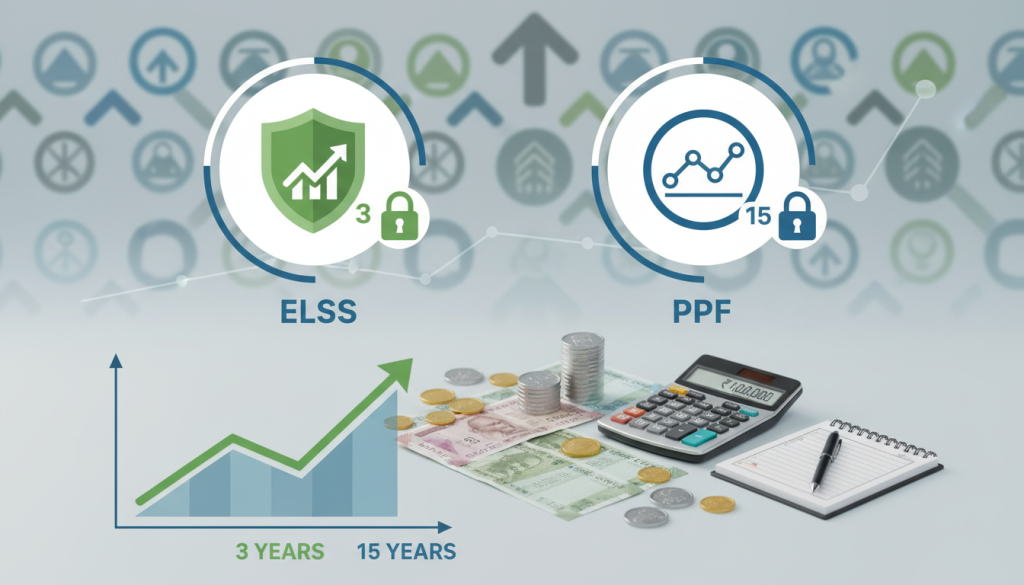
The main difference is in their commitment duration. This factor affects which option suits your financial plans better. The elss ppf lock-in period difference shapes your investment experience.
ELSS Three-Year Lock-in Period
ELSS has the shortest lock-in period at just three years. Your money is locked for 36 months. After that, you can redeem your units freely.
But, ELSS doesn’t allow early withdrawal before three years. No exceptions, even for emergencies. Once the lock-in ends, you control your investment fully.
PPF Fifteen-Year Maturity Period
PPF requires a 15-year commitment. This makes it a long-term wealth builder. The long duration helps in financial discipline and compounding.
You can take loans from the third to sixth year. Partial withdrawals are possible from the seventh year. This gives you liquidity within the long commitment.
After maturity, you can extend your PPF account in blocks of five years. This is great for retirement planning and long-term goals.
Minimum and Maximum Investment Amounts
Investment limits are another key difference in the elss vs ppf comparison. These limits affect how much you can invest and fit into your portfolio.
| Feature | ELSS | PPF |
|---|---|---|
| Minimum Investment | ₹500 per month via SIP (varies by fund) | ₹500 per year |
| Maximum Investment | No upper limit | ₹1.5 lakh per year |
| Tax Deduction Limit | Up to ₹1.5 lakh under 80C | Up to ₹1.5 lakh under 80C |
| Investment Mode | SIP or lump sum | Up to 12 deposits annually |
ELSS offers flexibility in investment amounts. You can start with ₹100 to ₹500 monthly. There’s no ceiling on how much you can invest, but tax benefits are capped at ₹1.5 lakh annually.
This unlimited investment makes ELSS attractive for larger equity market investments. You’re not limited by regulatory caps beyond the tax deduction limit.
PPF has defined boundaries. The minimum annual contribution is ₹500, making it accessible for modest savers. The maximum contribution is capped at ₹1.5 lakh per financial year, preventing it from becoming a tax shelter for high-net-worth individuals.
This cap ensures PPF focuses on small and middle-income savers. It also means you cannot use PPF alone for large tax planning investments.
Investment Frequency and Flexibility
Investment timing and frequency are key. ELSS offers maximum investment freedom. You can invest any amount at any time throughout the year.
Set up a monthly SIP for disciplined investing, make quarterly lump sum contributions, or invest whenever you have surplus funds. This flexibility allows you to time your investments based on market conditions or personal cash flow.
PPF allows up to 12 deposits per financial year. You can align contributions with your salary cycle or business income patterns. You could deposit monthly, quarterly, or make a single annual contribution before the March 31 deadline.
Exceeding the ₹1.5 lakh annual limit results in excess amounts not earning interest. This makes tracking your contributions essential.
Eligibility is another flexibility dimension. Everyone can invest in ELSS—resident Indians, Non-Resident Indians (NRIs), Hindu Undivided Families (HUFs), and corporate entities. This universal accessibility makes ELSS more inclusive.
PPF restricts participation to resident Indian individuals only. NRIs cannot open new PPF accounts, though existing accounts can continue until maturity. HUFs also cannot invest in PPF, limiting its use for family wealth planning.
The elss vs ppf comparison shows ELSS wins on flexibility and accessibility. PPF offers structured, disciplined saving with guaranteed returns. Your choice depends on whether you value investment freedom or prefer defined boundaries that enforce savings discipline.
Returns Comparison: ELSS vs PPF in 2026
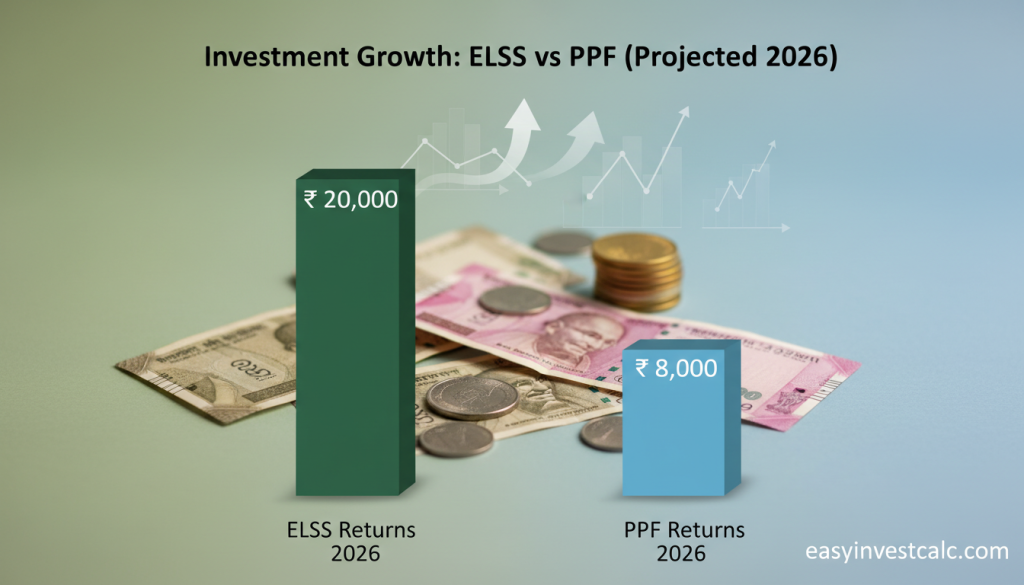
Let’s look at how much your money can grow in ELSS versus PPF. This is key to your investment choice. Knowing the elss ppf returns comparison helps set realistic goals and pick the right option.
But returns are more than just numbers. They show how much your savings grow. This growth helps you reach goals like buying a home, funding education, or securing retirement. Yet, comparing ELSS and PPF needs a deeper look because they work differently.
Historical Returns of ELSS Mutual Funds
ELSS funds mainly invest in stocks. So, your returns depend on the stock market. This means big opportunities but also risks.
When the market goes up, your investment can grow a lot. But, when it goes down, you might lose money temporarily.
Average Returns Over 5 and 10 Years
ELSS funds have shown strong performance over time. They’ve given returns between 12% and 16% over 10 years. Over 5 years, returns are usually between 10% and 14%, depending on the market.
The key is long-term consistency. Even with ups and downs in individual years, the longer you invest, the more likely you are to benefit from the market’s trend. Time smooths out the bumps in equity investing.
For example, investing ₹1.5 lakh a year in a good ELSS fund could grow to about ₹13-15 lakh in 7 years, assuming 12-14% returns. This shows the power of equity and disciplined investing.
Market-Linked Performance Factors
Many things affect ELSS returns each year. Growth in corporate earnings and economic indicators like GDP and inflation influence stock prices. Global events and interest rate policies also play a role.
This means you need patience and a long-term view when investing in ELSS. Short-term ups and downs are normal. Your goal should be to stay invested through market cycles to capture overall growth.
PPF Interest Rates Over the Years
PPF works differently. The government sets the interest rate quarterly, and it’s the same for all accounts. Your returns are completely guaranteed, no matter what the economy does.
Over the last decade, PPF rates have been between 7.1% and 8.7%. They’ve gone down from highs of 8.7% in 2015-2016 to today’s levels. This reflects changes in the interest rate environment.
Current Interest Rate for 2026
As of early 2026, the PPF interest rate is 7.1% per annum. This rate is compounded annually, meaning your interest earns interest in future years. The government reviews and may adjust this rate every quarter based on the economy and bond yields.
While 7.1% might seem low compared to ELSS, it’s a guaranteed, risk-free return. There’s no market risk, and your principal is safe. For conservative investors, this certainty is very valuable.
Guaranteed Returns Advantage
The biggest plus of PPF is its predictability. You know exactly what you’ll earn each year. This makes planning easier, which is great for specific goals with fixed timelines. There are no surprises, no volatility, and no worries about market crashes.
Also, PPF returns are completely tax-free. This makes the effective return even better, which is great for those in higher tax brackets. If you’re in the 30% tax bracket, a 7.1% tax-free return is like a taxable return of about 10.14%. This tax advantage makes PPF very attractive.
The annual compounding also works in your favor over the 15-year PPF term. Investing ₹1.5 lakh a year at 7.1% would grow to about ₹40.68 lakh by maturity. The tax-free returns and guaranteed growth make PPF a solid choice for conservative portfolios.
Expected Returns for 2026 and Beyond
Looking ahead, what can you expect from these two options? For ELSS, the growth is promising if the Indian equity markets keep their historical path. Economic growth, corporate profits, and more market participation suggest 12-15% returns over 7-10 years.
But, there are no guarantees. Market downturns, economic slowdowns, or global issues could affect short-term results. Your actual returns will depend on the ELSS fund you choose, when you invest, and how long you stay in.
PPF rates will likely stay in the 7-8% range, possibly adjusting slightly based on government bond yields and inflation. While growth might not be dramatic, steady, reliable accumulation with complete safety makes PPF perfect as a stability anchor in your portfolio.
The best tax saving option 2024 and beyond depends on your personal situation. If you’re young, have a long investment horizon, and can handle volatility, ELSS offers better growth. If you prefer safety and guaranteed returns, PPF is unmatched.
| Feature | ELSS | PPF | Key Difference |
|---|---|---|---|
| Return Type | Market-linked, variable | Fixed, guaranteed | ELSS offers higher but uncertain returns |
| Historical Returns | 12-16% annualized (10 years) | 7.1-8.7% (past decade) | ELSS historically outperforms by 4-9% |
| Risk Level | High (equity exposure) | Zero (government backed) | PPF eliminates all market risk |
| Tax on Returns | 12.5% on gains above ₹1.25 lakh | Completely tax-free | PPF provides better tax efficiency on returns |
| Best For | Growth-focused, long-term investors | Conservative, stability-seeking investors | Choose based on risk appetite and goals |
Many smart investors don’t pick just one. They mix ELSS and PPF based on their risk tolerance and financial goals. This balanced approach aims to capture growth while keeping a safety net of guaranteed returns.
Your choice between elss vs ppf should consider more than just return numbers. Think about your comfort with volatility, investment timeframe, and financial situation. Both options have their place in tax savings. The question is which mix is right for you.
Tax Benefits: ELSS versus PPF Under Section 80C
The real power of 80c investment options lies not just in what you save upfront, but in how your returns are taxed over time. When planning your financial future, understanding the complete tax picture is key. Both ELSS and PPF offer attractive tax advantages, but they work differently when it comes to taxing your earnings.
The tax benefits elss versus ppf comparison often determines which investment suits your financial goals better. While both options help reduce your current tax burden, the way they treat your accumulated wealth varies significantly. This difference can have a major impact on your actual take-home returns over the years.
Tax Deduction Benefits for Both Options
Both ELSS and PPF share common ground when it comes to immediate tax savings. You can claim deductions under Section 80C of the Income Tax Act for investments in either option. This makes them popular choices during the tax-saving season from January to March each year.
The beauty of these tax saving investments comparison is that you get to choose based on your risk appetite while enjoying upfront benefits. Whether you pick equity-linked ELSS or government-backed PPF, your tax deduction remains the same. This flexibility allows you to align your investment strategy with your personal comfort level.
Section 80C Deduction Up to Rs 1.5 Lakh
You can reduce your taxable income by investing up to ₹1.5 lakh annually through Section 80C. This deduction applies to the total of all qualifying investments, including ELSS, PPF, life insurance premiums, and other eligible options. For someone in the 30% tax bracket, this translates to immediate tax savings of approximately ₹46,800 including cess.
The deduction works the same way for both ELSS and PPF investments. You claim this benefit when filing your income tax return for the financial year. Your employer may also adjust TDS (Tax Deducted at Source) if you submit investment proof during the year.
Remember that this ₹1.5 lakh limit is cumulative across all Section 80C investments. If you invest ₹1 lakh in PPF, you can only claim an additional ₹50,000 through ELSS or other 80c investment options. Planning your investments strategically helps you maximize this benefit without exceeding the limit.
Taxation on Returns and Maturity
The major difference between ELSS and PPF emerges when you look at how returns are taxed. While both give you upfront deductions, the tax treatment of your earnings sets them apart. Understanding this distinction helps you calculate your actual post-tax returns accurately.
Your investment journey has three stages: investment, accumulation, and withdrawal. The tax applied at each stage determines whether an investment follows EEE or EET treatment. This classification significantly affects your final wealth creation.
ELSS Capital Gains Tax Treatment
ELSS follows the EET (Exempt-Exempt-Taxable) structure for taxation. Your initial investment is exempt under Section 80C, and the accumulation phase is also exempt from tax. When you redeem your ELSS units after the lock-in period, long-term capital gains tax may apply.
The good news is that LTCG from ELSS up to ₹1.25 lakh per financial year is completely tax-free. Any gains beyond this threshold are taxed at 12.5% without indexation benefits. This structure provides substantial tax relief for most retail investors.
Here’s a practical example: If you redeem ELSS units and your profit is ₹2 lakh, the first ₹1.25 lakh escapes tax entirely. You’ll pay 12.5% tax only on the remaining ₹75,000, which amounts to ₹9,375. For many investors, spreading redemptions across financial years can help stay within the tax-free limit.
PPF Tax-Free Maturity Benefits
PPF enjoys the prestigious EEE (Exempt-Exempt-Exempt) status, making it one of the most tax-efficient investments available in India. Your investment qualifies for Section 80C deduction, the interest earned annually is completely tax-free, and the final maturity amount is also entirely exempt under Section 10(11).
This triple tax exemption means every rupee you earn from PPF stays with you. There’s no tax deducted at any stage—during investment, accumulation, or withdrawal. For investors in higher tax brackets, this complete tax exemption significantly enhances the effective yield.
The tax-free interest compounds over 15 years without any deductions, allowing your wealth to grow uninterrupted. When you withdraw the maturity amount, you receive the full sum without filing any tax calculations or paying capital gains tax.
EEE vs EET Tax Treatment
The distinction between EEE and EET taxation frameworks helps you understand the long-term wealth implications. While both sound similar, the difference in taxation at withdrawal can substantially affect your final corpus. Choosing between them depends on your expected returns and tax bracket.
ELSS uses the EET model where returns face limited taxation only at redemption. The ₹1.25 lakh annual exemption covers most small to mid-sized investors completely. If you invest systematically and redeem strategically across years, you might never pay any capital gains tax on ELSS profits.
PPF’s EEE treatment offers complete peace of mind regarding taxation. You know exactly what you’ll receive at maturity without worrying about future tax rate changes. This predictability makes financial planning easier, for conservative investors seeking guaranteed post-tax returns.
| Tax Aspect | ELSS Treatment | PPF Treatment | Winner |
|---|---|---|---|
| Investment Deduction | Up to ₹1.5 lakh under Section 80C | Up to ₹1.5 lakh under Section 80C | Equal |
| Accumulation Tax | Tax-free during holding period | Interest completely tax-free | Equal |
| Withdrawal Tax | LTCG above ₹1.25 lakh taxed at 12.5% | Completely tax-free | PPF |
| Overall Structure | EET (Exempt-Exempt-Taxable) | EEE (Exempt-Exempt-Exempt) | PPF for tax efficiency |
The choice between tax benefits elss versus ppf ultimately depends on your return expectations and risk tolerance. ELSS might generate higher gross returns through equity exposure, but taxation reduces net gains slightly for larger profits. PPF’s returns, though potentially lower in absolute terms, remain entirely tax-free, boosting your effective post-tax yield.
For maximum benefit, consider using both instruments strategically within your ₹1.5 lakh Section 80C limit. This diversification gives you equity growth through ELSS while securing completely tax-free guaranteed returns through PPF. Your optimal mix depends on your age, income level, and financial goals.
Risk Analysis and Investment Suitability
Every investment has its own risks. Choosing between ELSS and PPF depends on your comfort with market ups and downs. Risk and returns go hand in hand. What works for someone else might not be right for you.
Knowing your risk profile helps you make choices that let you sleep well at night. An investment that worries you isn’t worth the risk, no matter how good the numbers look.
When deciding between elss vs ppf, your risk tolerance is key. Let’s look at the risks you face with each option.
Risk Profile of ELSS Investments
ELSS mutual funds are risky because they invest in stocks. Your investment’s value will go up and down with the stock market. This risk is the trade-off for the chance of higher growth.
The Net Asset Value (NAV) of your ELSS fund changes daily. This is because of the performance of the stocks it holds. Economic conditions, political events, and global trends all affect your returns.
Market Volatility and Your Returns
Stock markets can be unpredictable in the short term. In good times, your ELSS investment might grow by 20-30% in a year. But in bad times, it could drop by 10-20% or more.
This volatility can be hard, even for experienced investors. The question of elss or ppf which is better often comes down to how you handle these ups and downs.
Several factors affect ELSS performance:
- Market volatility: Daily price swings based on investor sentiment and news events
- Economic cycles: Recessions and slowdowns can temporarily hurt equity returns
- Company-specific risks: Individual stocks in the portfolio may underperform expectations
- Fund manager decisions: Portfolio construction choices directly impact your returns
With ELSS, you can’t guarantee returns. There’s a chance of lower returns or even losing money if you cash out during a market low. Timing is key in equity investments.
Potential for Higher Long-Term Gains
Despite the risks, ELSS is attractive because of its long-term growth. Short-term market swings tend to even out over time. Equity markets have always bounced back and reached new highs with enough time.
ELSS is best for investors with a long-term view. Even though you can lock in your investment for just three years, think of it as a 5-10 year investment to ride out market ups and downs.
By investing in quality Indian companies, your ELSS investment can grow faster than inflation. The long-term wealth creation is higher than with fixed-income options.
Many ELSS funds have given 12-15% annual returns over 10 years, despite market volatility. Patience and a long-term view are key to success.
Risk Profile of PPF Investments
PPF is much safer than ELSS. It’s backed by the Government of India, making it one of the safest investments for Indians. The main difference in tax saving investments comparison is that PPF has virtually no risk, while ELSS has market risks.
Your choice depends on what matters more to you—safety or the chance for higher returns.
Zero Market Risk Advantage
PPF offers complete protection from market risks. Your principal amount is safe, no matter what happens in the economy or stock market. There’s no risk of default or credit risk.
The interest rate is set by the government and doesn’t change. You know exactly what returns you’ll get. This makes planning easier.
PPF is perfect for those who value capital preservation over aggressive growth. It’s great for those nearing retirement or needing certainty in their investments.
Knowing your money is growing steadily without risk can give you peace of mind. This emotional comfort is valuable.
Stable but Lower Returns
PPF’s safety comes with capped returns. Currently, it offers around 7.1% annual interest. This is respectable but won’t match equity investments’ long-term growth.
These returns are tax-free under the EEE regime. But when you factor in inflation, the real returns are moderate—typically 3-4% above inflation.
PPF won’t create explosive wealth like equity investments can. It’s for steady, predictable growth, not high returns. For many, this stability is exactly what they need.
The tax saving investments comparison shows PPF offers certainty, while ELSS offers possibility. Neither is inherently better; they serve different needs and investor profiles.
Matching Investment Options to Your Risk Appetite
Choosing between elss vs ppf requires honest self-assessment. Your financial personality is more important than theoretical returns. Ask yourself these critical questions before deciding:
- Can you tolerate temporary losses? If seeing your investment value drop 15-20% worries you, ELSS might not be right.
- What’s your investment timeline? Do you have 5+ years before you need this money? Longer horizons favor ELSS; shorter timelines favor PPF.
- How important is guaranteed safety? If keeping your capital safe is your top priority, PPF is the logical choice.
- What are your financial goals? Retirement planning for someone in their 30s differs from someone in their 50s.
Understanding elss or ppf which is better for you depends on your answers to these questions. There’s no one-size-fits-all answer—only the right answer for you.
Here’s a practical comparison to guide your decision:
| Investment Characteristic | ELSS Suitability | PPF Suitability |
|---|---|---|
| Risk Tolerance | Moderate to high comfort with volatility | Low to zero tolerance for market risk |
| Investment Horizon | 5+ years for optimal results | 15 years (full maturity) for maximum benefit |
| Primary Goal | Wealth creation and growth | Capital preservation and steady returns |
| Age Group | Younger investors (20s-40s) | Conservative or older investors (40s-60s) |
Many smart investors don’t choose one or the other exclusively. They spread their investments between ELSS and PPF based on different goals and timelines. This creates a balanced portfolio that captures growth while keeping a safety net.
For example, you might invest in ELSS for long-term wealth and in PPF for guaranteed retirement security. This diversification strategy lets you benefit from both without risking everything on one investment.
Your risk appetite changes with life stages, financial responsibilities, and market experience. What feels risky at 25 might feel comfortable at 35. Regularly reassess your elss vs ppf allocation as your circumstances change.
Liquidity and Withdrawal Options Compared
Having access to your money is as important as the returns you earn. This is true, whether it’s for emergencies or new opportunities. Knowing the elss ppf lock-in period difference helps you plan for both expected and unexpected financial needs.
Life is unpredictable. Medical emergencies, education costs, or exciting investment chances can pop up when you least expect them. Knowing when and how to withdraw funds from your investments is key for smart financial planning.
When looking at elss vs ppf, the liquidity features are quite different. Each option has its own rules that can either help or hinder your ability to access funds when needed.
ELSS Redemption Rules After Lock-in
ELSS has a mandatory 3-year lock-in period from the date of each investment. During this time, you cannot redeem your units under any circumstances. There are no provisions for premature withdrawal, even in genuine emergencies like medical crises or job loss.
This strict lock-in is actually the shortest among most Section 80C investment options. Compare this to PPF’s 15-year commitment or NSC’s 5-year tenure, and ELSS suddenly looks quite flexible.
If you invest through a Systematic Investment Plan (SIP), remember that each monthly installment has its own separate 3-year lock-in. Your January 2026 SIP investment becomes available in January 2029, while your February 2026 investment unlocks in February 2029, and so on.
Once the lock-in period ends, ELSS offers complete redemption freedom. You can withdraw any amount—whether it’s 10%, 50%, or 100% of your investment—at any time without penalties or restrictions. This flexibility makes ELSS relatively liquid in the medium term.
Many investors choose to stay invested well beyond the mandatory 3-year minimum. This strategy allows them to continue benefiting from the equity market’s growth and compound returns over longer timeframes.
PPF Partial Withdrawal and Loan Facility
PPF operates with a 15-year maturity period, making it a long-term commitment. It provides two important liquidity features that offer some financial breathing room during the investment tenure.
These provisions ensure you’re not completely locked out of your money for the entire 15 years. Understanding these options helps you plan for contingencies while maintaining your long-term savings discipline.
Withdrawal Rules from Year 7 Onwards
PPF allows partial withdrawals starting from the seventh financial year after account opening. In practical terms, if you opened your account in 2020-21, you could make your first withdrawal during the 2026-27 financial year.
The withdrawal amount is restricted to maintain the savings discipline that PPF encourages. Typically, you can withdraw up to 50% of the balance at the end of the fourth year or the preceding year, whichever is lower.
These withdrawals are permitted for genuine needs like medical emergencies, children’s education fees, home down payments, or wedding expenses. The tax-free nature of these withdrawals makes them valuable during financial crunches.
“The best investment strategy balances growth with practical access to funds when life demands it.”
Loan Against PPF Balance
PPF offers a loan facility against your accumulated balance from the third financial year through the end of the sixth financial year. This feature provides emergency liquidity without disrupting your long-term investment.
The loan amount is typically capped at 25% of the balance at the end of the second financial year. You’ll pay interest on this loan, usually 1-2 percentage points above the prevailing PPF interest rate.
This facility works well for short-term cash needs. You get access to funds quickly while your PPF continues earning interest on the full balance. Once you repay the loan, your account continues growing uninterrupted toward the 15-year maturity goal.
After the account matures at 15 years, you face a choice. You can withdraw the entire corpus tax-free, or extend the account in 5-year blocks with or without making additional contributions.
Which Offers Better Liquidity for Your Needs
The liquidity winner depends on your financial situation and timeline. If you value flexibility and might need access to funds within 3-5 years, ELSS clearly wins. Your money becomes fully accessible after just three years with zero restrictions on redemptions.
For very long-term goals like retirement planning, PPF’s limited liquidity isn’t necessarily a disadvantage. The enforced discipline actually helps you stay committed to wealth building without the temptation to withdraw prematurely.
Consider your emergency preparedness before choosing. Do you have 6-12 months of living expenses saved in a liquid emergency fund? If yes, PPF’s longer lock-in becomes less problematic because you won’t need to tap into it for unexpected expenses.
Think about your upcoming financial obligations too. Are you planning a home purchase in 5 years? Will your children start college in 7 years? Your honest assessment of future cash needs should guide whether ELSS’s shorter lock-in or PPF’s structured long-term approach better matches your requirements.
Here’s a practical comparison of liquidity features:
| Liquidity Feature | ELSS | PPF |
|---|---|---|
| Minimum Lock-in Period | 3 years (mandatory) | 15 years (with partial access) |
| Emergency Withdrawal | Not allowed before 3 years | Loan from year 3-6, withdrawal from year 7 |
| Post Lock-in Flexibility | Complete freedom to redeem any amount | Limited to 50% of eligible balance |
| Loan Facility | Not available | Available from year 3 to year 6 |
Your investment horizon matters a lot. Young professionals in their 20s and 30s might prefer ELSS for its shorter commitment and alignment with medium-term goals. Those in their 40s and 50s focusing on retirement might find PPF’s structure perfectly suited to their needs.
Remember that diversification works beautifully here. You don’t have to choose exclusively between these options. Allocating some funds to ELSS for medium-term liquidity and some to PPF for disciplined long-term savings creates a balanced portfolio that addresses multiple financial needs simultaneously.
Making Your Choice: ELSS or PPF Which is Better for You
Choosing between ELSS and PPF depends on your personal situation. Your financial goals, age, risk tolerance, and how long you plan to invest are key. Let’s look at different investor profiles to find where you fit best.
There’s no one-size-fits-all answer to elss or ppf which is better. What works for someone else might not be right for you. It’s important to know yourself as an investor and choose what fits your profile.
Best Choice for Young Investors
If you’re young, ELSS is often the better choice for building wealth. You have time to recover from market ups and downs. Young people can handle the volatility of the market.
Long Investment Horizon Advantage
With a long time to invest, you can ride out market cycles. Time transforms risk into opportunity when investing in equity. This is great for those with 20 to 30 years until retirement.
Starting early with ELSS can create a large corpus. Equity returns over 15 to 20 years can grow your wealth much faster than fixed-income options.
Wealth Creation Through Equity
Young investors should take advantage of their risk-taking capacity. You likely have stable income and can handle short-term losses. ELSS is perfect for goals like saving for a house or retirement.
ELSS provides the growth needed to beat inflation. While PPF is safe, ELSS can build real wealth faster. The 3-year lock-in of ELSS also gives you flexibility to adjust your investments as needed.
Best Choice for Conservative Investors
For those who are risk-averse, PPF is often the better choice. If market volatility worries you, PPF’s guaranteed returns and government backing offer peace of mind.
Retirement Planning with PPF
PPF’s 15-year term is great for pre-retirement savings. The tax-free maturity provides a big corpus when you retire. This is essential for planning your post-retirement lifestyle.
Conservative investors can’t afford the risk of market downturns eroding their capital. PPF’s government backing ensures your principal is safe. The assured interest rate means you know exactly what you’ll get. This certainty is valuable for planning specific expenses like education or weddings.
Capital Protection Priority
If you’re cautious or don’t know much about investing, PPF is safer. The best tax saving option 2024 for cautious investors is capital preservation over aggressive growth. PPF keeps your money safe while earning reasonable returns.
For those in higher tax brackets, PPF’s complete tax exemption (EEE status) is attractive. It offers better post-tax returns than many fixed-income options. When certainty is more important than potentially higher but uncertain returns, PPF is the better choice.
Portfolio Diversification Strategy Using Both
Experienced investors use both ELSS and PPF in their portfolios. This strategy combines growth from equity and stability from fixed income. You don’t have to choose one over the other when both can serve different purposes in your financial plan.
Balancing Growth and Stability
Using ELSS and PPF together creates a balanced portfolio. ELSS’s aggressive growth works with PPF’s safe foundation. Different goals can be mapped to different instruments—use ELSS for longer-term goals and PPF for medium-term goals needing certainty.
This approach also offers tax benefits. You get immediate Section 80C deduction from both investments. PPF’s tax-free growth and ELSS’s tax-advantaged growth provide benefits. Your total Section 80C deduction is capped at ₹1.5 lakh, but you can split it between both instruments.
Practical implementation is straightforward. If you have ₹1.5 lakh to invest annually under Section 80C, you could split it—₹1 lakh in ELSS and ₹50,000 in PPF. This gives you equity exposure for growth while building a safe retirement corpus.
Optimal Allocation Based on Your Age
How you allocate between ELSS and PPF depends on your age and life stage. A common rule of thumb is to subtract your age from 100—the result is the percentage for equity exposure (ELSS), with the remainder in debt instruments (PPF).
| Age Group | Suggested ELSS Allocation | Suggested PPF Allocation | Investment Focus |
|---|---|---|---|
| 25-35 years | 70-75% | 25-30% | Aggressive wealth creation with some stability |
| 36-45 years | 55-65% | 35-45% | Balanced growth and security |
| 46-55 years | 40-50% | 50-60% | Capital preservation with moderate growth |
| 56-60 years | 25-35% | 65-75% | Safety-focused with limited equity exposure |
This age-based allocation ensures proper risk management as you progress through life stages. A 30-year-old might allocate 70% to ELSS and 30% to PPF, while a 50-year-old might reverse it to 50% ELSS and 50% PPF. This approach reduces equity risk as you approach retirement.
Remember, elss vs ppf isn’t necessarily an either-or decision. They’re complementary tools in your financial toolkit, each serving distinct purposes. You can invest in both simultaneously—they’re not mutually exclusive choices. The combined strategy provides diversification benefits that neither investment offers alone.
Your ultimate choice should align with your financial goals, risk tolerance, and investment horizon. Young investors seeking wealth creation often find ELSS more suitable, while conservative investors prioritizing safety gravitate toward PPF. Many smart investors use both to create a balanced, goal-oriented portfolio that grows over time while protecting what they’ve already built.
Conclusion
Your choice between elss vs ppf depends on your personal financial situation and goals. There’s no universal “winner” in this tax saving investments comparison.
ELSS is good if you’re okay with market ups and downs and want to grow your wealth. It has a shorter three-year lock-in, giving you more freedom. You can start with just ₹500 and grow your portfolio over time.
PPF is better if you value safety. It offers government-backed returns and is fully tax-exempt, making it great for retirement planning. Your money is safe, no matter what the market does.
Many smart investors choose both ELSS and PPF. This way, they get the chance to grow their wealth while keeping some money safe. It’s a smart move to balance risk and safety.
Consider your age, income stability, and financial goals before investing. Younger people might take more risk with ELSS. Those close to retirement might prefer PPF’s stability.
The debate between ELSS and PPF isn’t about finding the “better” option. It’s about finding what fits YOUR needs. Take time to think about your risk tolerance and investment timeline.
Start your tax-saving journey today. Whether you choose ELSS, PPF, or both, regular investing builds your financial future. Your money works harder when you make smart choices.
FAQ
Can I invest in both ELSS and PPF in the same financial year?
Yes, you can invest in both ELSS and PPF at the same time. Many smart investors do this. You can split the ₹1.5 lakh deduction limit between the two. For example, you could put ₹1 lakh in ELSS and ₹50,000 in PPF.
This way, you get the best of both worlds. ELSS offers growth, while PPF provides safety and guaranteed returns. It’s a smart way to balance risk and capture growth.
What is the lock-in period difference between ELSS and PPF?
ELSS has a three-year lock-in period, the shortest among Section 80C options. After three years, you can withdraw your money anytime. PPF, on the other hand, has a 15-year lock-in period.
But PPF offers some liquidity during this time. You can take a loan from the third to sixth year. And you can make partial withdrawals from the seventh year on.
Which investment offers better returns in 2026—ELSS or PPF?
The choice depends on your time horizon and market conditions. ELSS can offer higher returns because it invests in equities. Over 5-10 years, ELSS funds have returned 10-15% annually, sometimes more.
But these returns come with volatility. PPF, on the other hand, offers predictable, government-guaranteed returns. As of early 2026, PPF’s interest rate is 7.1% per annum, tax-free.
If you have a long investment horizon, ELSS might be better. But if you value certainty, PPF’s assured returns are attractive.
Are PPF returns completely tax-free compared to ELSS?
Yes, PPF returns are more tax-friendly. PPF follows the EEE structure, meaning your investment, interest, and maturity amount are all tax-free. ELSS follows the EET structure—your investment is tax-free, but long-term capital gains are taxable.
ELSS offers a ₹1.25 lakh exemption on long-term capital gains. This means many investors won’t pay tax on ELSS gains.
Can NRIs invest in ELSS and PPF?
NRIs can invest in ELSS but not in new PPF accounts. ELSS is available to resident Indians, NRIs, and entities. NRIs can invest in ELSS through their NRO/NRE accounts.
But PPF accounts can only be opened by resident Indians. If you became an NRI after opening a PPF account, you can continue it until maturity.
What happens if I withdraw from ELSS before the three-year lock-in period?
You can’t withdraw from ELSS before the three-year lock-in ends. There are no provisions for early withdrawal, even in emergencies. Each investment has its own three-year lock-in.
For example, if you started a SIP in January 2024, that installment can be redeemed in January 2027. This strict lock-in is why ELSS qualifies for Section 80C tax benefits.
Which is better for retirement planning—ELSS or PPF?
Both can be valuable for retirement planning, but they serve different purposes. For young professionals, ELSS is better because of its equity exposure. It offers higher returns over long periods.
But as you approach retirement, PPF becomes more suitable. It provides capital protection and predictable returns. The ideal strategy is to use both: ELSS for accumulation and PPF for pre-retirement years.
What is the minimum and maximum investment in ELSS versus PPF?
ELSS has no minimum investment limit, but you can start with as little as ₹500 per month. There’s no maximum limit either. PPF has a minimum of ₹500 per year and a maximum of ₹1.5 lakh.
Exceeding the PPF limit means the excess won’t earn interest. This cap ensures PPF is for small and middle-income savers.
How does the risk level compare between ELSS and PPF?
ELSS carries market risk because it invests in equities. Your investment value will fluctuate with the stock market. PPF, on the other hand, carries virtually zero risk.
PPF’s returns are capped at the government-declared rate, currently around 7.1%. This makes PPF ideal for risk-averse investors.
Can I take a loan or make partial withdrawals from ELSS like PPF?
No, ELSS does not offer any loan facility or partial withdrawal before the three-year lock-in period. Your money is completely locked for the full three years. PPF, on the other hand, offers structured liquidity options.
With PPF, you can take a loan from the third to sixth year. You can also make partial withdrawals from the seventh year onwards. This gives PPF some liquidity within its long 15-year tenure.
Which investment is better for achieving wealth creation goals?
For pure wealth creation over long time horizons, ELSS has the edge. It offers higher returns because of its equity exposure. Equity markets have historically delivered superior returns over 10, 15, or 20 years.
But PPF is excellent for disciplined, guaranteed wealth building. The 15-year tenure enforces saving discipline. For aggressive wealth creation, ELSS is the stronger choice. For steady, risk-free wealth building, PPF serves that purpose well.
How do ELSS and PPF compare for someone in a high tax bracket?
For those in higher tax brackets, both ELSS and PPF offer valuable benefits. PPF’s complete tax exemption makes it attractive. The immediate Section 80C deduction is the same for both, saving 30% (plus cess) on up to ₹1.5 lakh invested.
But PPF’s 7.1% return is entirely tax-free. This is equivalent to a pre-tax return of approximately 10.14% for someone in the 30% bracket. ELSS follows EET taxation, with a generous ₹1.25 lakh annual LTCG exemption.
For high-income individuals, ELSS’s higher gross returns can result in better post-tax wealth creation over long periods. The best approach is to use both: maximize PPF for tax-free accumulation and invest additional funds in ELSS for growth.
What is the difference between EEE and EET tax treatment?
EEE and EET refer to how investments are taxed at three stages: initial investment, accumulation phase, and withdrawal. Understanding this helps you evaluate the true tax efficiency of your investments. PPF follows the EEE structure, making it tax-free at all stages. ELSS follows the EET structure—tax-free at the initial and accumulation stages, but taxable at withdrawal.
ELSS offers a ₹1.25 lakh exemption on long-term capital gains. This means many investors won’t pay tax on ELSS gains.
Should I choose ELSS or PPF if I’m 50 years old and planning for retirement?
At 50, your investment choice should balance growth with capital protection. PPF becomes more attractive at this stage. The 15-year PPF tenure aligns with your retirement timeline.
As you approach retirement, capital preservation is key. PPF’s government-guaranteed returns eliminate this risk. PPF’s tax-free returns are valuable for retirement income planning. But you shouldn’t abandon equity exposure entirely.
A balanced approach works well: allocate 50-60% to PPF for safety and 40-50% to ELSS for growth. This gives you downside protection while maintaining upside participation.
Can I extend my PPF account after the 15-year maturity period?
Yes, you can extend your PPF account beyond the initial 15-year maturity period in blocks of five years at a time. You can continue these extensions indefinitely. This flexibility allows you to maintain the tax-advantaged status of PPF as long as you wish.
When your account matures after 15 years, you have three choices: (1) close the account and withdraw the entire corpus tax-free, (2) extend the account for five years without making any additional contributions, or (3) extend the account for five years with continued contributions of up to ₹1.5 lakh per year.
If you choose option 2 or 3, you can make partial withdrawals (up to 60% of the balance at the beginning of the extension period) once per year during the extended period. The advantage of extension is maintaining the EEE tax benefit—the interest continues to be completely tax-free.