
When Your Loan Ends With a Giant Bill: What You Need to Know
An amortization schedule with balloon payment is a loan repayment table that shows your monthly payments — but ends with one large lump sum due on a specific date, called the maturity date.
Here’s the quick version:
| Feature | Balloon Loan |
|---|---|
| Monthly payments | Lower than a fully amortizing loan |
| Payment basis | Usually calculated on a 15–30 year schedule |
| Actual loan term | Typically 3–7 years |
| Final payment | Large lump sum (the “balloon”) |
| Risk | Must refinance, sell, or pay in full at maturity |
Example: A $800,000 loan at 8% APR on a 3-year term produces a monthly payment of roughly $5,929 — but at the end of month 36, you still owe $786,023.60 all at once.
That gap between what you pay monthly and what you actually owe is exactly why balloon loans demand a clear exit plan before you sign.
These loans show up in commercial real estate, bridge financing, and even some residential mortgages. They can offer real advantages — lower monthly costs, easier short-term qualification. But as history shows, when borrowers have no plan for that final payment, the consequences can be severe. By 1933, balloon mortgages accounted for 40–50% of all U.S. residential mortgages — and a catastrophic share of those ended in default during the Great Depression.
This guide walks you through how to read and build an amortization schedule with a balloon payment, how to calculate what you’ll owe, and — most importantly — how to manage that maturity cliff before it manages you.
Understanding Balloon Loans vs. Fully Amortizing Debt
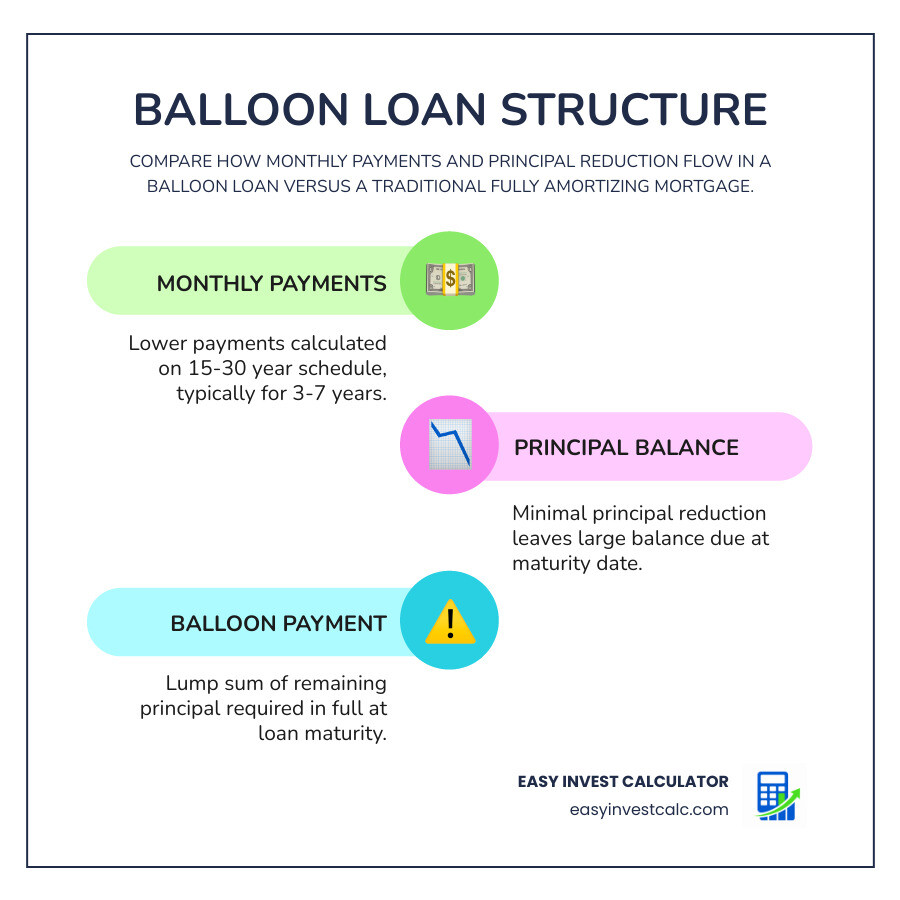
To understand why a balloon loan is “high-stakes,” we first need to look at how it differs from the standard loans most of us are used to. In a fully amortizing loan, every payment you make is calculated so that by the very last month of the term, your balance hits exactly zero. You pay a mix of principal and interest, and when the clock runs out, you own the asset outright.
A balloon loan is a different beast entirely. It’s like a hybrid: it acts like a long-term loan for your monthly budget but behaves like a short-term debt for your total payoff.
The Great Disconnect
The “magic” (and the danger) of a balloon loan is the disconnect between the amortization period and the loan term.
- The Amortization Period: This is the timeline used to calculate your monthly payment (often 15, 25, or 30 years).
- The Loan Term: This is how long the lender actually gives you to pay back the money (often 3, 5, or 7 years).
Because your monthly payments are spread out as if you had 30 years to pay, they remain relatively low and affordable. However, because the lender wants their money back in 5 years, you reach the “maturity date” with a massive principal balance still outstanding.
A Lesson from History
This isn’t just modern financial engineering; it’s a structure with a rocky past. Before the Great Depression, balloon mortgages were the norm. Homeowners would take out 5-year loans, paying mostly interest, and simply “roll” the loan into a new one at the end. When the economy collapsed in 1929 and banks stopped lending, borrowers couldn’t refinance. By 1933, nearly half of all residential mortgages in the U.S. were in default. This crisis led to the creation of Fannie Mae and the 30-year fixed-rate mortgage we know today.
When considering if this is Good Debt vs Bad Debt, you have to ask: do I have a guaranteed way to pay that final bill?
The Mechanics of an Amortization Schedule with Balloon Payment
When you look at an amortization schedule with balloon payment, it looks identical to a standard schedule—until the very last line.
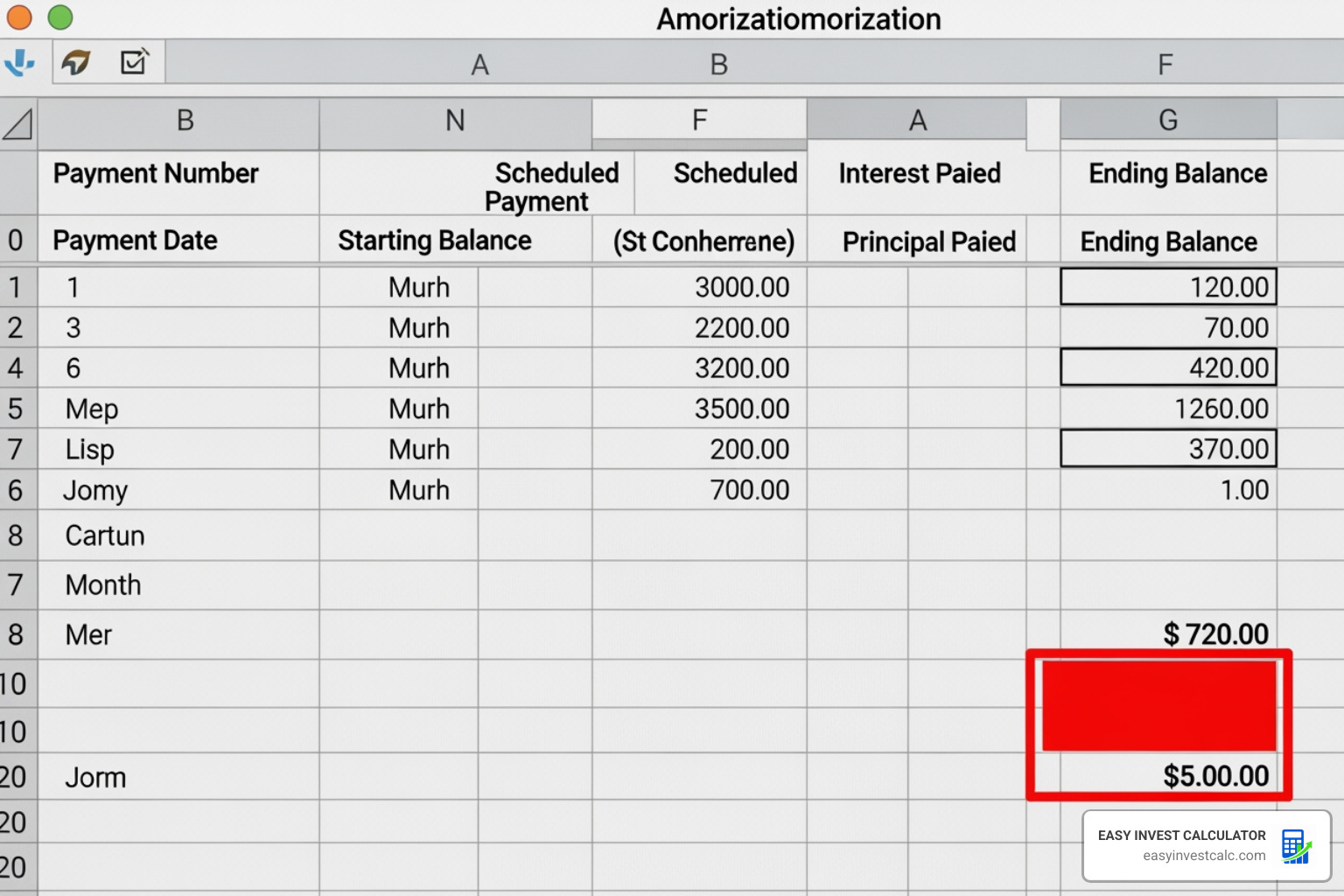
Let’s use a real-world example from May 2026. Imagine a commercial investor taking out an $800,000 loan at an 8% APR. To keep the business cash flow healthy, the lender agrees to a 30-year amortization schedule, but the loan term is only 3 years.
Using an EMI Calculator, we can see that the monthly principal and interest payment would be $5,870.18.
- Month 1: Most of that $5,870 goes toward interest, with only a small sliver reducing the $800,000 principal.
- Month 35: You’ve made 35 steady payments. You feel good. Your balance has barely budged, though.
- Month 36 (The Maturity Date): You owe your regular $5,870 payment PLUS the remaining balance of $786,023.60.
This “cliff” is the defining feature of the schedule.
Calculating Monthly Costs within an Amortization Schedule with Balloon Payment
Lenders use various methods to calculate the interest on these loans. One common method in commercial lending is the 365/360 method. This calculates daily interest based on a 365-day year but applies it to a 360-day factor, which slightly increases the yield for the lender.
In some cases, balloon loans are interest-only. In this scenario, your monthly payment covers zero principal. If you borrow $500,000, your monthly payments only cover the “rent” on that money. On the maturity date, your balloon payment is the original $500,000 you started with. This maximizes cash flow but leaves you with a 100% loan-to-value ratio at the end.
Tracking Principal Reduction in an Amortization Schedule with Balloon Payment
The biggest shock for many borrowers is how little equity they build. Because the payments are stretched over a long period, the “interest-heavy” phase of the loan lasts the entire term.
If you want to soften the blow, you can use an Amortization Schedule with Extra Payments to see how chipping away at the principal early on reduces that final “maturity cliff.” Without extra payments, you are essentially treading water, paying for the privilege of holding the debt while the principal allocation remains frustratingly small.
Strategic Exit Plans: Managing the Maturity Cliff
You should never sign a balloon note without a “Plan B” (and probably a Plan C). Since most people don’t have $786,000 sitting in a savings account, you need a strategic exit plan.
1. Refinancing
This is the most common strategy. You take out a new loan to pay off the old one. However, this is not guaranteed. You must qualify for a new loan in May 2029 (using our 3-year example) based on the interest rates and market conditions of that future time. If property values have dropped or your credit has slipped, you might find yourself stuck. We recommend starting the refinance process 6-12 months before the maturity date.
2. Asset Sale
Many investors use balloon loans for properties they plan to “flip” or sell within a few years. The goal is to sell the asset, pay off the lender, and pocket the profit. The risk here is market timing. If the real estate market cools down just as your balloon payment is due, you might be forced to sell at a loss.
3. Accelerated Paydown
If you have extra cash flow, applying it to the principal can significantly lower the final bill. Using Extra Payments: The Secret Sauce for Debt Freedom can help you visualize how a few hundred extra dollars a month can save you thousands in interest and shrink the balloon.
4. Conversion Options
Some “reset” or “two-step” mortgages allow you to convert the balloon payment into a traditional amortizing loan at the end of the term, though usually at current market rates.
If you’re feeling overwhelmed by the debt structure, the Debt Counseling Process: How to Prepare for Debt can provide a roadmap for managing these high-stakes obligations.
Risk Assessment: Pros, Cons, and Regulatory Guardrails
Is a balloon loan right for you? It depends on your risk tolerance and your specific financial goals.
| Pros | Cons |
|---|---|
| Lower Monthly Payments: Frees up cash flow for other investments. | Lump Sum Risk: The massive final payment can lead to default. |
| Easier Qualification: Sometimes easier to get for short-term projects. | Refinancing Uncertainty: No guarantee you can get a new loan later. |
| Lower Initial Rates: Often lower than a standard 30-year fixed rate. | Slow Equity Growth: You own very little of the asset after years of paying. |
Regulatory Guardrails
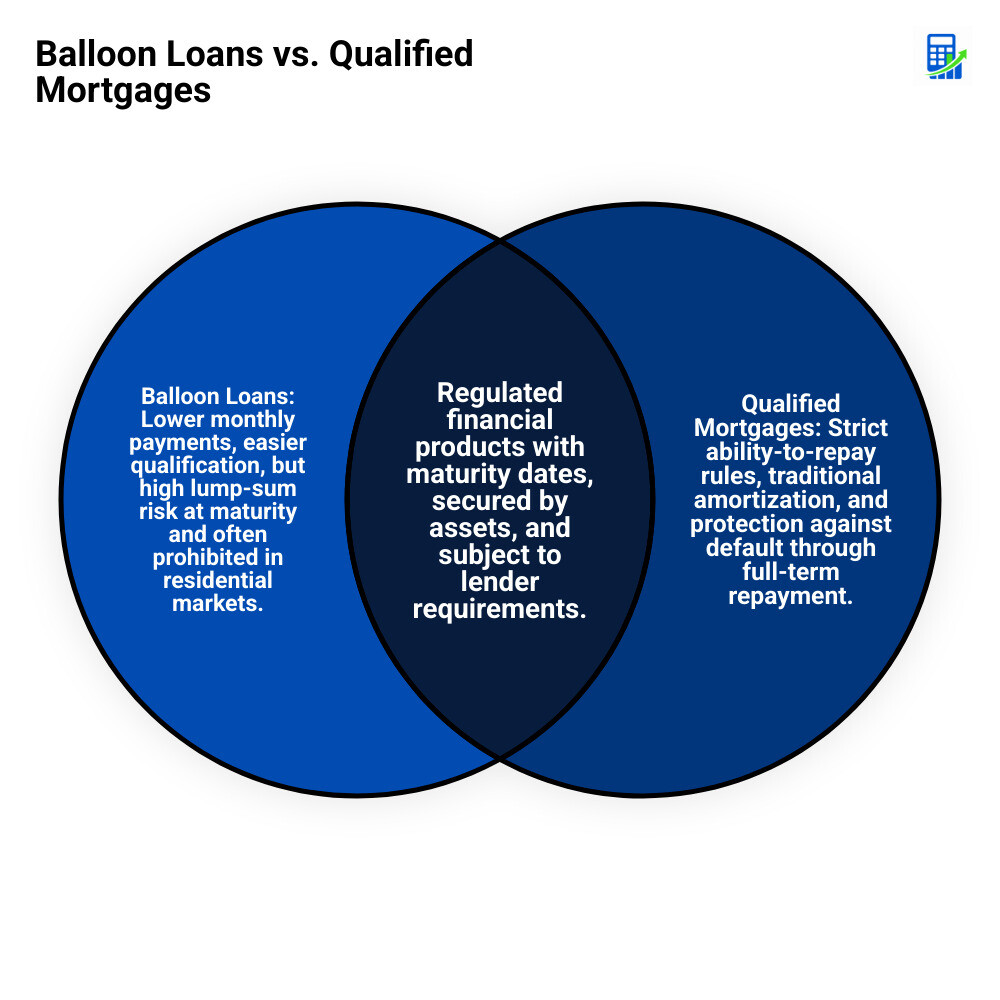
Because of the risks involved, the government has stepped in with rules like Regulation Z and “Ability-to-Repay” requirements. For most standard residential consumers, “Qualified Mortgages” generally prohibit balloon payments because they are considered high-risk.
However, balloon structures remain a staple in:
- Commercial Loans: Rates here typically range from 6.21% to 15.32%.
- Hard Money Loans: Used by flippers, these can have rates as high as 10% to 18%.
- Agency Loans: Freddie Mac and Fannie Mae offer specific balloon products for multifamily housing, with rates often hovering between 6.39% and 8.01%.
Frequently Asked Questions about Balloon Payments
What happens if I cannot make the balloon payment at maturity?
If the maturity date arrives and you cannot pay or refinance, the loan enters default. Because the loan is usually secured by an asset (like a house or a car), the lender can initiate foreclosure or repossession. This will cause a massive hit to your credit score—sometimes dropping it by up to 160 points—and could lead to legal action if the sale of the asset doesn’t cover the full debt.
Which types of loans commonly use balloon structures in 2026?
In the current 2026 market, you’ll most often see balloon payments in:
- Commercial Real Estate: Most business property loans are 5- or 7-year balloons.
- Bridge Loans: Short-term financing used while waiting for a property to sell.
- Auto Loans: Some “lease-like” car loans have a balloon payment at the end if you want to keep the car.
- Piggyback Mortgages: A smaller second mortgage (like a 15-year balloon) used to avoid paying Private Mortgage Insurance (PMI).
How do extra payments affect the final balloon amount?
Extra payments are the “kryptonite” to a balloon payment’s “Superman.” Every dollar you pay above the required amount goes directly toward the principal. This does two things:
- It reduces the total interest you pay over the life of the loan.
- It reduces the size of the final lump sum.
You can track this in real-time by using an Amortization Schedule with Extra Payments. Just be sure to check your loan contract for prepayment penalties, which are common in balloon and commercial loans.
Conclusion
A balloon loan is a powerful financial tool, but it’s one that requires a steady hand and a clear exit strategy. It offers the allure of lower monthly payments and flexibility for short-term investors, but it carries the heavy weight of a “maturity cliff” that can lead to financial ruin if ignored.
At EasyInvestCalc, we believe that financial freedom comes from understanding the math behind your money. Whether you are a commercial investor looking to expand your portfolio or a homeowner exploring creative financing, our goal is to provide fast, accurate, and user-friendly tools to help you plan effortlessly.
Don’t let a balloon payment catch you off guard. Calculate your loan payments today and build a schedule that works for your future, not against it.

Founder of EasyInvestCalc.com with 8+ years of experience in personal finance. Sunita simplifies complex financial mathematics—from SIP compounding to tax planning—empowering Indian investors to make smart, debt-free decisions based on real market mechanics.