Why a Boat Finance Calculator Is Your First Mate Before You Buy
A boat finance calculator is the fastest way to turn a dream purchase into a real budget plan. Before you fall in love with a vessel at the marina, you need hard numbers — monthly payment, total interest, and true ownership cost.
Here’s what a boat finance calculator tells you at a glance:
| Input | What It Does |
|---|---|
| Purchase price | Sets your total borrowing baseline |
| Down payment | Reduces the loan amount (typically 10%–20%) |
| Interest rate (APR) | Determines cost of borrowing (avg. ~8.40% in Q4 2025) |
| Loan term | Affects monthly payment and total interest paid |
| Estimated monthly payment | Your key affordability number |
For example, on an $80,000 boat with a $10,000 down payment over 10 years, the difference between a 7% and 9.5% APR is roughly $93 per month — and thousands more in total interest over the life of the loan.
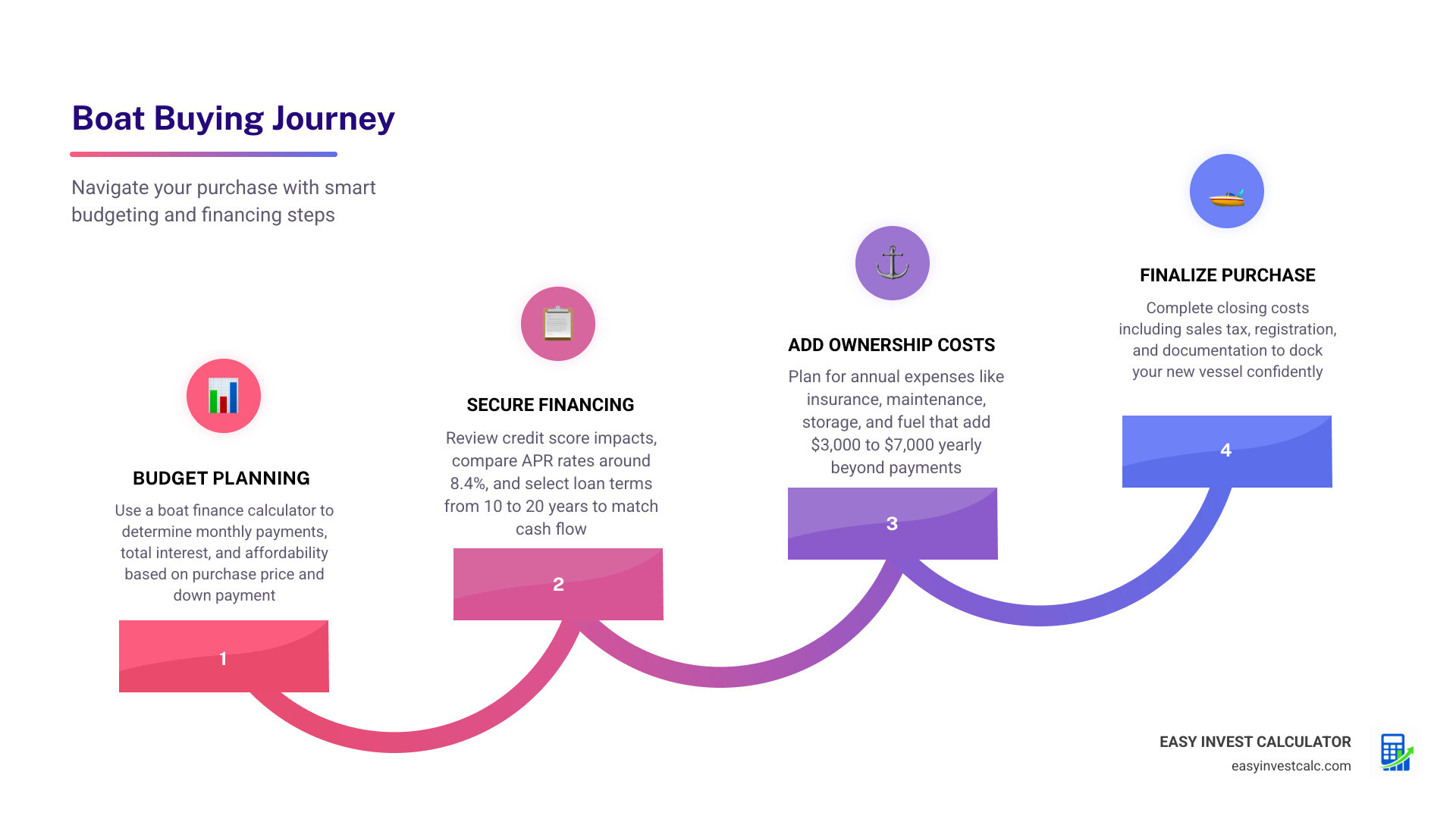
Boats are a significant financial commitment. Most buyers can’t pay cash, and the loan is just one piece. Insurance, storage, fuel, and maintenance can add $3,000 to $7,000 or more per year on top of your payments.
The good news? Running the numbers before you shop puts you in control.
Related content about boat finance calculator:
- amortization schedule with balloon payment
- amortization schedule with extra payments
- amortization schedule with fixed monthly payment
How a Boat Finance Calculator Navigates Your Budget

When we think about buying a boat, our minds usually drift to sunny days and calm waters. However, as any seasoned captain will tell you, a successful voyage begins with meticulous planning at the dock. A boat finance calculator serves as your primary navigational tool, helping you steer clear of financial shoals.
At its core, the calculator takes several key inputs to generate your estimated monthly installments. The purchase price is your starting point, but it’s rarely the amount you actually finance. By subtracting your down payment, you arrive at the principal loan amount. From there, the loan term (how many months you have to pay it back) and the interest rate determine your monthly commitment.
For a quick estimate, many in the industry use a “rule of thumb” where monthly payments land between 1% and 1.5% of the total purchase price. While this is a handy mental shortcut, using a precise EMI Calculator is the only way to ensure your budget can handle the reality of the loan.
Using the boat finance calculator for new vs used vessels
The math changes slightly depending on whether you are eyeing a brand-new showroom model or a pre-owned gem.
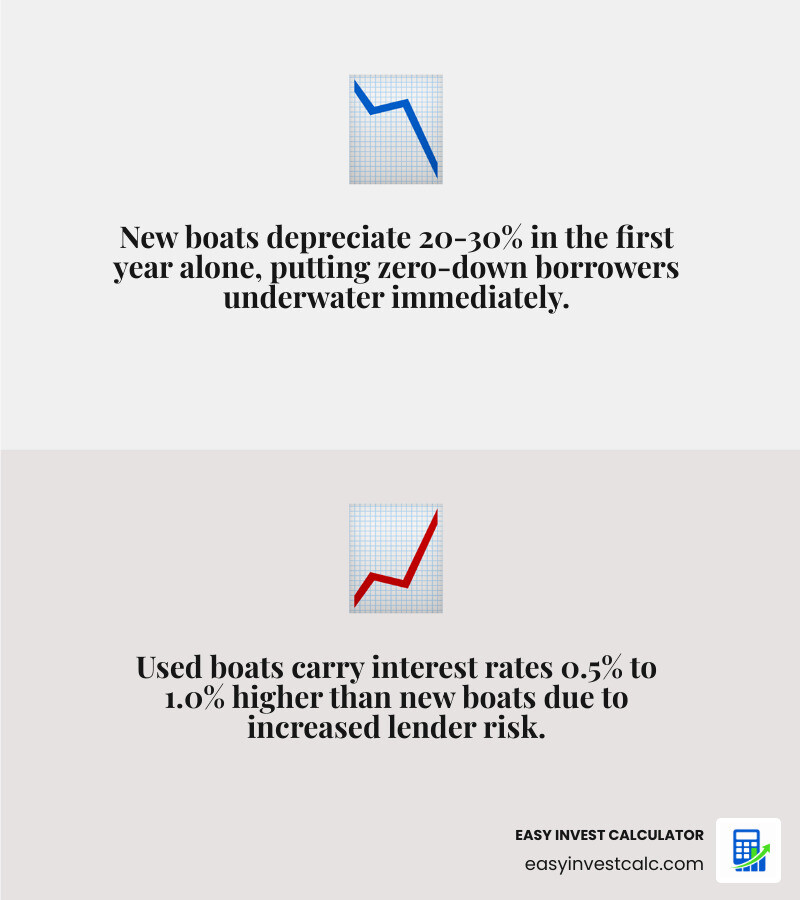
- Depreciation: New boats can lose 20% to 30% of their value in the first year alone. This means if you put zero down, you could immediately be “underwater” on your loan—owing more than the boat is worth.
- Marine Surveys: For used boats, especially those over $25,000, lenders almost always require a professional marine survey. This inspection costs roughly $20 to $25 per foot and ensures the boat is seaworthy and worth the asking price.
- Interest Rates: Historically, used boat loans carry interest rates about 0.5% to 1.0% higher than new boat loans because of the increased risk to the lender.
If you are looking to pay off a used boat faster to avoid the sting of depreciation, using an Amortization Schedule with Extra Payments can show you exactly how much interest you’ll save by chipping away at the principal early.
Estimating affordability with the 10% rule
How much boat can you actually afford? We recommend following the “10% Rule.” This guideline suggests that your total annual boating costs—including the loan, insurance, fuel, and maintenance—should not exceed 10% of your gross household income.
Lenders look at your debt-to-income (DTI) ratio very closely. Most marine lenders prefer a DTI of 36% or lower, though some will go up to 43% for buyers with stellar credit. If your monthly boat payment pushes your total debt obligations (mortgage, car loans, credit cards) past that 40% mark, you might find the approval process much tougher.
Factors That Steer Your Boat Loan Interest Rates

Interest rates aren’t just plucked out of thin air; they are a reflection of the risk the lender takes. In marine finance, rates are influenced by the economy, the age of the vessel, and your personal financial history.
Most boat loans are fixed-rate loans, meaning your interest rate and monthly payment stay the same for the entire life of the loan. This provides stability for your long-term planning. To understand how these payments are structured over time, you can dive into The Ultimate Guide to Fixed Rate Amortization.
Impact of credit scores on 2026 rates
As of May 2026, your credit score remains the most powerful lever in determining your APR. Marine lenders typically look for a score of at least 680, but the “Gold Standard” is 740 and above.
When you apply, the lender will perform a hard inquiry, which might temporarily dip your score by a few points. However, successfully managing an installment loan like a boat loan can actually improve your credit mix and score over the long term. For more detailed insights on how credit reporting works, you can consult Scientific research on credit score impacts.
Optimizing your boat finance calculator results
If the numbers coming out of your boat finance calculator look a bit high, you have a few ways to “trim the sails”:
- Increase the Down Payment: While 10% is the most common down payment, bumping that up to 20% or 30% can drastically lower your interest rate and monthly payment. It also protects you from depreciation.
- Adjust the Term Length: Boat loans are unique because they offer very long terms—often 120, 180, or even 240 months (10 to 20 years). A longer term lowers the monthly payment but significantly increases the total interest you pay over time.
- Shop Around: Don’t just take the first offer from a dealer. Credit unions often offer rates 0.5% to 2% lower than traditional banks.
Beyond the Monthly Payment: The True Cost of Ownership
One of the biggest mistakes new captains make is budgeting only for the loan payment. In reality, the boat loan is often just the “entry fee.” For a mid-sized boat valued at $30,000, annual operating costs can easily range from $3,000 to $7,000.
| Expense Category | Estimated Annual Cost | Why It Matters |
|---|---|---|
| Insurance | 1.5% – 3% of boat value | Required by lenders; protects against theft/accidents |
| Maintenance | 10% of boat value | Engines, hull cleaning, and winterization |
| Storage/Mooring | $1,000 – $10,000+ | Depends on if you trailer or use a marina |
| Fuel | $500 – $5,000+ | Varies wildly by engine size and usage |
If you’re transitioning from being a car owner to a boat owner, it’s helpful to see how these schedules differ. You can check out The Car Buyers Guide to Auto Amortization Schedules to compare how vehicle loans differ from marine financing.
Hidden fees and closing costs
When you sit down to sign the papers, be prepared for “closing costs.” These aren’t always included in the initial quote:
- Sales Tax: Most states charge 4% to 8%. On a $50,000 boat, that’s an extra $4,000 upfront.
- Registration & Documentation: You’ll need state registration and, for larger vessels, US Coast Guard Documentation.
- Loan Origination Fees: Lenders may charge 1% to 3% of the loan amount just to process the paperwork.
- Trailer Costs: If the boat doesn’t come with a trailer, a new one can cost between $2,000 and $8,000.
Annual maintenance and the 1% estimate
While the “10% of value” rule is a safe bet for total costs, some experts suggest budgeting at least 1% of the purchase price specifically for routine mechanical maintenance. This includes oil changes, impeller replacements, and winterization (the process of preparing the boat for cold storage). Neglecting these can lead to catastrophic engine failure, which will cost far more than the annual service.
Advanced Strategies for Boat Financing
Once you understand the basics, you can look at more advanced ways to structure your deal. Most boat loans are secured, meaning the boat itself is the collateral. If you stop paying, the lender takes the boat. However, some buyers with high net worth use unsecured personal loans. These don’t require the boat as collateral but usually come with higher interest rates and shorter terms (5–7 years).
For those looking at unique structures, an Amortization Schedule with Balloon Payment can show you how to keep monthly payments very low by agreeing to pay a large lump sum at the end of the loan term. This is common for buyers who plan to sell or trade in the boat after 3–5 years.
The second home tax deduction
Here is a “captain’s secret”: your boat might be tax-deductible. According to IRS rules, if your boat has basic living facilities—specifically a sleeping berth (bed), a galley (kitchen), and a head (toilet)—it can qualify as a second home.
This allows you to deduct the interest on your boat loan just like a home mortgage. For a large loan, this can save you thousands of dollars in federal taxes every year. Always check the latest IRS guidance on home interest deductions or consult a tax professional to ensure your vessel qualifies.
Refinancing your marine loan
Just because you signed a loan today doesn’t mean you’re stuck with it forever. If interest rates drop or your credit score improves significantly (say, moving from a 660 to a 740), you should look into refinancing.
A “break-even analysis” will tell you if the cost of refinancing (fees) is lower than the amount of interest you’ll save. Since many boat loans have no prepayment penalties, refinancing can be a smooth way to lower your monthly overhead once you have established some equity in the vessel.
Frequently Asked Questions about Boat Loans
What is a typical down payment for a boat?
The most common down payment is 10 percent. However, depending on your credit and the lender, requirements can range from 0% (for highly qualified buyers) up to 30%. Putting more money down reduces the lender’s risk and almost always results in a lower interest rate.
What credit score is needed for boat financing?
Most lenders require a minimum score of 680. To unlock the best rates (currently starting around 6.24%–7.5% in 2026), you generally need a score of 740 or higher. Lenders will also verify that your debt-to-income ratio stays below 43%.
Can I finance a boat for 20 years?
Yes, but typically only for larger loans. Most lenders require the loan amount to be at least $100,000 to qualify for a 20-year (240-month) term. While this makes a luxury yacht’s monthly payment more affordable, keep in mind that you will pay significantly more in total interest over two decades compared to a 10-year term.
Conclusion
At EasyInvestCalc, we believe that financial clarity is the key to enjoying your time on the water. By using a boat finance calculator, you move from “guessing” to “knowing.” You can account for the purchase price, the hidden fees of ownership, and the long-term impact of interest rates with total accuracy.
Whether you are buying a small fishing boat or a luxury cruiser, being a responsible captain starts with your finances. Use our EMI Calculator today to map out your journey and ensure your next adventure is smooth sailing from start to finish.