

A 2nd home mortgage calculator is one of the most important tools you can use before committing to a vacation or second property purchase. It helps you estimate your true monthly costs — including principal, interest, taxes, insurance, and fees — so there are no surprises.
Quick answer: What does a 2nd home mortgage calculator estimate?
| Input | Typical Value |
|---|---|
| Down payment required | 10–20% minimum |
| Interest rate premium | 0.50–1.00% above primary residence rates |
| Credit score needed | 640+ (700+ for best rates) |
| Max debt-to-income ratio | 43% (36% preferred) |
| PMI required if down payment | Below 20% |
Second homes cost more to finance than primary residences — not just in price, but in terms and conditions. Lenders see them as higher risk. If you hit financial trouble, they know you’re more likely to stop paying on a vacation home before your main one.
For busy professionals trying to build wealth, that complexity can feel overwhelming. You’re not just calculating one mortgage — you’re layering a second payment on top of your existing financial life.
That’s exactly where a dedicated calculator makes the difference.
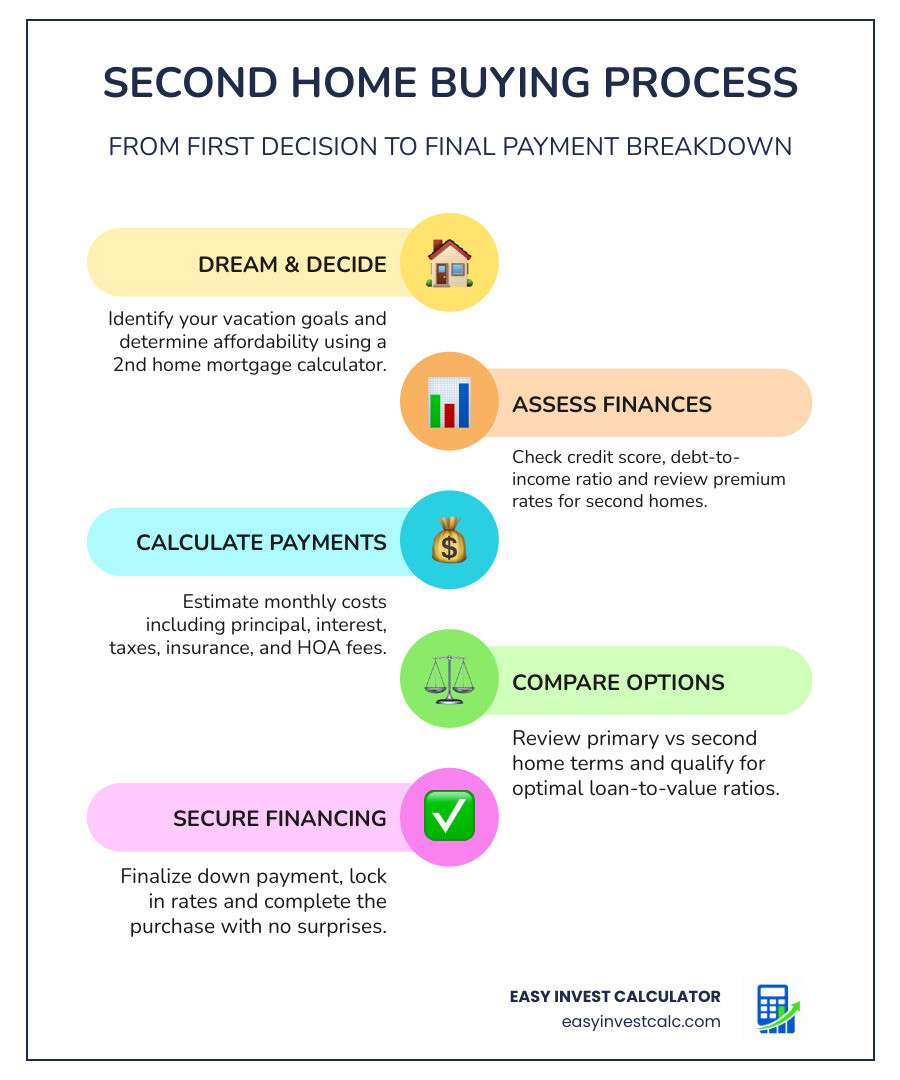
Basic 2nd home mortgage calculator vocab:
Planning Your Escape with a 2nd home mortgage calculator

When we dream of a second home, we usually picture the sunset over the lake or the snow falling on a mountain cabin. We rarely picture the amortization schedule. However, planning your escape requires a cold, hard look at the numbers. A 2nd home mortgage calculator is different from a standard one because it forces us to look at our finances holistically.
Unlike your first home, where you might have used an FHA or VA loan with a tiny down payment, second homes are strictly “conventional” territory. You are managing two sets of risks now. Lenders know that in a financial pinch, people protect their primary roof first. This “default risk” is why a 2nd home mortgage calculator often defaults to higher interest rates and stricter debt-to-income (DTI) requirements.
To stay on top of your game, you should Master Your Yearly Budget with an Annual Amortization Calculator to see how that second payment fits into your 12-month cash flow. It isn’t just about the principal and interest; it’s about how that second debt interacts with your first. Recent Scientific research on nonbank mortgage servicing highlights that the mortgage industry is changing, with nonbank lenders taking a larger role. This means more options for you, but also a greater need for you to do your own math.
Key Factors in a 2nd home mortgage calculator
To get an accurate result, you can’t just plug in a home price and hope for the best. We need to look at the “Big Five” factors:
- Down Payment: While you might have put 3% down on your first home, expect to put down at least 10% for a second home, and often 20% if you want to snag the best rates.
- Interest Rates: In May 2026, we are seeing that second home rates typically carry a premium of 0.5% to 1.0% over primary residence rates.
- Property Taxes: These aren’t always the same as your primary home. Some jurisdictions charge higher property tax rates for non-resident owners.
- Homeowners Insurance: Insuring a home you don’t live in full-time is pricier. Lenders worry about a pipe bursting while you’re away, so “vacant” or “seasonal” home insurance adds to the monthly tally.
- HOA Fees: Many vacation homes are in managed communities or condos. These fees can be a significant chunk of your monthly “all-in” payment.
Qualification and Eligibility for Second Home Financing

Getting approved for a second home is like the “Advanced Mode” of mortgage applications. Lenders will scrutinize your credit score more heavily—usually looking for a 640 minimum, though 700+ is where the “fun” interest rates live.
The biggest hurdle is the Debt-to-Income (DTI) ratio. Lenders typically follow the 28/36 rule: no more than 28% of your gross income should go toward housing, and no more than 36% toward total debt. When you add a second mortgage, that 36% limit gets crowded very quickly. If you are considering a long-term strategy, check out The 50-Year Mortgage Survival Guide to understand how extended terms can impact your DTI and long-term interest costs.
Another vital metric is the Loan-to-Value (LTV) ratio. For second homes, lenders are much stricter. While you might get an 80% LTV on a primary home easily, some lenders might cap a second home at 70% or 75% if the market is volatile.
| Requirement | Primary Residence | Second Home |
|---|---|---|
| Min. Down Payment | 3% – 5% | 10% – 20% |
| Min. Credit Score | 580 – 620 | 640 – 700 |
| Interest Rate | Market Base | Base + 0.5% to 1.0% |
| PMI Required? | Yes, if < 20% down | Yes, if < 20% down |
| Loan Types | FHA, VA, USDA, Conv. | Conventional Only |
Understanding 2nd home mortgage calculator Interest Rates in 2026
As of May 2026, market trends have stabilized somewhat after the volatility of the mid-2020s. However, the “rate premium” for second homes remains a reality. Lenders view these properties as discretionary. If the economy dips, you might sell the beach house, but you’ll fight to keep your main house.
Currently, interest rates for primary residences are hovering around 6.5%, but our 2nd home mortgage calculator users should prepare for rates closer to 7.25%. We also see interesting shifts in the secondary market; for example, Scientific research on second mortgage securitization shows that Freddie Mac has proposed new ways to securitize second mortgages, which could eventually lead to more competitive pricing for borrowers. To see how these rates play out over time, we recommend using The Ultimate Guide to Fixed Rate Amortization to visualize your equity growth.
Hidden Costs and Tax Implications of a Second Property
The sticker price is just the beginning. When we use a 2nd home mortgage calculator, we often forget the “ghost costs.” Maintenance on a second home is often higher because you aren’t there to catch small leaks before they become floods. You may also need to hire a property management company if the house is far away, which can take 10% to 25% of your rental income if you choose to lease it out.
Speaking of leasing, the tax man has very specific rules:
- Personal Use Only: If you don’t rent it out, you can typically deduct the mortgage interest on up to $750,000 of total mortgage debt (combined for both homes).
- The 14-Day Rule: If you rent the home for 14 days or fewer per year, you don’t have to report that income to the IRS. It’s essentially “tax-free” vacation money!
- Rental Property: If you rent it for more than 14 days, it becomes a business. You must report income, but you can also deduct expenses like utilities, insurance, and even depreciation.
To see if the math makes sense as an investment, you should Calculate Your Rental Yield and Mortgage to ensure the “fun” doesn’t turn into a financial drain.
Strategies to Lower Your Second Home Monthly Payments
If the numbers on the 2nd home mortgage calculator look a bit scary, don’t panic. There are several ways to bring that monthly payment down to earth.
The most effective strategy is a larger down payment. Putting 20% down doesn’t just lower the principal; it eliminates Private Mortgage Insurance (PMI). On a second home, PMI can be even more expensive than on a primary residence because of the perceived risk.
Another option is to look at Amortization Schedule with Extra Payments. By paying even a small amount extra toward the principal each month, you can shave years off the loan and save tens of thousands in interest.
Some buyers are also looking at “Alternative Financing.” Instead of a traditional second mortgage, you might use a Home Equity Line of Credit (HELOC) on your primary residence to pay cash for the second home. This can sometimes result in a lower overall interest rate, though it does put your primary home at risk. For those with a shorter-term exit strategy, an Amortization Schedule with Balloon Payment might offer lower initial payments, though it requires a plan for the final large “balloon” sum.
Frequently Asked Questions about Second Home Mortgages
Can I use rental income to qualify for a second home loan?
This is a common point of confusion. If you classify the property as a “Second Home,” lenders generally cannot use potential rental income to help you qualify. They assume you are using it for your own vacations. If you need that rental income to meet DTI requirements, you must classify the property as an “Investment Property.” This usually comes with even higher interest rates and a requirement for a 20-25% down payment. However, some lenders may credit up to 75% of projected fair market rents if you have a history of landlording.
How much down payment is required for a vacation home?
While some niche programs allow for 10% down, the industry standard for a second home is 20%. If you put down less than 20%, be prepared to pay PMI. In the 2026 market, many lenders are tightening their belts, so having a 20% “skin in the game” is the best way to ensure your loan gets through underwriting without a hitch.
Are interest rates higher for second homes than primary residences?
Yes, almost always. You can expect a “risk premium” of 0.50% to 1.00%. Lenders analyze millions of data points, and the data shows that people in financial distress will save their primary home and let the vacation home go into foreclosure first. You are paying for that statistical reality.
Conclusion
At EasyInvestCalc, we believe that “Double the Houses” should indeed mean “Double the Fun,” not double the stress. By using a 2nd home mortgage calculator early in the process, you can walk into a real estate office with the confidence of someone who knows their numbers inside and out.
Whether you’re looking for a beachside bungalow or a quiet forest retreat, smart investing starts with accurate calculations. Don’t let hidden fees or interest rate premiums catch you off guard. Take control of your financial future today and Calculate Your Monthly Payment to see just how close your dream home really is. Happy hunting!

Founder of EasyInvestCalc.com with 8+ years of experience in personal finance. Sunita simplifies complex financial mathematics—from SIP compounding to tax planning—empowering Indian investors to make smart, debt-free decisions based on real market mechanics.