Why Every Car Buyer Needs an Amortization Calculator for Their Loan
Using an amortization calculator car loan tool is the fastest way to see exactly what you’ll pay each month — and how much of that goes to interest versus actually owning your car.
Here’s what a car loan amortization calculator tells you at a glance:
| What You Enter | What You Get Back |
|---|---|
| Loan amount (vehicle price minus down payment) | Monthly payment amount |
| Annual interest rate (APR) | Total interest paid over the life of the loan |
| Loan term (in months) | Exact payoff date |
| Extra payments (optional) | Interest savings and shortened term |
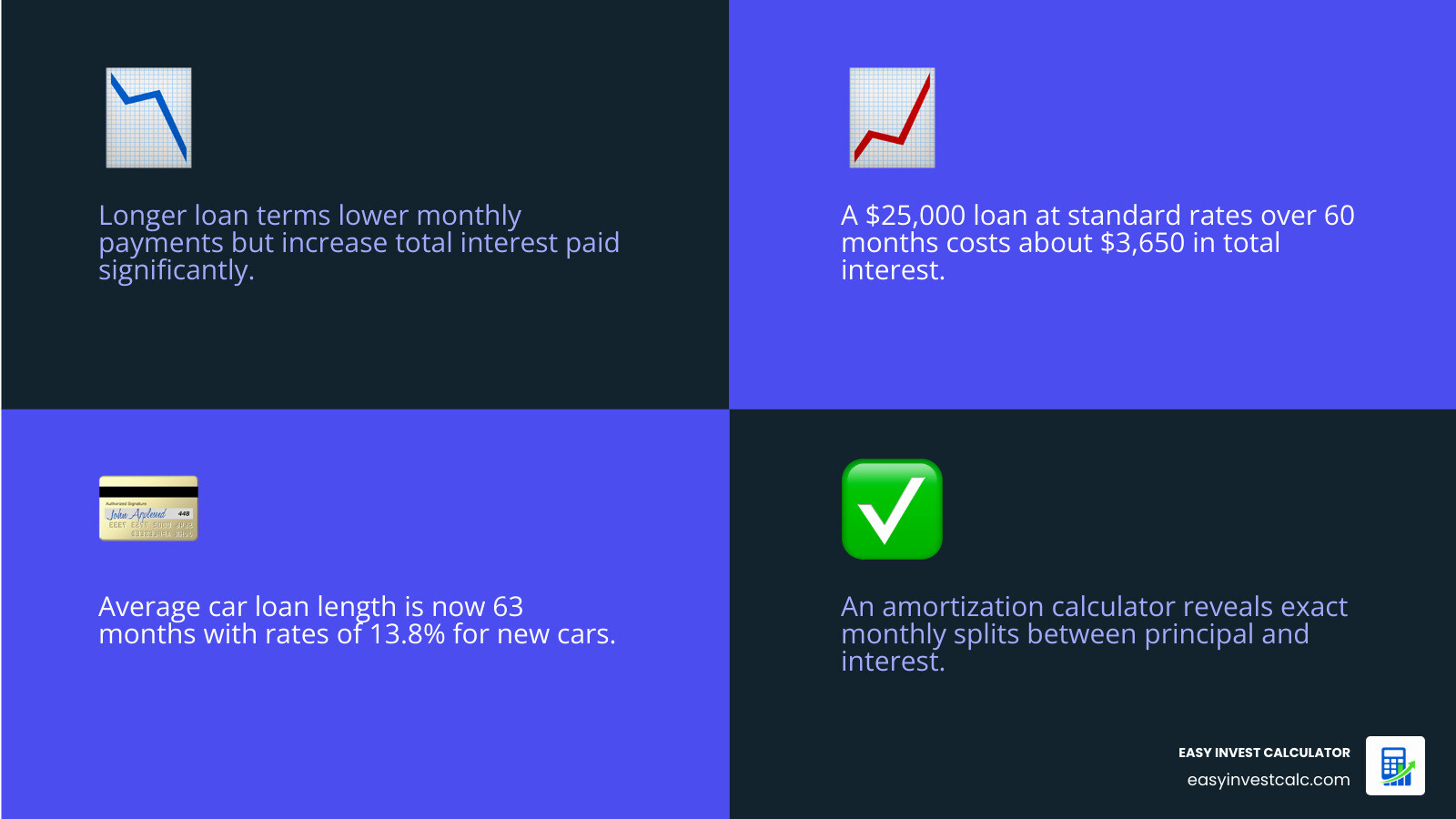
Quick example: A $25,000 loan at a standard rate over 60 months works out to roughly $477 per month — and you’d pay around $3,650 in interest by the time it’s done. Change one variable, and every number shifts.
Here’s the problem most car buyers run into: they focus on the monthly payment and ignore the total cost. A longer loan term lowers your monthly bill but raises what you pay overall. That gap can be thousands of dollars.
The average car loan is now 63 months long, with average rates of 13.80% for new cars and 16.20% for used. At those rates, the difference between a smart loan and a costly one isn’t the car you pick — it’s the numbers you run before you sign.
That’s exactly what this guide walks you through.
Amortization calculator car loan word list:
- amortization schedule with extra payments
- amortization schedule with fixed monthly payment
- amortization schedule calculator excel
What is an Amortization Calculator Car Loan Tool?
At its core, an amortization calculator car loan tool is a financial roadmap. When you borrow money to buy a vehicle, you aren’t just paying back the price of the car; you’re paying back the loan principal plus the cost of borrowing that money, known as the interest rate.
Amortization is the process of spreading out these payments over a set period, known as the repayment term. Unlike credit cards, which are “revolving debt” and can go on forever, a car loan is an “installment loan.” It has a clear beginning, middle, and end.
Most car loans use simple interest, meaning the interest is calculated based on the declining balance of the loan. As you chip away at the principal, the amount of interest you owe each month decreases. To see this in action, you can use an Auto Amortization Schedule to visualize the month-by-month breakdown.
Because the vehicle serves as vehicle collateral, the lender has a safety net. If payments stop, they can repossess the car. This security is why car loan rates are generally lower than personal loan rates, but it also means you need to be certain your monthly budget can handle the commitment. For a deeper dive into the mechanics, check out The Car Buyer’s Guide to Auto Amortization Schedules.
How Car Loan Amortization Works: Principal vs. Interest
Every time you make a car payment, your money is split into two buckets:
- Principal: This goes toward the actual balance of the car.
- Interest: This is the profit for the lender.
In the early stages of your loan, a larger chunk of your monthly installments goes toward interest. This is because interest is calculated based on your current balance. Since your balance is highest at the start, the interest charge is also at its peak. As you pay down the balance, the interest portion shrinks, and more of your money goes toward the principal.
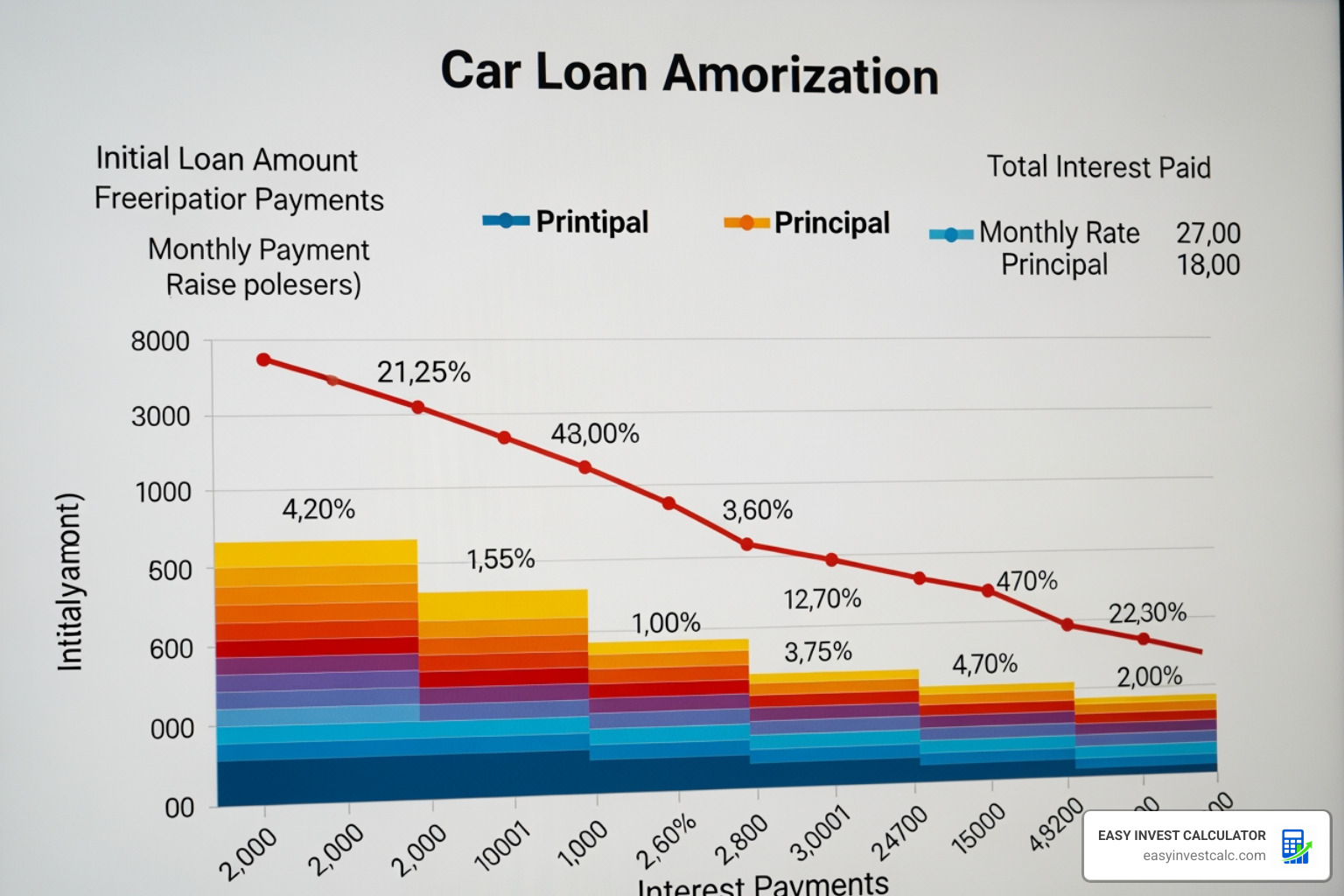
This is often referred to as “front-loaded interest,” though it isn’t an artificial fee—it’s just the math of a declining balance. You can see this shift clearly by using an Amortization Schedule Calculator: Principal vs Interest.
Total Interest Comparison: The Term Trap
Choosing a longer term might seem like a win for your wallet, but the total interest cost tells a different story.
| Loan Amount | Interest Rate | Term | Monthly Payment | Total Interest Paid |
|---|---|---|---|---|
| $30,000 | 7.02% | 48 Months | $719 | $4,496 |
| $30,000 | 6.94% | 60 Months | $593 | $5,591 |
In the table above, extending the loan by just one year saves you $126 a month but costs you an extra $1,095 in total interest. This is why we always recommend looking at the “big picture” before deciding on a term.
Understanding the Amortization Calculator Car Loan Breakdown
A detailed payment schedule provides more than just a monthly number. It shows you your equity building progress. Equity is the difference between what the car is worth and what you owe. Since new cars lose around 20% of their value in the first year alone, according to industry depreciation data, tracking your principal reduction is vital to avoid being “underwater” (owing more than the car is worth).
If you want to track this yourself, you can learn about Excel at Debt: Building Your Own Amortization Schedule to customize your tracking. Knowing your exact payoff date and loan maturity helps you plan for your next vehicle or a future where you have no car payment at all!
Key Factors Influencing Your Monthly Car Payments
Several moving parts determine what your amortization calculator car loan results will look like. Understanding these can save you thousands.
- Vehicle Price & Condition: New cars often have lower interest rates (averaging 13.80%) but higher price tags and faster depreciation. Used cars might have lower prices but higher rates (averaging 16.20%).
- Down Payment: This is your best weapon against interest. Ideally, you should aim for 15% to 20% of the vehicle’s cost. For example, increasing a down payment from $9,000 to $12,000 on a $45,000 car can reduce your monthly payment by $39 and save over $500 in interest.
- Trade-in Value: Trading in your old car acts like a down payment, reducing the amount you need to borrow.
- Sales Tax & Fees: Don’t forget that taxes and dealer fees can add 8-10% to the total car cost. If you roll these into the loan, you’ll be paying interest on them for years.
To get a head start on your planning, we recommend you Shift Your Finances into High Gear with an Auto Loan Calculator and use our Drive Away Happy with a Car Loan Repayment Calculator.
How Credit Scores Impact Your Amortization Calculator Car Loan Rate
Your credit score is the single most important factor in determining your APR (Annual Percentage Rate). APR is a broader measure than just the interest rate; it includes the interest plus any lender fees.
As of May 2026, based on research on auto loan rate trends, here is how credit tiers typically affect new car loan rates:
| Credit Tier | Score Range | Estimated New Car APR |
|---|---|---|
| Super Prime | 781-850 | 4.88% |
| Prime | 661-780 | 6.51% |
| Near Prime | 601-660 | 9.77% |
| Subprime | 501-600 | 13.34% |
| Deep Subprime | 300-500 | 15.85% |
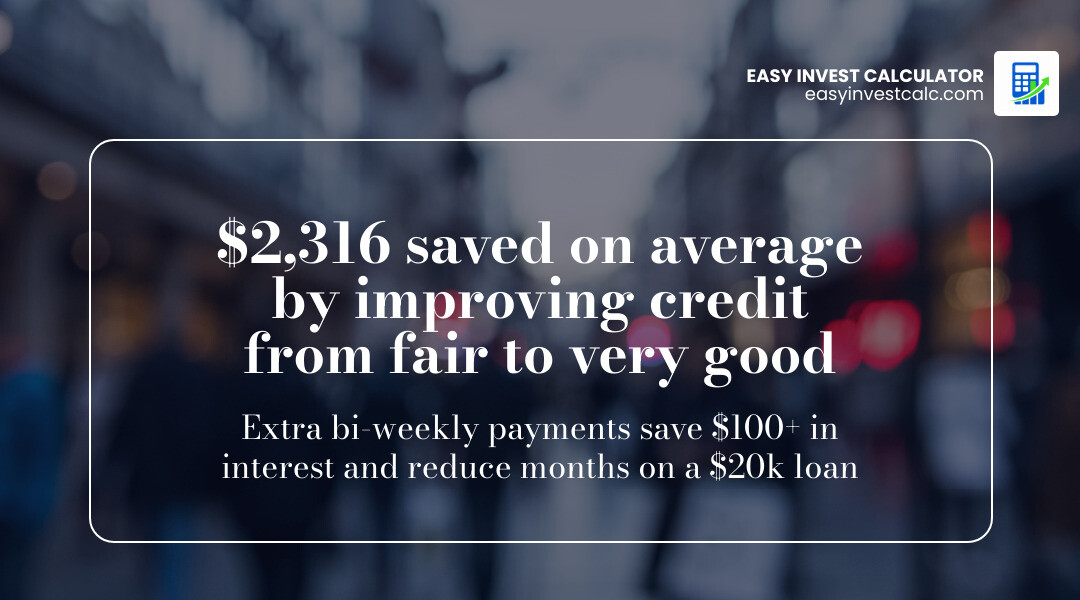
The “Credit Savings” Insight: Improving your credit score from “fair” to “very good” can save an average of $2,316 over the life of a car loan. If your score is currently on the lower side, it might be worth spending a few months improving it before you apply.
Strategies for Early Payoff and Interest Savings
If you’ve already signed a loan, you aren’t stuck with the original interest total. You can use an Amortization Schedule with Extra Payments to see how even small additions can drastically change your debt timeline.
Here are our favorite “secret sauces” for debt freedom:
- Bi-Weekly Payments: Instead of one monthly payment, pay half the amount every two weeks. Because there are 52 weeks in a year, you’ll end up making 26 half-payments—the equivalent of 13 full monthly payments. This can save nearly $100 in interest on a standard $20,000 loan and shave months off the term.
- Rounding Up: If your payment is $477, round it up to $500. That extra $23 goes straight to the principal, reducing the balance that interest is calculated on next month.
- Early Extra Payments: Extra payments made in the first year of a loan are more powerful than those made in the final year. Why? Because they reduce the principal balance earlier, preventing more interest from ever accruing.
- Refinancing: If your credit score has improved or market rates have dropped, refinancing can secure a lower APR. However, most lenders will only refinance up to the current value of the car. If you owe $10,000 on a car worth $5,000, refinancing may not be an option.
For more tips, check out Extra Payments: The Secret Sauce for Debt Freedom.
Frequently Asked Questions about Car Amortization
Does paying extra reduce my monthly payment?
No. When you make extra payments, your required monthly installment stays the same. However, the extra money goes directly toward principal reduction, which shortens your loan term and results in significant interest savings. The only way to lower your actual monthly payment is to refinance the loan.
Why is my interest higher at the start of the loan?
This is due to the declining balance nature of amortization. Since interest is calculated as a percentage of what you owe, and you owe the most at the very beginning, the interest charge is naturally higher. As the principal ratio of your payment increases, the interest portion shrinks.
Is a longer loan term always better for budgeting?
While a longer term (like the current 63-month average) helps with immediate monthly cashflow, it increases the total cost of the vehicle significantly. It also increases the risk of negative equity, where you owe more than the car is worth, making it difficult to sell or trade in the vehicle later.
Conclusion
Navigating car financing doesn’t have to be a headache. By using an amortization calculator car loan tool, you can move from “guessing” to “planning.” Car ownership costs an average of $4,507.11 every year beyond just the loan payment—including fuel, insurance, and maintenance, as noted in consumer expenditure reports. Smart borrowing is the first step toward managing those costs effectively.
At EasyInvestCalc, we believe in making financial planning effortless. Whether you are looking to buy your first car or refinance an existing one, our tools are here to help you find the most accurate path to debt freedom.
Ready to see the numbers for yourself? Shift your finances into high gear with an EMI calculator and take control of your car buying journey today!