
ELSS vs PPF: Is 3-Year Lock-in Worth It? Complete 2026 Comparison
PersonalFinanceInsight | Investment Comparisons | Tax Planning 2026
🔍 In-Depth Analysis · 2026
Every Indian investor asks this question at tax-saving time. The honest, data-backed answer might surprise you.
By: Saroj Yadav·Updated: May 2026·12 Min Read·Section 80C Guide
Every March, millions of Indian salaried employees scramble to submit proof of tax-saving investments. Two names dominate the conversation: ELSS and PPF. On the surface, they look remarkably similar — both offer deductions up to ₹1.5 lakh under Section 80C of the Income Tax Act. But dig even a centimetre deeper, and you find two completely different financial animals.
One could potentially double your money in five years. The other promises steady, guaranteed growth for fifteen. One is backed by market equity; the other by the Government of India. And the question every investor asks — “Is ELSS better than PPF for a 3-year lock-in?” — does not have a one-word answer. It has a nuanced one.
This article unpacks that nuance, with real numbers, recent data, and practical guidance — so you can make a decision that actually fits your life.
3 YrsELSS — Shortest lock-in among all Section 80C instruments
7.1%PPF interest rate (as of Q1 2026, government-guaranteed)
12–15%ELSS historical average CAGR over long-term horizons
₹1.5LMaximum annual deduction limit under Section 80C for both
What Exactly Are ELSS and PPF? A Beginner’s Context
Before comparing them, you need to know what you are actually comparing. Both ELSS and PPF are popular Section 80C tax-saving tools, but they are fundamentally different in nature.
Understanding ELSS (Equity Linked Savings Scheme)
ELSS is a type of mutual fund that primarily parks your money into the stock market — equities and equity-related instruments. Because it is linked to market performance, returns are neither fixed nor guaranteed. However, it carries the shortest mandatory lock-in period of just 3 years among all Section 80C investment options, which is one of its biggest selling points.
- Regulated by SEBI (Securities and Exchange Board of India)
- “Minimum investment as low as ₹500 per month via SIP. You can estimate your potential returns using an ELSS Mutual Fund Calculator before investing.”
- No upper cap on investment — only ₹1.5 lakh qualifies for tax deduction
- Open to both resident Indians and NRIs
- Available via mutual fund platforms, banks, and stockbrokers
Understanding PPF (Public Provident Fund)
PPF is a government-backed savings scheme, which is where it gets its signature reliability. The interest rate is announced quarterly by the Ministry of Finance and does not depend on stock market movements. The lock-in period here, however, is a full 15 years — though partial withdrawals are permitted after year 6.
- Backed by the Indian government — zero default risk
- Minimum investment: ₹500/year; Maximum: ₹1.5 lakh/year money grows over 15 years, check out the PPF Returns Calculator.
- One PPF account per individual (joint accounts not permitted)
- NRIs cannot open new PPF accounts; existing ones can be maintained till maturity
- Available at post offices, SBI, and other authorised banks
📘 Quick Context
Both ELSS and PPF are part of the “EEE” (Exempt-Exempt-Exempt) tax category under the old tax regime — meaning the investment, the gains, and the maturity amount are all tax-free, with a crucial asterisk for ELSS explained further below.
The Lock-in Period Debate: 3 Years vs 15 Years
This is where the comparison begins in earnest — and where ELSS holds an undeniable structural advantage for investors who prioritize flexibility.
ELSS: The 3-Year Advantage — and Its Real Meaning
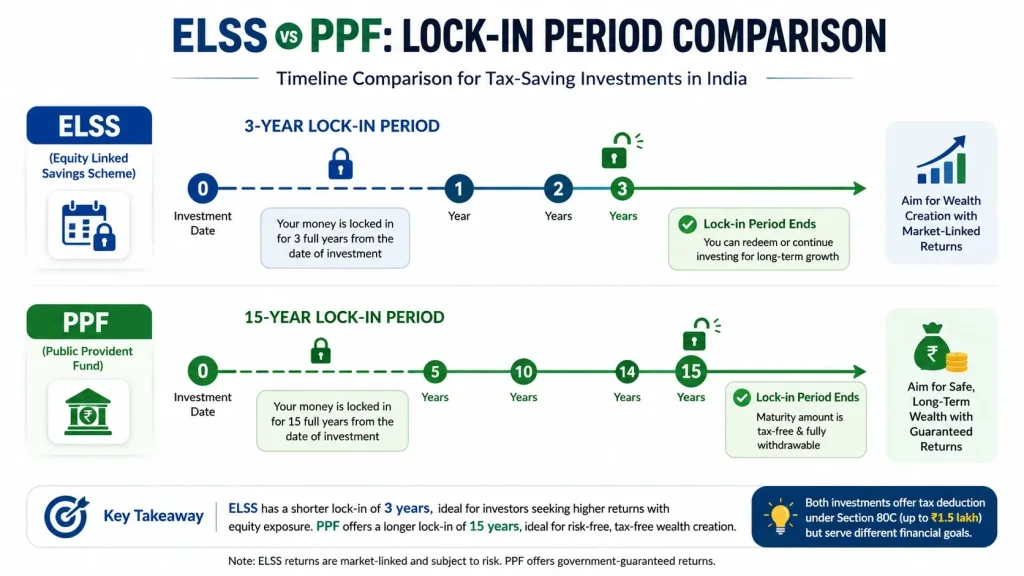
A 3-year lock-in sounds short. But here is something first-time investors often miss: when you invest via a Systematic Investment Plan (SIP), each monthly instalment carries its own 3-year lock-in. So if you start a monthly SIP in April 2026, the April instalment unlocks in April 2028 — but the January 2026 instalment unlocks in January 2029, and so on.
This is not a disadvantage by design — it actually enforces a healthy investing discipline. But it means your ELSS portfolio does not become fully liquid in a single moment, three years from the start date.
PPF: 15 Years, With a Silver Lining
PPF’s 15-year lock-in is non-negotiable. However, it does offer partial relief: loans are available against PPF balance from year 3 onwards, and partial withdrawals are permitted from year 7. After maturity, you can extend your PPF in 5-year blocks indefinitely — a useful feature for retirement planning.
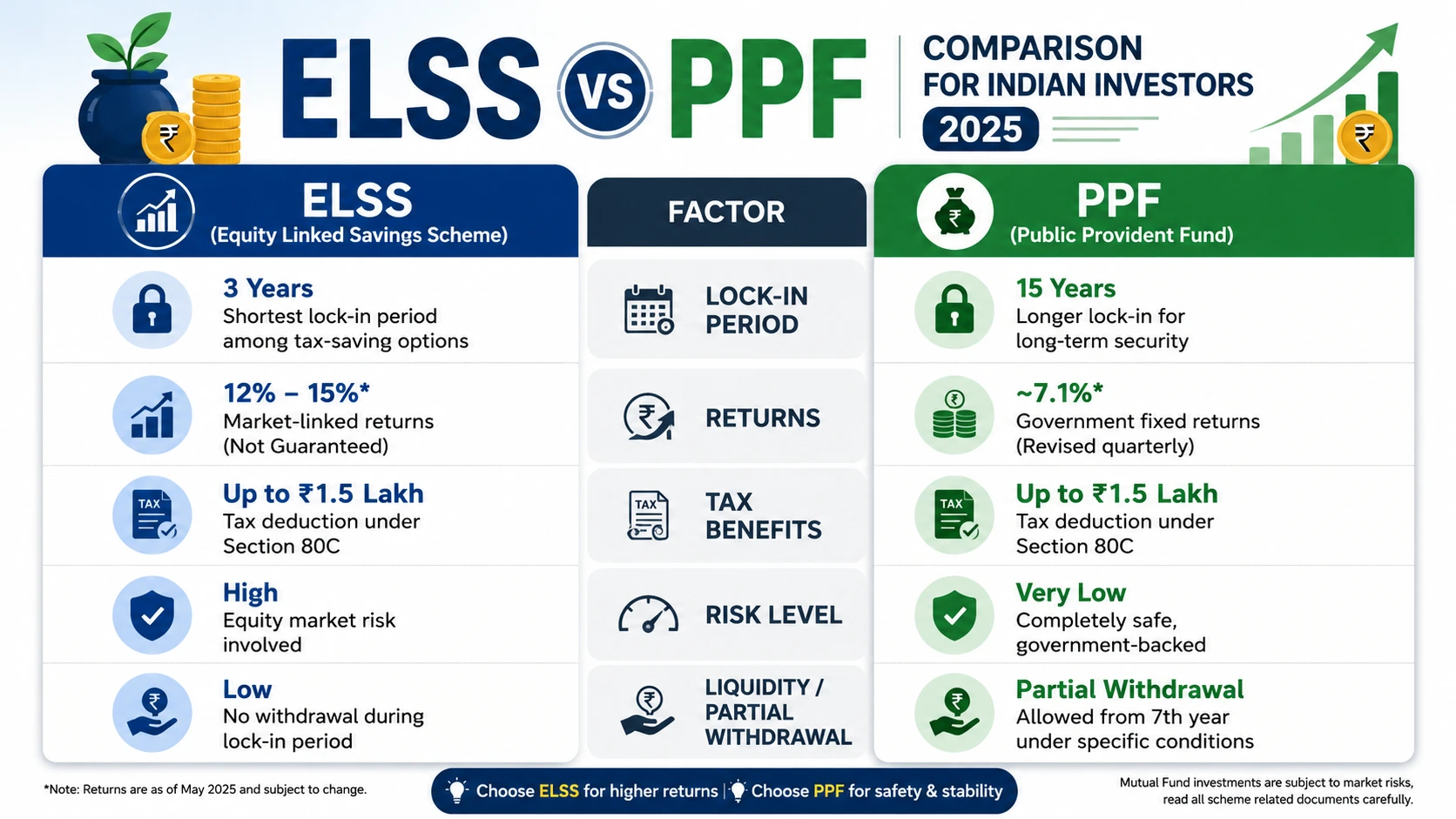
| Parameter | ELSS | PPF |
|---|---|---|
| Lock-in Period | 3 Years ✓ Shorter | 15 Years |
| Returns | Market-linked (12–15% historical CAGR) | Fixed (7.1% p.a., government-set) |
| Risk Level | Moderate to High | Zero Risk |
| Tax on Gains | LTCG @10% on gains >₹1 lakh/year | Fully tax-free (EEE) ✓ Better |
| Min. Investment | ₹500 | ₹500/year |
| Max. Investment | No cap (₹1.5L for tax benefit) | ₹1.5 lakh/year |
| Liquidity | After 3 years ✓ Better | Partial after 7 years |
| Who Can Invest | Indians + NRIs | Resident Indians only |
| Regulated By | SEBI | Ministry of Finance |
| Capital Safety | Not guaranteed | Government-guaranteed ✓ Safer |
| Ideal For | Wealth creation, medium-term | Retirement, long-term safety |
Returns Face-Off: Where the Real Difference Lies
Returns are the headline argument for ELSS — and with good reason. The potential gap between ELSS and PPF returns over time can be substantial.
📈 Indicative Return Comparison (₹1.5 Lakh/Year Investment)
ELSS
~12% CAGR
PPF
7.1% Fixed
* ELSS return is illustrative based on historical averages. Actual returns vary with market conditions. PPF rate is current government rate (Q1 FY 2026-27).
The 3-Year ELSS Math
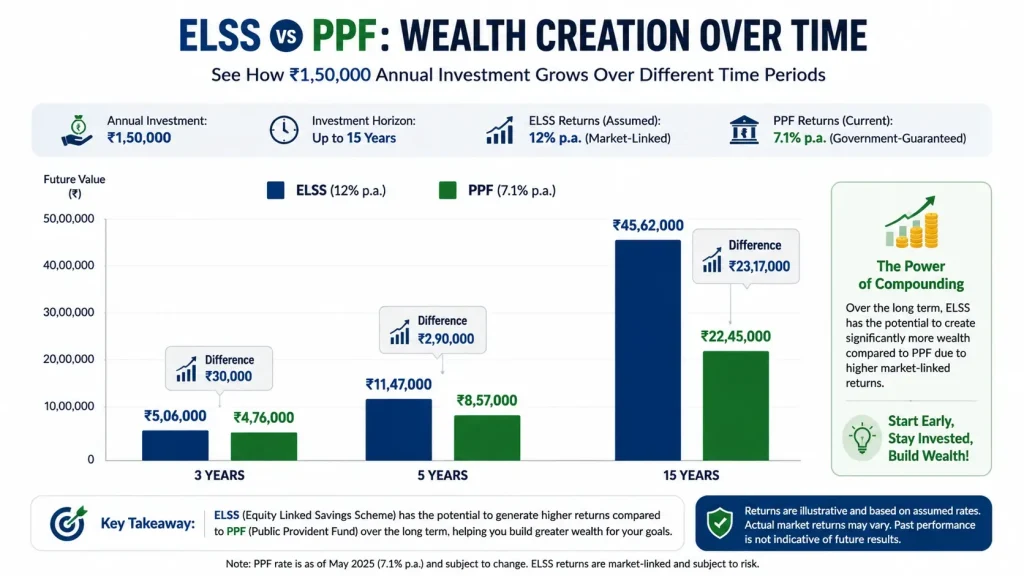
If you invest ₹1.5 lakh in ELSS as a lump sum and earn a 12% CAGR over 3 years, your investment could grow to approximately ₹2,10,739. By comparison, the same amount invested in PPF at 7.1% would generate roughly ₹49,000 in interest over the same period — though the corpus would remain locked for the longer tenure.
But this math comes with an important caveat: ELSS over just 3 years can also deliver negative returns during a prolonged market downturn. Equity markets can be unforgiving in the short run. The 3-year lock-in is the minimum, not the recommended holding period for ELSS. Most financial advisors suggest staying invested for 5–7 years for optimal results If you are investing monthly, use a Step-Up SIP Calculator to see how a small annual increase can double your final corpus
PPF’s 15-Year Magic
The compounding power of PPF over 15 years is genuinely impressive. Investing ₹1.5 lakh annually at 7.1% for 15 years creates a corpus of approximately ₹40.68 lakh — entirely tax-free. Compare this to ELSS via SIP at ₹12,500/month over 15 years at a 12% return: the projected corpus is around ₹63 lakh, but from this, you pay 10% LTCG on gains exceeding ₹1 lakh annually.
⚠️ Important Tax Note
ELSS is not fully exempt from taxes beyond the 3-year lock-in. Long-Term Capital Gains (LTCG) exceeding ₹1 lakh in a financial year are taxed at 10%. PPF, by contrast, enjoys complete EEE status — every rupee of interest is tax-free. This difference matters significantly for high-value investors.
💹
Risk Landscape: What Happens When Markets Fall?
This is the question that separates ELSS investors from PPF investors in character, not just strategy.
PPF investors sleep well during market crashes. In 2020 when COVID-19 sent Indian markets tumbling 40%, PPF accounts continued earning their government-set interest without a blip. ELSS investors, on the other hand, watched their portfolios shrink — though those who stayed invested through the recovery made exceptional gains by late 2020 and 2021.
🔴 Market Risk Reminder
ELSS funds are equity-linked. In a bearish 3-year cycle, you could unlock your investment at a loss. This has happened. It is not hypothetical. Anyone investing in ELSS should have a genuine tolerance — emotional and financial — for this possibility.
“The right investment is not the one with the highest return. It is the one you can hold through a storm without panic-selling.”— Common financial planning wisdom
Who Should Choose ELSS — and Who Should Stick With PPF?
This is the most practical section of this entire comparison. Forget the generic advice. Here is a clear, honest breakdown by investor profile.
✅ Choose ELSS If You Are…
- Between 25 and 45 years old with a long earning runway
- Comfortable with short-term portfolio volatility
- Looking for returns that beat inflation meaningfully
- Building wealth alongside tax savings
- An NRI looking for Section 80C benefits
- Investing with a 5+ year mental horizon (despite 3-year lock-in)
- Using SIPs rather than lump-sum investing
✅ Choose PPF If You Are…
- Risk-averse or nearing retirement (50+)
- Prioritizing capital protection over return maximization
- Planning a long-term corpus (15+ year horizon)
- Wanting completely tax-free maturity with zero surprises
- Someone who cannot tolerate portfolio value fluctuations
- A government employee building a safety net
- A first-time investor new to structured savings
The “Both” Strategy — What Experts Actually Recommend
Most seasoned financial planners in India do not recommend choosing one over the other — they recommend using both in a calibrated ratio. A common allocation is:
- Age under 35: 70% ELSS + 30% PPF — prioritize growth, build safety base
- Age 35–45: 50% ELSS + 50% PPF — balance growth and security
- Age 45+: 30% ELSS + 70% PPF — shift toward capital preservation
✅ Expert Insight
Financial planners consistently note that ELSS and PPF are not rivals — they are complements. PPF provides the floor (safety), and ELSS builds the ceiling (wealth). Using both under the ₹1.5 lakh Section 80C limit is often the most balanced tax-saving strategy for salaried individuals.
Latest Developments and Updates: What Changed in 2026?
The investment landscape is not static. Here is what has changed recently that affects the ELSS vs PPF comparison:
New Tax Regime Impact
The new income tax regime (FY 2024–25 onwards) does not allow Section 80C deductions. This is a significant shift. If you are under the new regime, neither ELSS nor PPF gives you a tax deduction on investment — but PPF interest and maturity remain tax-free regardless. ELSS gains are still subject to LTCG tax.
For anyone still on the old tax regime, both instruments retain their full Section 80C deduction benefits up to ₹1.5 lakh.
PPF Interest Rate — Stable but Below Inflation
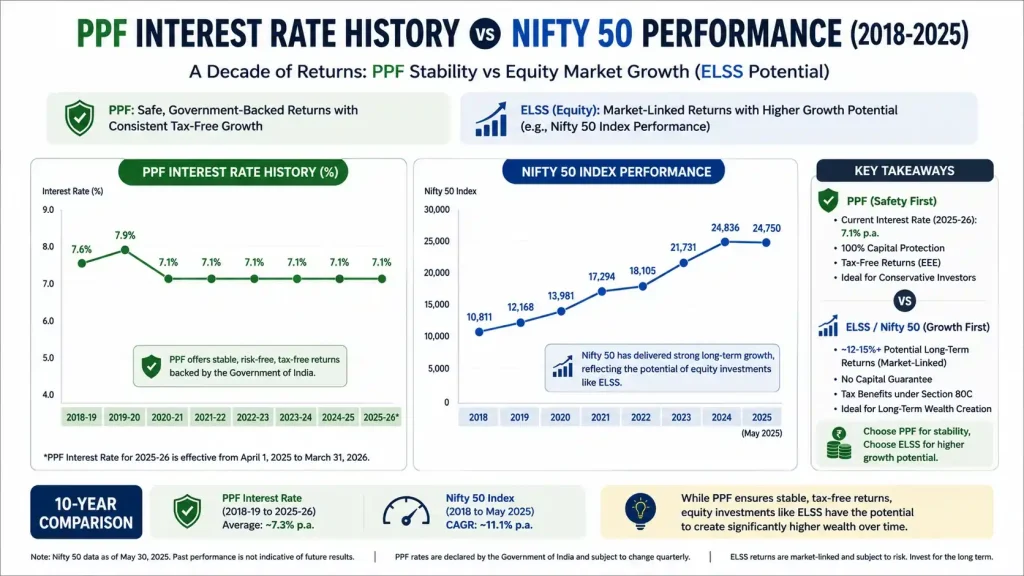
The PPF interest rate has remained at 7.1% per annum since April 2020. While this provides predictability, India’s retail inflation has hovered around 5–6%, meaning the real return on PPF (inflation-adjusted) is relatively modest. This is one of the reasons ELSS, despite its risk, remains attractive for wealth creation.
ELSS Market Performance Post-2022
After a volatile 2022, Indian equity markets recovered strongly in 2023–24. Many ELSS funds have delivered 15–22% CAGR over the last 3 and 5-year periods as of early 2026. This has renewed interest in ELSS, particularly among younger investors using SIP routes via platforms like Zerodha, Groww, and Paytm Money.
Real-World Impact: What This Choice Means for Your Financial Life
This debate is not abstract. The ELSS vs PPF decision shapes real outcomes over decades.
Consider Aarav, 32, a software engineer in Bengaluru earning ₹18 lakh annually. He invests ₹1.5 lakh each year under Section 80C. If he puts it all in PPF for 15 years at 7.1%, he builds a corpus of roughly ₹40.68 lakh — guaranteed and tax-free. If he puts it all in ELSS and earns a 13% CAGR over 15 years, his corpus could exceed ₹65 lakh — but with LTCG tax liability on gains and no guarantee.
Now consider Meera, 55, a teacher approaching retirement. She has zero appetite for risk. For her, PPF is not a compromise — it is the right tool. The stability and tax-free maturity provide exactly the certainty she needs as she plans her post-retirement years.
The same financial product can be a perfect fit for one person and completely wrong for another. That is the essence of personal finance.
◆
Not Sure Which One Fits Your Goals?
Drop your question in the comments below — our investment team reads every one. Or share this article with someone who is still undecided about their Section 80C investments this year.
⚡ Key Takeaways — Quick Summary
1
Lock-in edge goes to ELSS: 3 years vs PPF’s 15 years. For investors who value flexibility, this matters enormously.
2
Returns edge goes to ELSS (with risk): Historical CAGR of 12–15% vs PPF’s fixed 7.1%. But ELSS returns are not guaranteed — market downturns can erode value over short periods.
3
Tax edge goes to PPF: ELSS is taxed at 10% LTCG on gains over ₹1 lakh/year. PPF is fully EEE — zero tax at every stage.
4
Safety edge goes to PPF: Government-backed with guaranteed returns. Zero risk of capital loss. ELSS has no capital protection.
5
New Tax Regime alert: Under the new tax regime, Section 80C deductions are unavailable — making the traditional ELSS vs PPF tax-saving argument moot for those who have switched.
6
The smartest strategy is usually both: Use PPF as your safety anchor and ELSS as your growth engine. Allocate based on your age, risk profile, and financial goals.
Frequently Asked Questions
Is ELSS better than PPF for a 3-year lock-in period?
For pure liquidity, yes — ELSS’s 3-year lock-in is significantly shorter than PPF’s 15 years. However, “better” depends on your goal. If you want higher potential returns and can handle market risk, ELSS wins on flexibility and growth. If you need guaranteed returns and zero risk, PPF wins overall. Most experts recommend using both in a balanced ratio based on your age and financial goals.
What is the current PPF interest rate in 2026?
As of Q1 2026, the PPF interest rate is 7.1% per annum, compounded annually. This rate has remained unchanged since April 2020. The Ministry of Finance reviews PPF rates quarterly but has maintained stability in recent years.
Do ELSS investments qualify for deduction under the new tax regime?
No. Under India’s new income tax regime (applicable from FY 2023–24 onwards), Section 80C deductions — including those for ELSS and PPF investments — are not available. You can still invest in both instruments, but the tax deduction benefit applies only under the old tax regime.
Can I invest in both ELSS and PPF in the same financial year?
Absolutely. In fact, this is what most financial advisors recommend. You can split your ₹1.5 lakh Section 80C limit between ELSS and PPF in any proportion you choose — for example, ₹1 lakh in ELSS and ₹50,000 in PPF. This gives you exposure to market-linked growth while maintaining a government-backed safety cushion.
Conclusion: There Is No Universal Winner — Only the Right Fit
The ELSS vs PPF debate has no absolute winner. What it does have is a clear framework for choosing: your age, your risk appetite, your time horizon, and your tax regime.
If you are young, growth-oriented, and comfortable watching your portfolio fluctuate in exchange for potentially higher long-term returns, ELSS is a compelling choice — especially with its 3-year lock-in giving you far more flexibility than PPF’s 15-year commitment.
If you are risk-averse, nearing retirement, or simply prioritize guaranteed, tax-free compounding with zero market exposure, PPF remains one of the best instruments the Indian financial system offers.
And if you are like most investors — somewhere in between — the answer is simply both. Split your Section 80C allocation between ELSS for growth and PPF for stability. Let each do what it does best.
The future outlook for both instruments remains strong. Indian equity markets are projected to grow steadily through 2026–2030, which bodes well for ELSS. PPF will continue to offer its reliable, government-assured returns regardless of market conditions.
Your money, your goals, your choice — but now, at least, an informed one.
Disclaimer: This article is for informational purposes only and does not constitute financial advice. Please consult a SEBI-registered financial advisor before making investment decisions.