Why an Amortization Schedule with Fixed Monthly Payment Is the Key to Understanding Your Loan
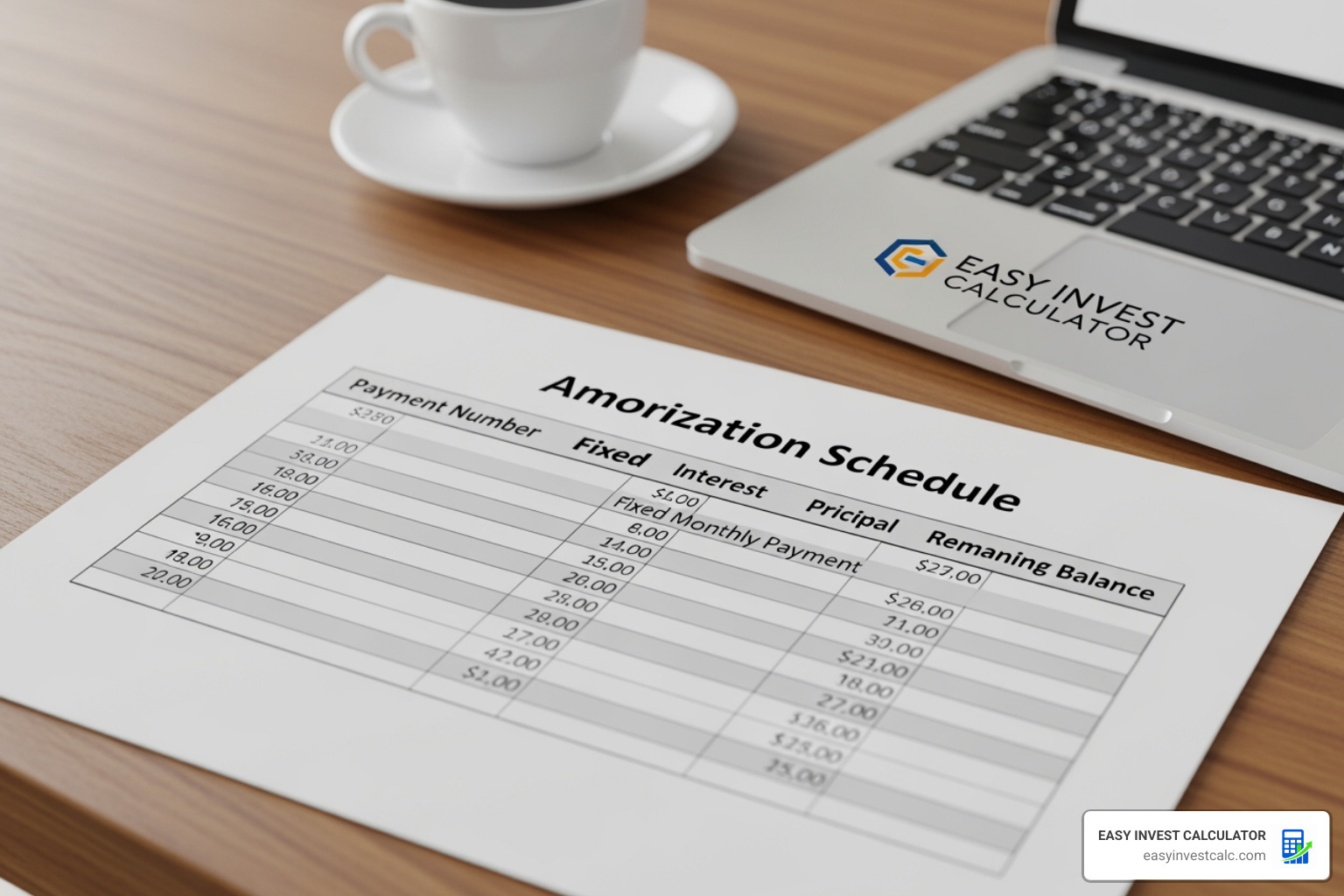
An amortization schedule with fixed monthly payment is a table that shows exactly how each loan payment is split between interest and principal — and how your remaining balance shrinks over time.
Here’s what it covers at a glance:
| Component | What It Means |
|---|---|
| Fixed Monthly Payment | The same dollar amount due every month |
| Interest Portion | The cost of borrowing, highest in early payments |
| Principal Portion | The amount that reduces your loan balance |
| Remaining Balance | What you still owe after each payment |
The total payment never changes. But what’s inside that payment shifts dramatically over time — early on, most of your money goes to interest; later, most goes to principal.
This matters because most people only look at the monthly number. A low payment might look appealing on the surface, but it doesn’t tell you how much you’re actually paying in interest over the life of the loan. On a $200,000 30-year mortgage at 6%, for example, you’d pay over $103,000 in interest alone — more than half the original loan amount.
Understanding your amortization schedule puts you in control. It helps you plan extra payments, compare loan terms, and make smarter refinancing decisions — without needing to be a math expert.
Understanding the Amortization Schedule with Fixed Monthly Payment
When you take out a standard mortgage or car loan, you are likely entering into a “fully amortizing” agreement. This means that if you make every payment on time, the loan will be exactly $0 at the end of the term. To make this happen, lenders create an amortization schedule with fixed monthly payment to map out the journey from your first dollar owed to your final “paid in full” celebration.

At its core, this schedule is a roadmap. It prevents the “sticker shock” that comes with realizing how much borrowing actually costs. For example, if you take a $400,000 mortgage at 6.10% over 30 years, your fixed monthly payment is $2,424. While that number stays the same, the schedule reveals a sobering truth: in the early years, over 75% of that payment is “eaten up” by interest. In fact, after five years of making those $2,424 payments—totaling over $145,000—your actual loan balance would have only dropped by about $27,326.
Using a tool like our EMI Calculator allows you to see this breakdown instantly. It transforms a vague monthly bill into a clear strategy for building equity.
The Mechanics of an Amortization Schedule with Fixed Monthly Payment
Why is the interest so high at the beginning? It’s not a conspiracy; it’s simple math. Interest is calculated based on your remaining balance. Since your balance is highest on day one, the interest charge is also at its peak. As you chip away at the principal, there is a smaller “bucket” of debt for the interest rate to apply to, which allows more of your fixed payment to go toward the principal.
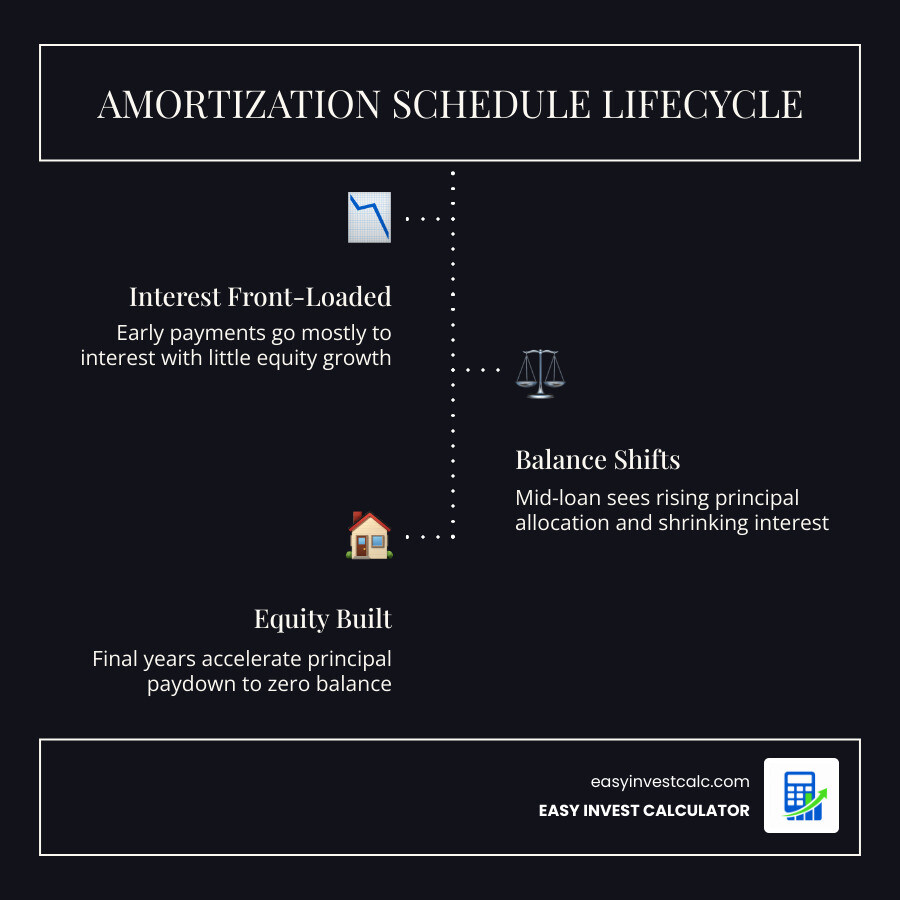
This process creates three distinct phases:
- The Interest-Heavy Phase: Usually the first half of the loan. Your equity (the portion of the asset you actually own) grows at a snail’s pace.
- The Tipping Point: The moment where your principal payment finally exceeds your interest payment. On a 30-year loan at 4%, this often doesn’t happen until payment 153—nearly 13 years in!
- The Equity Acceleration Phase: The final years where the balance drops rapidly because almost the entire payment is hitting the principal.
According to Scientific research on mortgage structures, this predictable structure is what provides financial stability for households, allowing for long-term budgeting without the fear of fluctuating monthly costs.
Key Components of a Repayment Table
To read an amortization schedule with fixed monthly payment like a pro, you need to understand these five columns:
- Scheduled Payment: The total amount you send the lender (Principal + Interest).
- Beginning Balance: What you owed before that month’s payment.
- Interest Portion: The “fee” for the loan, calculated as (Balance x Interest Rate) / 12 months.
- Principal Portion: The “leftover” part of your payment that actually reduces your debt.
- Ending Balance: Your new debt amount, which becomes next month’s beginning balance.
The Math Behind Fixed-Rate Loan Calculations
We know math can be intimidating, but the formula for a fixed-rate loan is actually a beautiful piece of financial engineering. It ensures that despite the shifting ratio of interest to principal, the total amount you pay stays exactly the same every month.

Calculating the Monthly Installment
The standard formula used by lenders and our calculators is: M = P [ i(1 + i)^n ] / [ (1 + i)^n – 1 ]
Where:
- M = Total monthly payment
- P = Principal loan amount
- i = Monthly interest rate (Annual rate divided by 12)
- n = Number of months (Term length x 12)
Let’s look at some real-world examples from May 2026:
- Scenario A: A $100,000 personal loan at 7% for 5 years results in a $1,980.12 monthly payment.
- Scenario B: A $200,000 mortgage at 5% for 30 years results in a $1,073.64 monthly payment.
Notice how the term length drastically changes the payment. Even though the mortgage in Scenario B is twice as large as the loan in Scenario A, the monthly payment is nearly half because the debt is spread over 30 years instead of five. However, the trade-off is that the 30-year borrower will pay significantly more in total interest.
Factors Influencing the Amortization Timeline
Three main levers determine how your loan lives and breathes:
- Loan Amount: Larger loans mean higher interest charges every month, especially at the start. A $560,000 mortgage at 9% requires a hefty $4,506 monthly payment just to keep up with the amortization.
- Interest Rate: Even a 1% difference can be staggering. On a $400,000 loan at 6.10%, you’ll pay over $463,000 in interest over 30 years. If that rate were lower, the “tipping point” where you pay more principal than interest would arrive years sooner.
- Term Length: This is the biggest factor in total cost. A $200,000 loan at 4% costs $343,739 total over 30 years but only $266,287 over 15 years. By choosing a shorter term, you save $77,452!
Strategic Benefits of Extra Payments and Refinancing
One of the most powerful reasons to study an amortization schedule with fixed monthly payment is to find ways to break it. You aren’t “stuck” with the schedule the bank gives you; you can use it as a baseline to beat.
Impact of Extra Payments on an Amortization Schedule with Fixed Monthly Payment
Making extra payments is like taking a shortcut on a long road trip. Because interest is calculated on your remaining balance, any extra dollar you pay today reduces the balance that interest is calculated on for every single month remaining in the loan.
We call this the “snowball effect” of principal reduction. For instance, on a $250,000 loan at 6.5%, adding just $50 extra to your monthly payment can shorten your 30-year term by over two and a half years and save you roughly $32,900 in interest.
If you’re interested in seeing how your specific numbers look, check out our guide on Extra Payments: The Secret Sauce for Debt Freedom or use our specialized Amortization Schedule with Extra Payments tool to model different scenarios.
When to Consider Refinancing
Refinancing is essentially hitting the “reset” button on your amortization schedule. Borrowers usually do this to snag a lower interest rate or change their loan term.
In our current May 2026 market, many experts suggest that if you can drop your rate by 1% or more, it’s worth looking at the numbers. However, you must be careful. If you are 10 years into a 30-year mortgage and you refinance into a new 30-year mortgage, you are resetting the interest-heavy phase. Even with a lower rate, you might end up paying more in total interest because you’ve extended the time you are in debt.
Refinancing Checklist:
- Check the Tipping Point: If you’ve already passed the point where most of your payment goes to principal, refinancing might actually slow down your equity growth.
- Calculate Closing Costs: It usually costs 2% to 5% of the loan amount to refinance. Ensure your monthly savings will cover these costs within 24 months.
- Consider a Shorter Term: If rates have dropped, you might be able to switch from a 30-year to a 15-year loan for a similar monthly payment, cutting your interest costs by tens of thousands.
Amortization in Business: Fixed Payments vs. Depreciation
While we usually talk about amortization in terms of loans, it’s also a vital accounting concept. In a business context, amortization is the process of spreading the cost of an intangible asset (like a patent, trademark, or software) over its useful life.
This is different from depreciation, which applies to tangible assets (like machinery, vehicles, or buildings).
| Feature | Amortization | Depreciation |
|---|---|---|
| Asset Type | Intangible (Patents, Copyrights) | Tangible (Trucks, Equipment) |
| Salvage Value | Usually zero | Often has resale value |
| Purpose | Spreading cost over time | Reflecting wear and tear |
For a business owner, understanding the amortization schedule with fixed monthly payment for a business loan is critical for cash flow, while accounting amortization is critical for tax strategy. Both help paint a picture of the company’s long-term financial health.
Amortization vs. Adjustable-Rate Loans
Not all loans have a “fixed” schedule. Adjustable-Rate Mortgages (ARMs) have an initial fixed period (like 5 years) after which the interest rate—and your payment—can change based on market conditions.
When an ARM rate changes, the lender performs “re-amortization.” They take the remaining balance and the remaining months and calculate a new fixed payment based on the new rate. This can lead to “payment shock” if rates rise significantly. This is why many borrowers prefer the boring but beautiful stability of a fixed-rate loan; you know exactly what your payment will be in May 2036, not just May 2026.
Frequently Asked Questions about Amortization
How does the allocation between principal and interest change over time?
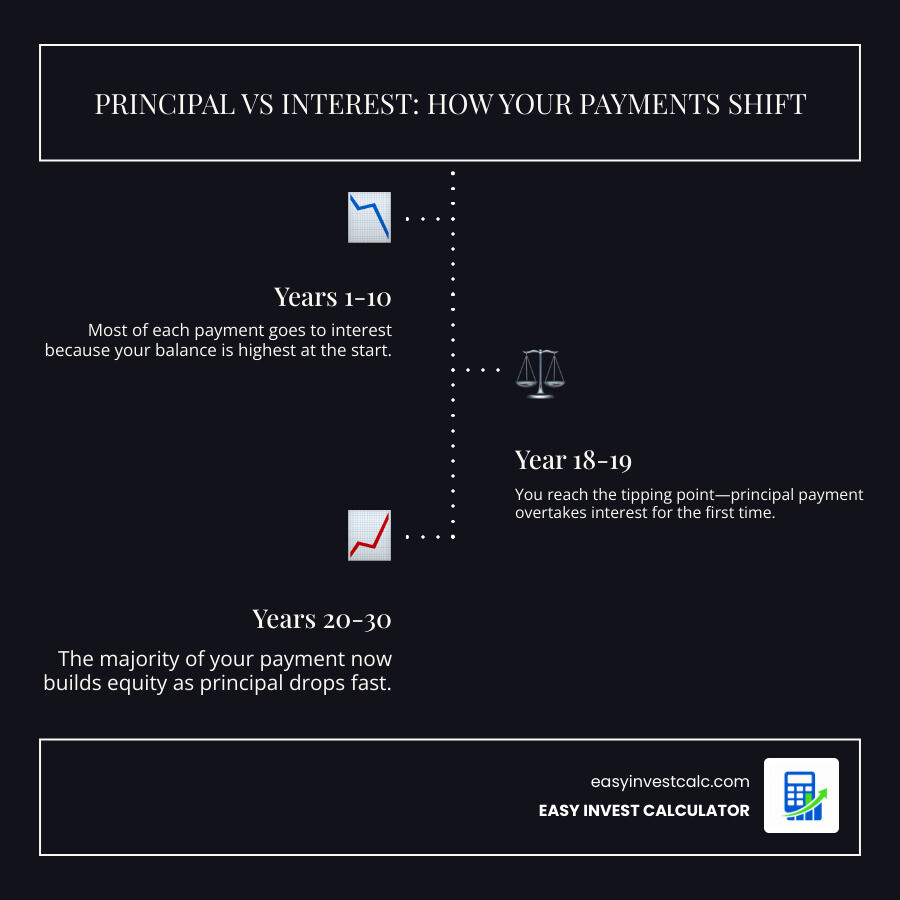
In the beginning, your balance is high, so the interest charge (calculated as a percentage of that balance) is high. As you pay down the principal, the balance drops. Since the total payment is fixed, as the interest portion shrinks, the principal portion must grow to fill the gap. It’s a seesaw effect that favors the bank early on and favors you later on.
Can I use an amortization schedule for credit card debt?
Technically, no. Credit cards are “revolving debt,” not “installment debt.” Because you can charge new purchases and the balance changes daily, there is no fixed end date or fixed payment. However, you can create an amortization plan for credit cards by stopping new charges and using a calculator to determine a fixed monthly payment that will kill the balance in a set number of months.
What is the “tipping point” in a 30-year mortgage?
The tipping point is the month where your principal payment becomes larger than your interest payment. For a 30-year loan at 6%, this typically happens around year 18 or 19. If you have a 15-year loan, the tipping point happens much faster—usually by year 3 or 4—which is why 15-year loans build wealth so much more effectively.
Conclusion
Navigating lending can feel like walking through a fog, but an amortization schedule with fixed monthly payment acts as a powerful lighthouse. It strips away the mystery of where your money is going and reveals the true cost of your debt.
Whether you are a first-time homebuyer looking at a $400,000 mortgage or a business owner managing startup costs, the data is clear: those who understand their schedule save more money. By identifying your tipping point, modeling the impact of extra payments, and keeping an eye on refinancing opportunities, you move from being a passive borrower to an active wealth builder.
At EasyInvestCalc, we believe financial freedom starts with better tools. We encourage you to take your loan documents, head over to our EMI Calculator, and see exactly how your journey to debt-free living looks. As we look ahead through May 2026 and beyond, every dollar of principal you pay today is a seed planted for your future financial security. Happy planning!

Founder of EasyInvestCalc.com with 8+ years of experience in personal finance. Sunita simplifies complex financial mathematics—from SIP compounding to tax planning—empowering Indian investors to make smart, debt-free decisions based on real market mechanics.