

How Extra Payments Can Slash Your Loan Interest (And How to Calculate the Savings)
Using an amortization calculator with extra payments is one of the fastest ways to see exactly how much money you can save by paying more than your minimum each month.
Here’s what extra payments can do for a typical mortgage:
| Extra Monthly Payment | Loan Example | Interest Saved | Time Saved |
|---|---|---|---|
| $50/month | $250,000 at 5%, 30 years | $21,298 | 2 years 4 months |
| $100/month | $400,000 at 6%, 25 years remaining | $35,000+ | 2 years 2 months |
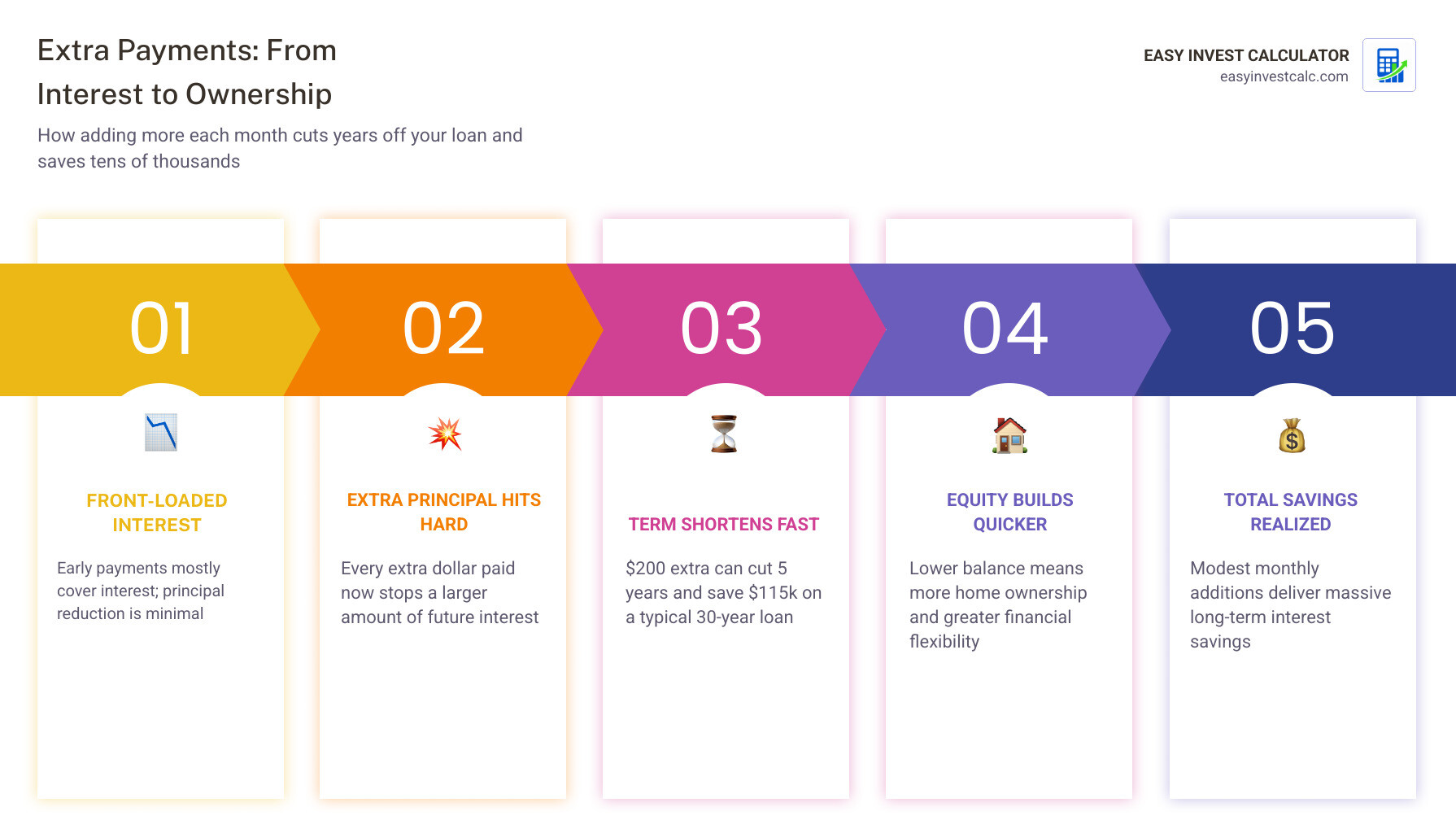
| $200/month | $405,000 at 6.625%, 30 years | $115,823 | 5 years 7 months |
| $300/month | $300,000 at 5%, 30 years | $91,741 | 9 years |
The numbers are striking. A modest extra payment — money many people already have in their budget — can save tens of thousands of dollars over the life of a loan.
Here’s the thing most borrowers don’t realize: mortgage interest is front-loaded. In the early years, most of your payment goes to interest, not principal. That means every extra dollar you put toward principal right now stops a much larger amount of interest from ever accruing.
This guide walks you through exactly how to use an amortization calculator with extra payments, what the results mean, and what to watch out for before you start paying extra.
Essential amortization calculator with extra payments terms:
- amortization schedule with extra payments
- amortization schedule calculator
- amortization schedule with fixed monthly payment
Understanding the Amortization Calculator with Extra Payments
At EasyInvestCalc, we believe that understanding your debt is the first step toward conquering it. An amortization calculator with extra payments is more than just a math tool; it’s a roadmap to financial freedom. But what exactly is it doing under the hood?
In simple terms, amortization is the process of spreading out a loan into a series of fixed payments over time. Each payment you make is split into two buckets: interest (what you pay the lender for the privilege of borrowing) and principal (the actual balance of your loan). In the beginning, the interest bucket is nearly full, while the principal bucket only gets a few drops. As you move through your term, the buckets swap roles.
When you use our tool, you’re looking at several key factors:
- Loan Principal: The original amount you borrowed.
- Interest Rates: As of May 2026, we are seeing a market where even a small percentage point difference can mean the cost of a luxury car over thirty years.
- Repayment Terms: Usually 15 or 30 years for mortgages.
- Extra Payments: This is the “magic” variable that disrupts the lender’s original plan.
By using an Amortization Schedule Calculator: Principal vs Interest, you can visualize this tug-of-war between your balance and the interest. Most loans, especially home and auto loans, are fixed-rate, meaning your monthly payment stays the same, but the internal “split” changes every single month.
How Amortization Schedules Change with Extra Principal
The “secret” that banks don’t exactly shout from the rooftops is that interest is calculated based on your current balance. If you reduce that balance today, the interest charge for next month—and every month after that—is smaller.
This is why extra payments are so powerful in the early years of a loan. When you make a standard payment, the bank takes their cut of interest first. Whatever is left goes to the principal. However, when you make an extra principal payment, 100% of that dollar goes toward reducing the balance.
According to The Ultimate Guide to Fixed Rate Amortization, this creates a snowball effect. By shrinking the principal faster than scheduled, you are effectively “deleting” future interest payments that would have been calculated on that money. You aren’t just building equity; you are protecting your future income from being eaten by interest.
Strategies to Accelerate Your Loan Payoff
Not all extra payments have to look the same. Depending on your cash flow in May 2026, you might choose one or a combination of these strategies:
- Monthly Recurring Payments: Adding a set amount, like $100 or $200, to every single payment. This is the most consistent way to see long-term results.
- One-time Windfalls: Did you get a tax refund or a bonus at work? Dropping a lump sum of $5,000 into your principal can shave a massive amount of time off your loan.
- Bi-weekly Schedules: Instead of one monthly payment, you pay half every two weeks. Because there are 52 weeks in a year, you end up making 26 half-payments, which equals 13 full payments. That’s one extra full payment a year without even feeling it!
As we explain in Extra Payments: The Secret Sauce for Debt Freedom, the goal is to find a rhythm that fits your lifestyle. Even small changes, like rounding up your $1,850 mortgage payment to $2,000, can have a life-changing impact.
Comparing Interest Savings Across Frequencies
To give you a clearer picture, let’s look at how different frequencies impact a $300,000 mortgage at 5% interest:
| Payment Strategy | Annual Extra Amount | Total Interest Saved | Time Shaved Off Loan |
|---|---|---|---|
| Round up ($150 extra/mo) | $1,800 | $51,420 | 4 years 8 months |
| Bi-weekly Payments | ~1 monthly payment | $48,000+ | 4 years |
| $300 Monthly Extra | $3,600 | $91,740 | 9 years |
| $5,000 One-time (Year 1) | $5,000 (once) | $18,500+ | 1 year 2 months |
Maximizing Savings with an Amortization Calculator with Extra Payments
To get the most out of an amortization calculator with extra payments, you should experiment with “what-if” scenarios. What if you waited five years to start? What if you increased your payment by 5% every year?
The primary benefit of using an Amortization Schedule with Extra Payments is the “Time Saved” metric. For many of us, the goal isn’t just to save money; it’s to reach a point where we don’t have a monthly obligation hanging over our heads. Imagine retiring at 55 instead of 65 because your house is paid off. That is the kind of financial flexibility we want for all our users at EasyInvestCalc.
Critical Factors Before Making Extra Payments
Before you start throwing every spare penny at your mortgage, we need to talk about the fine print. While paying off debt early is generally great, there are a few “gotchas” in the lending world.
First, check for prepayment penalties. While most modern conventional mortgages (and government-backed loans like FHA or VA) don’t have them, some older or “non-conforming” loans do. Usually, these penalties only apply during the first three to five years of the loan. If you have a penalty, it might actually cost you more to pay early than to just stick to the schedule.
Second, consider your opportunity cost. If your mortgage interest rate is 3% but you could earn 7% in a diversified investment account, you might actually be “losing” money by paying down the mortgage. However, in May 2026, with interest rates often higher than they were in the early 2020s, paying down a 6.5% or 7% loan is a guaranteed “return” on your money that is hard to beat.
Lastly, never sacrifice your emergency fund. Wealth is built on stability. If you put all your cash into your house and then the roof leaks, you can’t easily get that money back out without taking a high-interest loan or a HELOC. We suggest having 3-6 months of expenses in a high-yield savings account before you get aggressive with extra payments.
If you are a DIY enthusiast, you might even want to try Excel at Debt: Building Your Own Amortization Schedule to track your progress alongside your bank’s statements.

Ensuring Payments Apply to Principal in Your Amortization Calculator with Extra Payments
This is the most important practical step: You must tell your lender how to use the extra money.
Many lenders, if they receive an extra $500, will simply apply it to “next month’s payment.” This is called being “paid ahead.” While it feels nice to see a $0 balance due next month, it does nothing to save you interest. The interest for next month will still be calculated on the old, higher balance.
To truly slash your interest, you must:
- Specify “Principal Only”: Most online portals have a checkbox or a separate field for “Principal Addition.”
- Check Your Statement: After making the payment, look at your next statement. Ensure the “Principal Balance” dropped by the full amount of your extra payment.
- Contact the Lender: If you are mailing a check, write “Apply extra to principal” on the memo line and include a separate note.
By ensuring the money hits the principal balance immediately, you ensure the amortization calculator with extra payments results you saw online actually happen in real life.
Frequently Asked Questions about Extra Loan Payments
How much interest can I save by paying an extra $100 per month?
As shown in our research, paying an extra $100 per month on a $400,000 loan at 6% interest can save you over $35,000 in total interest. Not only that, but you’ll be done with your mortgage 2 years and 2 months sooner. If you start this early in the loan, the savings are even higher because you stop that interest from compounding over decades.
Will extra payments automatically reduce my monthly bill?
No. This is a common misconception. When you make extra principal payments, your required monthly payment stays exactly the same. What changes is the end date of the loan. If you want a lower monthly bill, you would need to “recast” your mortgage (where the bank recalculates your payment based on the new, lower balance) or refinance. Most people choose to keep the payment the same to finish the loan as fast as possible.
Is it better to invest extra cash or pay down a mortgage in 2026?
This depends on your specific interest rate. If your mortgage is at 7% and a high-yield savings account is paying 4%, paying the mortgage is the smarter move—it’s like getting a guaranteed 7% return on your money, tax-free. However, if you have high-interest credit card debt (often 20% or higher), you should always pay that off before touching your mortgage principal. Credit cards are revolving debt, not amortized, and they will eat your wealth much faster than a mortgage.
Conclusion
Taking control of your debt is one of the most empowering things you can do for your financial future. Whether you use a one-time windfall or a steady monthly addition, every dollar you put toward your principal today is a gift to your future self.
By using an Amortization Schedule with Extra Payments, you can move from “guessing” to “knowing.” You can see the exact date you will be debt-free and the exact amount of interest you’ll keep in your own pocket rather than handing it to the bank.
At EasyInvestCalc, we are dedicated to providing the tools you need to make these decisions with confidence. Don’t let your loan dictate your life for the next 30 years. Take a few minutes today to start planning your debt-free future and see just how much you can save. Your future self—and your bank account—will thank you.