
Before You Buy: Why a Boat Payment Calculator Changes Everything
A boat payment calculator is the fastest way to know what you’ll actually owe each month before you sign anything. Here’s the quick answer if that’s all you need:
How to calculate your monthly boat payment:
| Input | What to Enter |
|---|---|
| Loan amount | Boat price minus your down payment |
| Interest rate (APR) | Current average is around 8.40% (Q4 2025) |
| Loan term | Typically 10–20 years |
| Down payment | Usually 10%–30% of the purchase price |
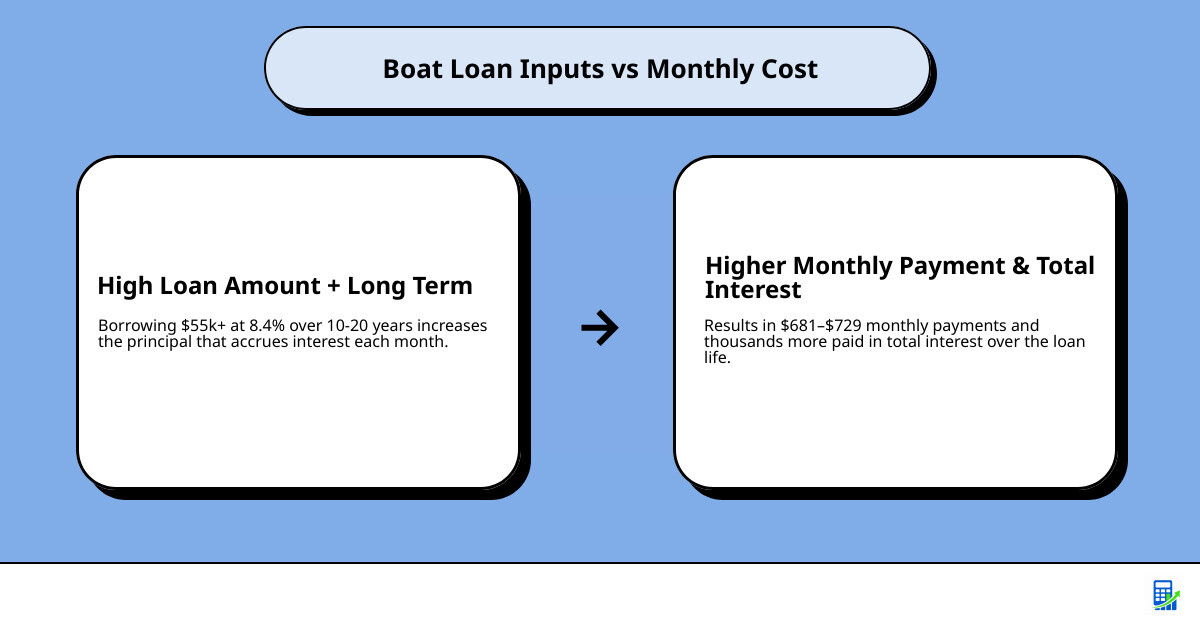
Quick example: A $55,842 loan at 8.40% APR over 10 years puts your monthly payment somewhere between $681 and $729 depending on your credit score.
Buying a boat is exciting. It’s also a big financial commitment — and most people focus only on the sticker price.
The real cost is much larger. Between interest charges, sales tax, fees, insurance, storage, and fuel, the total picture looks very different from the price tag on the dock.
The average boat loan in Q4 2025 was $55,842, according to recent industry data. Over a 10-year term, even a small difference in your interest rate can cost you thousands more in total interest.
That’s why running the numbers before you shop matters. A calculator gives you clarity — and clarity gives you negotiating power.
How a Boat Payment Calculator Works
At its core, a boat payment calculator is a mathematical tool that takes the complexity out of amortization. When you borrow money for a boat, you aren’t just paying back the price of the vessel; you are paying for the privilege of using the bank’s money.
The calculator uses a standard formula to determine your Equated Monthly Installment (EMI). It balances the loan principal (the amount you actually borrowed) against the interest rate and the time you have to pay it back. Because boat loans often have much longer terms than car loans—sometimes stretching up to 20 years—the way interest compounds can be eye-opening.
If you have ever used an EMI Calculator, you know the drill. You plug in the numbers, and it spits out a monthly figure. However, a marine-specific calculation requires a bit more nuance because the stakes (and the terms) are generally higher than your average personal loan.
Understanding the boat payment calculator inputs
To get an accurate result, you need to feed the calculator the right data. Garbage in, garbage out! Here are the key ingredients:
- Purchase Price: This is the negotiated price of the boat. This isn’t always the “sticker price.”
- Down Payment: Most marine lenders require between 10% and 30%. In May 2026, putting down 15-20% is considered the “sweet spot” to avoid being “upside down” (owing more than the boat is worth) due to depreciation.
- Annual Percentage Rate (APR): This is the cost of the loan, including interest and certain fees. As of late 2025, the average offered APR was 8.40%, but this fluctuates based on the economy and your credit profile.
- Loan Term: This is how long you’ll be paying. While 10 to 20 years is typical for large vessels, smaller boats might have terms of 5 to 10 years.
- Sales Tax: Don’t forget this! Most U.S. states charge 4% to 8% sales tax. If you don’t pay this upfront, you might be rolling it into the loan, which increases your monthly payment.
- Trade-in Value: If you are upgrading, the value of your current boat acts like a second down payment, reducing the total amount you need to finance.
Using a boat payment calculator for affordability
We always tell our users: just because a bank says you can afford a $800 monthly payment doesn’t mean your lifestyle agrees. A boat payment calculator helps you perform a “reality check” on your debt-to-income (DTI) ratio.
A common rule of thumb in marine financing is that your total monthly boat costs (loan + insurance + storage) should not exceed 10-15% of your discretionary income. You can use the calculator to “reverse engineer” your purchase. If you know you can only afford $500 a month, you can adjust the purchase price in the tool until you hit that target.
Understanding the difference between Good Debt vs Bad Debt is crucial here. A boat is a depreciating asset—it’s “lifestyle debt.” Using a calculator ensures you aren’t over-leveraging yourself for a hobby, keeping your financial ship upright even in choppy economic waters.
The Impact of Credit and Terms on Your Interest Rate
Your credit score is the captain of your financial ship. It determines whether you get a “premier” interest rate or a “subprime” one that makes the boat twice as expensive over time.
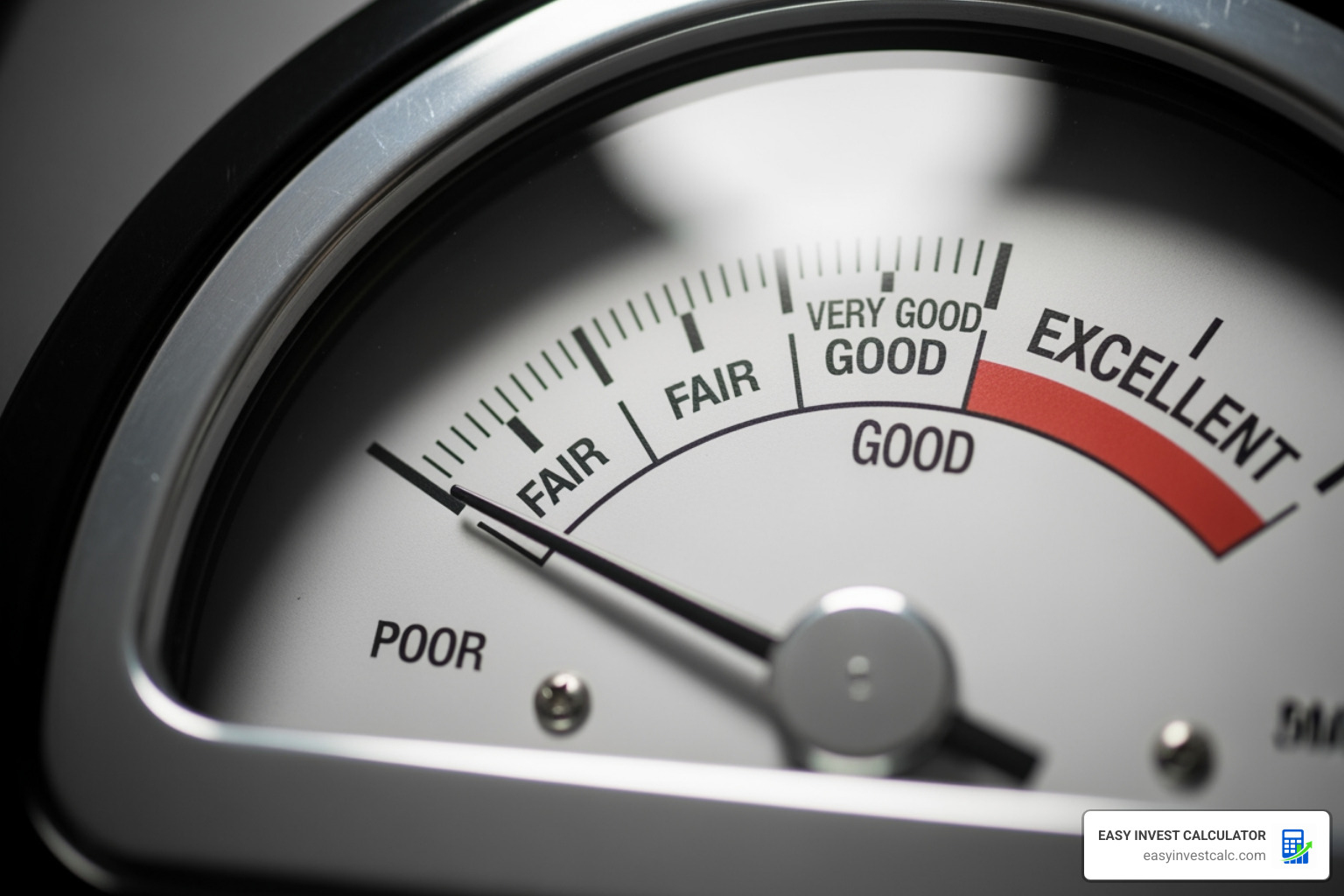
Data from Q4 2025 shows a clear divide in how much borrowers pay based on their FICO scores. Even a 1% difference in APR can change your financial life. Let’s look at a $55,842 loan over 10 years:
| Credit Tier | FICO Range | Estimated APR | Monthly Payment | Total Interest Paid |
|---|---|---|---|---|
| Excellent | 740–850 | 8.12% | $681.06 | $25,885 |
| Good | 670–739 | 8.94% | $705.57 | $28,826 |
| Fair/Poor | 580–669 | 9.70% | $728.71 | $31,603 |
As you can see, someone with “Fair” credit pays $5,718 more in interest than someone with “Excellent” credit for the exact same boat. That’s enough money to cover fuel and maintenance for several years!
Navigating boat loan terms and durations
The length of your loan is a double-edged sword.
- Short-term loans (5–10 years): These have higher monthly payments but significantly lower total interest costs. You build equity in the boat much faster.
- Long-term loans (15–20 years): These make expensive boats “affordable” by dropping the monthly payment. However, you will pay a mountain of interest. On a 20-year loan, you might end up paying for the boat twice over.
Before committing to a long term, check your State boat registration and tax info to see if there are additional annual fees that might make a high monthly payment even harder to manage.
Hidden Costs: What Your Boat Loan Doesn’t Show
If you only budget for the number you see on a boat payment calculator, you’re going to get “soaked.” The monthly loan payment is just the “entry fee” to boating.
Industry experts suggest that annual ownership costs for a boat can range from 10% to 20% of the boat’s value. For a $30,000 boat, expect to spend $3,000 to $6,000 per year on:
- Insurance Premiums: Marine insurance is more complex than auto insurance. It covers environmental damage, salvage, and specialized liability.
- Fuel Expenses: Boats don’t get 30 miles per gallon. Some large vessels measure fuel consumption in gallons per hour.
- Storage Fees: Whether it’s a slip at a marina or a dry-stack facility, keeping your boat somewhere safe costs money.
- Maintenance: Saltwater, sun, and engines don’t mix well. Regular oil changes, winterization, and hull cleaning are non-negotiable.
If these numbers look scary, it might be time to look into the Debt Counseling Process: How to Prepare for Debt to ensure your total household budget can handle the “leak” a boat represents.
Upfront fees and closing costs
When you close on a boat loan, there are several “stealth” costs that often get forgotten:
- Loan Origination Fees: Lenders may charge 1% to 3% of the loan amount just to process the paperwork. On a $50,000 loan, that’s $500–$1,500.
- Marine Survey: For used boats, most lenders require a professional survey. Think of this as a “home inspection” for a boat. It can cost $500 to $1,000+.
- Title and Registration: These vary by state but are unavoidable.
- Documentation Fees: For larger vessels, you may want or need “Federal Documentation” through the Coast Guard. You can find more info on this at the Federal maritime documentation guide.
Pro Tips to Save on Your Marine Financing
We want you to enjoy the water, not worry about the bank. Here are three professional strategies to keep your costs down:
- The “20% Rule”: While some lenders offer 0% or 10% down, aiming for 20% down payment reduces your loan-to-value ratio. This often triggers a lower interest rate and protects you if you need to sell the boat quickly.
- Bi-Weekly Payments: Instead of one monthly payment, pay half the amount every two weeks. Because there are 52 weeks in a year, you’ll end up making 13 full payments instead of 12. This can shave months or even years off a 15-year loan.
- Shop Your Rate: Don’t just take the dealer’s financing. Check with credit unions and specialized marine lenders.
You can visualize these savings by using an Amortization Schedule with Extra Payments. Seeing the “Total Interest” number drop as you add extra principal payments is incredibly satisfying.
Accelerating your payoff strategy
The secret to true “boat ownership” is actually owning it—not the bank. Making principal-only payments is the fastest way to debt freedom. Even an extra $50 or $100 a month directed specifically at the principal (the original amount borrowed) can save you thousands in interest over the life of the loan.
Think of it this way: every dollar of principal you pay off early is a dollar that can no longer accrue interest at 8.40%. It’s like getting a guaranteed 8.40% return on your money. For more on this strategy, check out Extra Payments: The Secret Sauce for Debt Freedom.
Frequently Asked Questions about Boat Loans
What is the typical down payment for a boat?
The typical range is 10% to 30%. While “zero-down” loans exist for borrowers with pristine credit, they are rare and usually come with higher interest rates. Lenders prefer you to have “skin in the game” because boats are mobile assets that can be harder to recover than a house if a borrower defaults.
Can I get a boat loan with a 600 credit score?
Yes, but it will be expensive. A 600 score falls into the “subprime” or “fair” category. You should expect an APR significantly higher than the average 8.40%—potentially in the 12% to 18% range. You will also likely be required to provide a larger down payment (25%+) and may be limited to shorter loan terms.
Are boat loan interest rates fixed or variable?
Most boat loans are fixed-rate, meaning your monthly payment stays exactly the same for the entire term. This provides stability for budgeting. Variable-rate loans exist and often start with a lower “teaser” rate, but they can increase if market interest rates rise, potentially making your boat payment unaffordable in the future.
Conclusion
At EasyInvestCalc, we believe that financial freedom starts with better information. Using a boat payment calculator isn’t just about finding a monthly number; it’s about understanding the long-term impact of your purchase on your wealth.
As of May 2026, the marine market remains a “borrower’s market” for those with high credit scores, but interest costs remain a significant factor in total ownership. By planning for hidden costs, maximizing your down payment, and choosing a term that fits your real-world budget, you can ensure that your time on the water is spent relaxing, not stressing over bills.
Ready to start crunching the numbers for your next adventure? Head over to our EMI Calculator and see how much boat you can truly afford today. Happy sailing!