

Why Getting Your Buy to Let Numbers Right Before You Invest Matters
A buy to let mortgage repayment calculator is one of the most important tools a property investor can use before committing to a purchase. Here’s what it tells you at a glance:
What a buy to let repayment calculator shows you:
| Output | What It Means |
|---|---|
| Monthly mortgage payment | Capital + interest you pay each month |
| Total interest paid | Cost of borrowing over the full term |
| Loan-to-value (LTV) | Your deposit as a % of the property value |
| Rental coverage ratio | Whether rent covers 125%–145% of payments |
| Equity built over time | How much of the property you own outright |
Buying a rental property sounds straightforward. But the numbers behind it — mortgage repayments, rental yields, tax rules, stress tests — can get complicated fast.
Many investors focus only on rental income and forget about the full cost of a repayment mortgage. That gap between expectations and reality is where deals go wrong.
In the UK right now, lenders require rental income to cover at least 125% of monthly mortgage interest — and some push that to 145%. On top of that, since October 2024, every additional residential property purchase attracts a 5% Stamp Duty Land Tax (SDLT) surcharge. These aren’t small details. They can make or break your cash flow.
This guide walks you through exactly how to use a repayment calculator to estimate your payments, stress-test your investment, and compare strategies — so you can invest with confidence, not guesswork.
Understanding the Buy to Let Mortgage Repayment Calculator
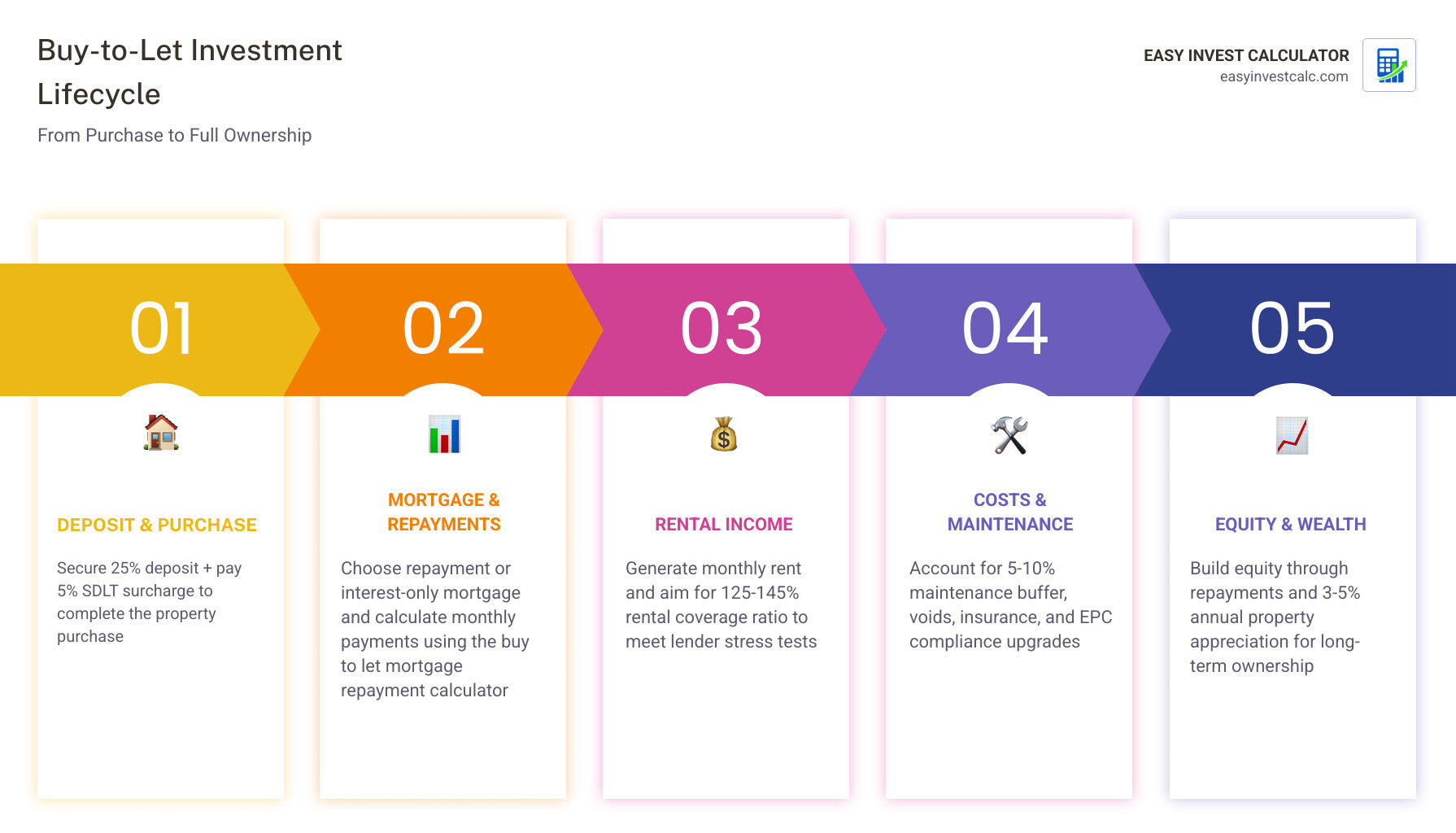
When you start your journey as a landlord in May 2026, the first fork in the road is deciding how you want to pay back the bank. Most people are familiar with “interest-only” mortgages in the buy-to-let (BTL) world, but the buy to let mortgage repayment calculator is designed for those who want to see the path to full ownership.
Repayment vs. Interest-Only
An interest-only mortgage does exactly what it says on the tin: you only pay the interest charges each month. Your debt never gets smaller. A repayment mortgage, however, includes both the interest and a portion of the capital (the original loan amount).
Capital Reduction and Equity Growth
Every time you make a payment on a repayment mortgage, your “principal balance” drops. This creates a “snowball effect” of equity growth. While interest-only landlords rely entirely on house prices going up to make money, repayment landlords build wealth even if property prices stay flat. You are essentially using your tenant’s rent to buy the house for yourself, brick by brick.
Understanding the difference between Good Debt vs Bad Debt is vital here. A BTL mortgage is generally considered “good debt” because it’s an investment that generates income and builds an asset, provided the numbers stack up.
Monthly Payment Components
Your monthly payment is split into two parts:
- Interest Charges: What the bank charges you for the privilege of borrowing.
- Principal Repayment: The bit that actually pays off the house.
In the early years of a 25-year term, most of your payment goes toward interest. As the years go by, the ratio flips, and you start crushing that principal balance much faster.
How to Use a Buy to Let Repayment Calculator for Maximum Accuracy
Using a buy to let mortgage repayment calculator isn’t just about plugging in two numbers and hoping for the best. To get a “pro-level” estimate, you need to be precise with your inputs.

Property Purchase Price and Deposit
In the UK BTL market of 2026, the standard deposit is 25% (giving you a 75% Loan-to-Value, or LTV). While some specialist lenders might let you in with 20%, you’ll usually pay a premium in interest rates. If you can stretch to a 40% deposit, you’ll unlock the most competitive rates on the market.
Interest Rate Cycles and Loan Terms
Interest rates aren’t static. In May 2026, we are seeing a market influenced by previous Bank of England shifts. When using the calculator, it’s wise to look at different terms. A 15-year term will have much higher monthly payments but will save you tens of thousands in interest compared to a 30-year term.
To see how these payments change over time, we recommend checking out an Amortization Schedule with Extra Payments. This shows you exactly how much of each monthly payment is chipping away at your debt.
Upfront Cost Estimation
Don’t forget that your “total investment” is more than just the deposit. You need to factor in:
- Mortgage Arrangement Fees: Usually between £999 and £2,000, or sometimes a percentage of the loan.
- Legal Fees: £1,000–£2,000.
- Survey Costs: £500–£1,000.
- SDLT: The big one (more on that later).
Key Inputs for Your Buy to Let Mortgage Repayment Calculator
To get an accurate picture of your monthly cash flow, you need to look beyond the mortgage payment itself.
Monthly Rental Income and Stress Testing
Lenders don’t just care if the rent covers the mortgage; they want a “buffer.” This is called the Interest Coverage Ratio (ICR). Most lenders require the rent to be at least 125% of the mortgage payment, calculated at a “stressed” interest rate (often 5.5% to 8%).
If you are a higher-rate taxpayer, this requirement often jumps to 145%. This ensures that even if interest rates spike, you won’t default on the loan.
Maintenance Buffers and Void Periods
A property is never 100% occupied and 100% maintenance-free. Pro landlords budget for:
- Maintenance: 5%–10% of gross rent.
- Void Periods: 1 to 2 weeks per year (roughly 4% of annual income).
- Letting Agent Fees: 8%–12% for full management.
Current Scientific research on UK housing market trends suggests that while rents are rising, so are the costs of compliance and repairs. Failing to include these in your buy to let mortgage repayment calculator will lead to a very nasty surprise at the end of the tax year.
Why Investors Choose a Buy to Let Mortgage Repayment Calculator Over Interest-Only
While interest-only is the “traditional” choice for landlords, the repayment model is gaining fans in 2026 for several reasons.
Full Property Ownership and Risk Mitigation
By the end of the mortgage term, you own the property 100% outright. You don’t have to worry about how you’ll pay back the massive original loan. This is the ultimate “set it and forget it” retirement plan.
Capital Appreciation
Historically, UK residential property has averaged 3%–5% annual capital appreciation in nominal terms. When you combine this with the fact that you are also paying down the debt, your net worth grows from two directions at once.
Extra Payments
If you find yourself with a surplus of cash, making overpayments can drastically shorten your mortgage. We like to call Extra Payments: The Secret Sauce for Debt Freedom because of how much interest they save. Even an extra £100 a month can shave years off a 25-year mortgage.
Comparing Repayment vs. Interest-Only Strategies for Landlords
Which strategy is right for you? It depends on your goals: scaling a massive portfolio or building a secure nest egg.
| Feature | Repayment Mortgage | Interest-Only Mortgage |
|---|---|---|
| Monthly Payment | Higher (Capital + Interest) | Lower (Interest only) |
| Monthly Cash Flow | Lower | Higher |
| Equity Growth | Automatic (Monthly) | Dependent on House Prices |
| Total Interest Paid | Lower | Higher |
| Risk Profile | Lower (Debt reduces) | Higher (Debt stays same) |
Cash Flow Optimization
If your goal is to replace your salary today, interest-only is often the winner because it leaves more “cash in hand” every month. However, for those worried about the Debt Counseling Process: How to Prepare for Debt, the repayment model offers a much safer long-term exit strategy.
Section 24 Tax Impact
Since the introduction of Section 24, individual landlords can no longer deduct all their mortgage interest from their rental income before paying tax. Instead, they get a 20% tax credit. This makes interest-only mortgages much more “expensive” for higher-rate taxpayers because they are paying tax on money that is going straight to the bank.
Factoring in UK Tax Rules and SDLT Surcharges in 2026
The landscape for landlords in May 2026 is heavily shaped by two major factors: taxes and energy regulations.
5% SDLT Surcharge
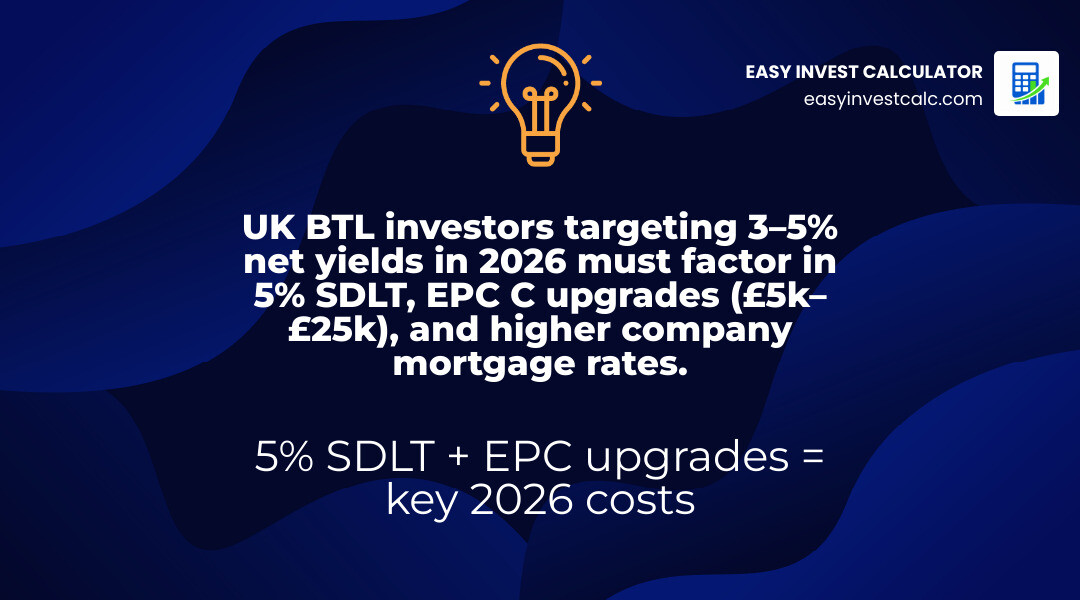
Since October 2024, the surcharge for additional residential properties has been set at 5%. This is on top of the standard Stamp Duty rates.
- Example: On a £250,000 BTL property, the total SDLT would be roughly £17,500.
This is a massive upfront cost that must be factored into your ROI (Return on Investment) calculations.
Limited Company vs. Individual Ownership
Many landlords now choose to buy through a Limited Company (Special Purpose Vehicle).
- The Pro: You can still deduct 100% of your mortgage interest as a business expense, bypassing Section 24.
- The Con: Mortgage rates for companies are typically 0.5% to 1% higher than for individuals, and there are extra accountancy costs.
EPC C Requirements
The government has proposed that all new tenancies must have an EPC (Energy Performance Certificate) rating of ‘C’ by 2028, with all existing tenancies following by 2030. Upgrading an old “D” or “E” rated property can cost anywhere from £5,000 to £25,000. If you are buying a property in 2026, you must check the EPC rating, or you might be hit with a huge bill in just two years.
Latest Research on Rental Yield Benchmarks
What is a “good” yield? A gross rental yield of 5%–7% is generally considered healthy in the current market.
- Gross Yield Formula: (Annual Rent / Property Price) x 100.
- Net Yield: This is the “real” number. It’s what’s left after all expenses (mortgage, insurance, maintenance, voids). A net yield of 3%–5% is a solid target for most UK investors.
Frequently Asked Questions about BTL Mortgages
What is a good rental yield in 2026?
Currently, a gross yield between 5% and 8% is the benchmark for a successful investment. However, this varies wildly by region. While London offers great capital growth, gross yields often hover around a low 3.8% due to sky-high property prices. In contrast, locations in the North of England, like Liverpool or Manchester, frequently see yields between 7% and 10%.
How does the 5% SDLT surcharge affect my initial investment?
The 5% surcharge (introduced in late 2024) significantly increases the “barrier to entry.” It means you need more liquid cash upfront. If you are using a buy to let mortgage repayment calculator, you should add this tax to your “Total Cash Invested” figure to see your true Cash-on-Cash return. It essentially adds about 2-3 years to the time it takes for the property to “pay for itself” via rental income.
Can I switch a residential mortgage to buy-to-let?
Yes, but you can’t just move out and start renting it. You need “Consent to Let” from your current lender, or you must remortgage onto a specific BTL product. BTL mortgages are regulated differently and are assessed primarily on the property’s rental potential rather than just your personal salary.
Conclusion
Investing in property in 2026 is no longer a “get rich quick” scheme; it’s a professional business that requires precise financial planning. By using a buy to let mortgage repayment calculator, you move from guessing to knowing.
Whether you choose the cash-flow-heavy interest-only route or the wealth-building repayment path, the key is to account for every penny—from the 5% SDLT surcharge to the eventual EPC C upgrades.
At EasyInvestCalc, we believe that financial independence starts with the right data. Don’t let hidden costs eat your profits. Take control of your portfolio, run the numbers for various scenarios, and Calculate your monthly payments now to ensure your next investment is a winner.