Why Your Down Payment Determines Whether You Can Afford That Boat
Using a boat loan calculator with down payment is the fastest way to see exactly how much you’ll owe each month — and how much your upfront cash saves you over time. Here’s a quick snapshot:
| Down Payment | Boat Price | Loan Amount | Est. Monthly Payment (7% APR, 10 yr) |
|---|---|---|---|
| 10% ($8,000) | $80,000 | $72,000 | ~$837 |
| 15% ($12,000) | $80,000 | $68,000 | ~$790 |
| 20% ($16,000) | $80,000 | $64,000 | ~$743 |
| 25% ($20,000) | $80,000 | $60,000 | ~$697 |
Estimates based on industry rate data. Your actual rate will vary by credit score and lender.
Most boat buyers focus entirely on the sticker price. That’s the wrong place to start.
Your down payment is the single biggest lever you control before you ever sign a loan agreement. Put down more, and your monthly payment drops, your interest costs shrink, and your risk of going “underwater” on the loan decreases — because boats depreciate fast.
Put down too little, and you could owe more than the boat is worth within the first year or two.
In May 2026, the average boat loan carries an APR around 8.40%, and lenders typically require 10% to 30% down depending on your credit profile and whether the boat is new or used. That means on a $70,000 boat, you’re looking at $7,000 to $21,000 out of pocket before you even think about interest, insurance, or storage.
This guide breaks down exactly how down payments affect your loan, what the calculator is actually telling you, and how to make sure your boat purchase doesn’t become a financial anchor.
How a boat loan calculator with down payment works
A boat loan calculator with down payment is essentially a mathematical model of your future financial life on the water. It takes your raw numbers—what you want to buy and what you have in the bank—and turns them into a predictable monthly obligation.
At its core, the calculator works by subtracting your down payment from the total purchase price to find the principal amount. This is the actual sum you are borrowing. From there, the tool applies an interest rate (APR) over a specific timeframe (the loan term) to determine your monthly installments.
To get the most accurate results, you need to input:
- Purchase Price: The “out-the-door” price, including the trailer and major accessories.
- Down Payment: The cash you’re paying upfront.
- Interest Rate (APR): This is heavily influenced by your credit profile. In May 2026, excellent credit (740+) might land you a rate around 6.24%, while fair credit could see rates closer to 10%.
- Loan Term: How many months you’ll be paying. While auto loans rarely exceed 72 months, boat loans can stretch to 120, 180, or even 240 months (20 years) for larger vessels.
If you want to see how this compares to other types of financing, our EMI Calculator is a fantastic tool for side-by-side comparisons of different loan structures.
Calculating monthly payments with a boat loan calculator with down payment
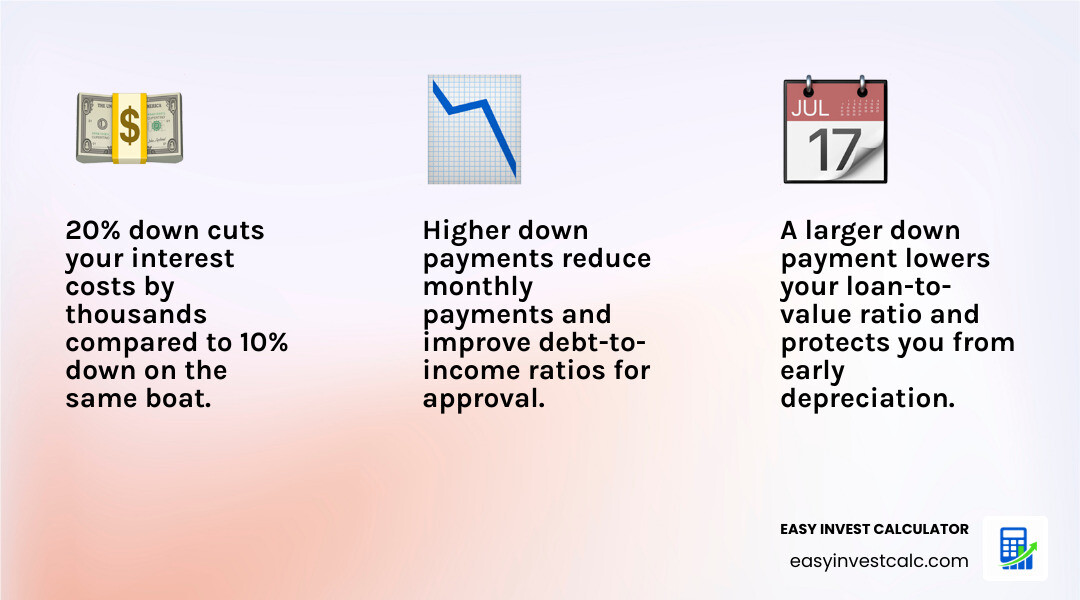
The magic happens when you adjust the down payment slider. Every dollar you put down reduces the Loan-to-Value (LTV) ratio. Lenders love a low LTV because it means they are taking on less risk. If you put 20% down, the lender only has 80% of the boat’s value at stake.
A higher down payment doesn’t just lower the principal; it often unlocks lower interest rates. Lenders view a buyer with “skin in the game” as more likely to keep up with payments. When you use a boat loan calculator with down payment, watch how the total interest paid over the life of the loan plummets as you increase the initial cash layout.
To see the long-term impact of these choices, check out our Amortization Schedule with Extra Payments. It shows you exactly how much of each monthly installment goes toward the bank’s pocket (interest) versus your own equity (principal).
Why a boat loan calculator with down payment is essential for budgeting
We’ve all heard the joke that “BOAT” stands for “Bring Out Another Thousand.” To avoid that punchline, you need to use a calculator to determine true affordability.
A golden rule in the marine industry is the 10% income rule: Your total annual boat costs—including the loan, insurance, fuel, and maintenance—should not exceed 10% of your gross household income.
Many calculators offer a “reverse calculation” or “price checker” feature. Instead of asking “What is the payment for this $100,000 boat?”, you ask “If I can afford $800 a month, how much boat can I buy?” This keeps your expectations grounded in reality. When deciding if this is a wise move for your portfolio, it’s worth brushing up on the difference between Good Debt vs Bad Debt. While a boat is a lifestyle asset, financing it smartly prevents it from becoming “bad debt” that sinks your credit score.
The financial impact of your down payment
While 10% is the most common requirement, we almost always recommend aiming for 20%. Why? Because of the “Depreciation Cliff.”
New boats can lose 20% of their value the moment they hit the water. If you only put 10% down, you are instantly “underwater” on the loan—meaning you owe the bank more than the boat is worth. If you needed to sell the boat six months later, you’d have to write a check to the bank just to get out of the deal.
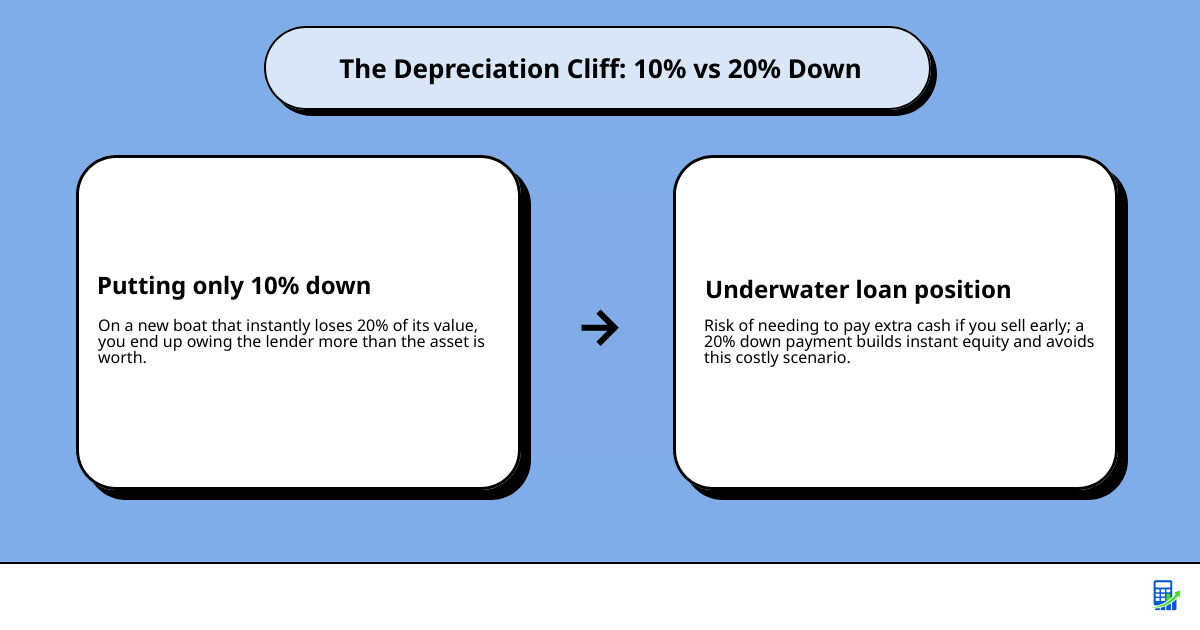
A 20% down payment acts as a financial life jacket. It ensures you have immediate equity. Furthermore, the interest savings are massive. On a $50,000 loan over 10 years at 8%, increasing your down payment from $5,000 to $10,000 could save you thousands in interest charges alone.
If you find yourself with extra cash later on, applying it to the principal can further accelerate your path to ownership. We call this Extra Payments: The Secret Sauce for Debt Freedom. Even an extra $50 a month can shave a year off a long-term boat loan.
Beyond the monthly payment: True costs of ownership
The loan payment is just the “cover charge” to enter the club. The real costs of boat ownership are ongoing and often catch first-time buyers off guard.

Industry data suggests that annual ongoing costs typically run 25% to 40% of the boat’s original purchase price for the first few years. Here is what a boat loan calculator with down payment usually doesn’t show you:
- Marine Insurance: Expect to pay 1.5% to 3% of the boat’s value annually.
- Maintenance: A safe estimate is 10% of the boat’s value per year for oil changes, hull cleaning, and winterization.
- Storage and Dockage: Depending on your location, a marina slip can cost hundreds or even thousands per month.
- Fuel: Boats aren’t known for their MPG. A single weekend of cruising can easily cost $200-$500 in fuel.
- Marine Survey: If you are buying a used boat over $25,000, most lenders require a professional survey. This usually costs $20 to $25 per foot of boat length.
If you’re feeling overwhelmed by these numbers, it might be time to look at the Debt Counseling Process: How to Prepare for Debt. It’s better to realize a boat is out of reach before you sign the papers.
One silver lining? If your boat has a sleeping berth, a galley (kitchen), and a head (bathroom), it may qualify as a second home. This means the interest on your secured boat loan could be tax-deductible. Check the IRS Second Home Deduction Eligibility guidelines to see if your dream vessel qualifies for a tax break.
Secured vs Unsecured boat loans
When financing, you’ll generally choose between two paths:
| Feature | Secured Boat Loan | Unsecured Personal Loan |
|---|---|---|
| Collateral | The boat itself | None |
| Typical APR (2026) | 6.5% – 9% | 10% – 18% |
| Loan Terms | Up to 20 years | Usually 5-7 years |
| Credit Score | 700+ preferred | 680+ |
| Risk | Repossession if you default | Lawsuit/Credit damage |
Secured loans are the standard for most significant boat purchases. Because the lender can seize the boat if you stop paying, they offer much lower interest rates and longer durations. Unsecured loans are faster to get and don’t require a marine survey, but you’ll pay a premium in interest for that convenience.
Frequently Asked Questions about boat financing
What is the typical down payment for a boat loan?
Most marine lenders require a down payment between 10% and 30%. If you have a credit score above 740, you might qualify for 10% down. If you are buying a used boat or have a credit score in the 600s, expect the lender to ask for 20% or even 30% to offset the risk.
Is boat loan interest tax deductible?
Yes, potentially. Under IRS rules, a boat can be considered a “qualified residence” if it has basic living facilities (sleeping, cooking, and toilet). If it meets these criteria and is used as collateral for the loan, the interest is often deductible as mortgage interest on your Schedule A.
How long can you finance a boat?
While 10 years (120 months) is the standard for mid-sized boats, many lenders offer 15 or 20-year terms for loans exceeding $75,000 to $100,000. That longer terms result in much higher total interest costs, even if the monthly payment looks attractive.
Conclusion
Buying a boat should be about freedom, not financial stress. By using a boat loan calculator with down payment, you can strip away the guesswork and see exactly how your upfront investment protects your future.
Remember: the more you put down today, the less you owe tomorrow, and the faster you build real equity in your vessel. Whether you are looking at a modest fishing boat or a luxury yacht, smart financing starts with the right tools. Visit our EMI Calculator today to start modeling your next adventure on the water. At Easy Invest Calculator, we believe in making your financial planning as smooth as a calm day on the lake.